Original article: Sobrino contratado, tío ad honorem: así opera el equipo de la diputada PNL Paulina Muñoz
By Leonardo Buitrago and Mauricio San Cristóbal | El Ciudadano Investigation and Analysis Unit
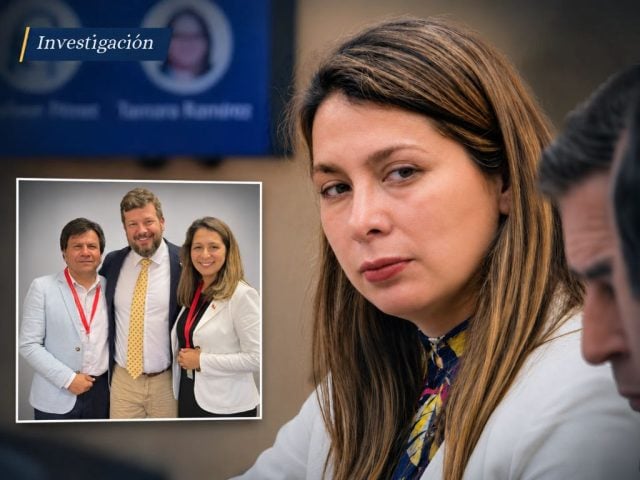
The official roster of the team for Deputy Paulina Muñoz Minte, who represents District 25 in the Los Lagos Region and is a member of the National Libertarian Party (PNL) chaired by Johannes Kaiser, doesn’t fully explain how roles are distributed within her parliamentary environment. Documents, legal cases, public records, and testimonies examined by El Ciudadano reveal a structure that includes both employees hired by the Chamber and others who serve outside of that list.
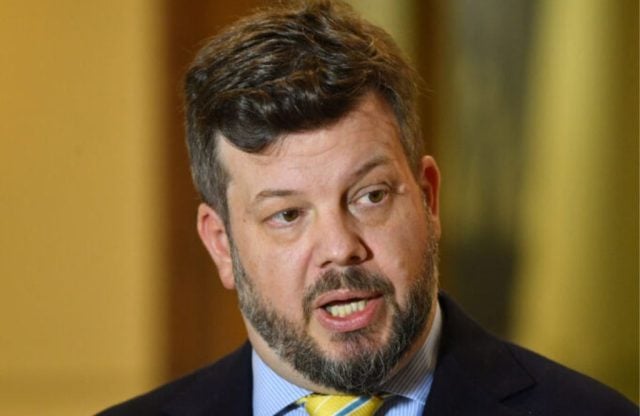
Among those officially employed is Felipe Francisco Mújica Barrientos, nephew of Víctor Andrés Mújica Delgado, who is formally listed as a communication advisor. His uncle, however, is not listed among the staff contracted by the Chamber of Deputies, although he acknowledges working directly with Muñoz in a capacity he defines as ad honorem. He has also represented the parliamentarian at public events and, according to his own statements to this media outlet, has communicated directives to team members on behalf of the deputy.
Andrés Mújica’s connection with Muñoz dates back at least to the parliamentary campaign of 2025. Electoral documentation provided by the Electoral Service (Servel) identifies him as «campaign chief – territorial work» and notes that he provided services from September 20 to November 13 of that year. For those services, he issued an invoice for $5,000,000. [View Servel Report]
The same report details that he participated in defining and structuring the campaign, designing the communication strategy, managing media hiring, organizing work teams, developing social media strategies, and deploying the candidate across the 12 communes of District 25.
In addition to these services, Mújica organized the campaign closing event held on November 13, 2025, for which he issued a second invoice for $3,250,000. In total, documents related to the electoral accounting indicate $8,250,000 in fees for both services. [View campaign closing report and invoice]
From Paid Campaign Chief to Uncontracted Collaborator
After Paulina Muñoz was elected as deputy for District 25, Andrés Mújica remained connected to her political environment, albeit under a different arrangement than during the campaign: without a contract with the Chamber and, according to him, as an ad honorem collaborator.
In a conversation with El Ciudadano, Mújica (who was a councilor in Purranque for Renovación Nacional from 2004 to 2008) confirmed his ongoing collaboration with the parliamentarian and linked this work with his own political aspirations.
«I work directly with the deputy (…) I have intentions of running for mayor of Purranque, to reclaim the mayor’s office in that municipality. So, being under the wing of a deputy serves me as a political opportunity. I was her campaign chief at one point; I helped her and I will continue doing so,» he stated.

Mújica also acknowledged that he represents Muñoz in certain activities when the deputy is unavailable.
«When the deputy sometimes cannot attend events, she assigns me or any of the collaborators to represent her in the commune, and in that there is no crime, no illegality; anyone can go in the deputy’s place to note down points,» he explained.
This role has been publicly acknowledged. On October 1, Radio Sago identified him as the «representative of Deputy Paulina Muñoz» when reporting on a security meeting held in Purranque. [View Radio Sago publication]
When asked why he performs these duties without having a contract with the Chamber of Deputies, Mújica stated he does not wish to formally join her parliamentary team because his main economic activity is in radio.
«If I commit, I can handle the deputy’s tasks, even as a driver, but I have never gone beyond my past as a councilor. Also, I work in radio and I do well, so I have no interest in being hired,» he said.
In the same conversation, however, Mújica differentiated his political collaboration from other income related to his radio activity, noting that he receives payments for advertising and programs in which he participates.
«Yes, I get paid for my advertising, my programs, my 30% share. The deputy has a spot at the regional level that is paid with resources permitted by the state, the Congress. That’s where my 30% comes from; I’m happy that way, no one tells me what to do,» he maintained.
His statements do not establish that these payments correspond to remuneration for his political collaboration with Muñoz. However, they indicate a commercial relationship related to radio spaces, distinct from the collaboration he defines as ad honorem.
Mújica also mentioned that he is not a member of the National Libertarian Party and that his political support stems more from personal relationships than from party affiliation.
The Chamber is Uncertain About Functions of an Uncontracted Collaborator
In light of the duties that Andrés Mújica acknowledges fulfilling in Paulina Muñoz’s environment, El Ciudadano requested through transparency that the Chamber of Deputies clarify whether a person who collaborates ad honorem can formally represent a parliamentarian, issue instructions to contracted staff, or perform supervisory and coordination work.
The Chamber’s response revealed an information gap: the institution stated that it does not have records of individuals who collaborate ad honorem with deputies, “since there are no legal or regulatory norms governing such a situation.”
«The way each deputy organizes and distributes the tasks performed by the support staff hired by the Corporation to provide services in their parliamentary functions is strictly a matter for them, and this Corporation holds no further information about it than the description of duties contained in the respective employment contract or agreement for honoraria services, as applicable,” it indicated.
In other words, the Chamber knows the functions established in employment contracts but lacks traceability concerning those who collaborate without such instruments. The corporation clarified that, if there is no employment contract or agreement for honoraria services, it “has no information regarding such functions.”
Felipe Mújica: Indefinite Contract and Questions About Task Distribution
Unlike his uncle, Felipe Francisco Mújica Barrientos is formally part of Paulina Muñoz’s parliamentary team. A journalist by profession, he began his services on March 12, 2026, and his contract with the Chamber of Deputies was signed on the 26th of that month.
The document incorporates him «as a professional to perform the duties of communication advisor» within Muñoz’s team, with responsibilities in District 25 and at the National Congress offices in Valparaíso and Santiago. Furthermore, the contract specifies that these duties are not exclusive of other roles stemming from the nature of parliamentary function. [View Felipe Mújica’s contract]
Initially, the agreement provided for a gross monthly salary of $2,600,000, plus $300,000 for transportation and another $300,000 for meals. The initial validity extended until April 30, 2026.
On April 23, the parties agreed on a first modification, effective May 1, which maintained the base salary of $2,600,000, raised the transportation allowance to $600,000, and extended the contract until July 31. The new remuneration clause did not include the meal allowance noted in the original document.
Subsequently, a second modification, signed on August 12 but effective from the 1st of that month, transformed the connection into a permanent contract. [View the second contract modification]
The contract clearly delineates Felipe Mújica’s position and working conditions. However, it does not clarify how roles are distributed within the team, especially regarding the role that his uncle Andrés acknowledges performing without being on the internal staff list.
The Lawsuit Describing a Leadership Not Listed on the Roster
The question of how functions are distributed within Paulina Muñoz’s team also comes up in an ongoing labor case. Luis Gabriel Rehbein Schwerter, former territorial advisor to the deputy, has filed a labor protection lawsuit for violation of fundamental rights following his dismissal, attributing to Andrés Mújica a role of “chief of staff” that does not appear on the official team roster. [View lawsuit by Luis Gabriel Rehbein]
Rehbein’s employment began on March 11, 2026. His contract with the Chamber of Deputies, signed on March 26, included him as a territorial advisor for Muñoz in District 25, with a gross salary of $1,000,000, plus $100,000 for transportation and $100,000 for meals, and was initially valid until May 31.
On April 23, the contract was modified to expand the territory of service to District 25 and the National Congress offices in Valparaíso and Santiago. The base salary remained at $1,000,000, and the transportation allowance increased to $200,000. His responsibilities included weekly planning for territorial work, outreach to social and trade leaders, meeting coordination, and institutional representation for the deputy.
This contractual framework is relevant to what Rehbein describes next: according to his lawsuit, instructions regarding the performance of these duties did not solely come from the formal team structure, but also from Andrés Mújica, who did not have a contract with the Chamber.
The De Facto Leadership Described in the Lawsuit
Rehbein’s lawsuit places the origin of this command structure at the beginning of his employment relationship. According to his account, during a planning meeting held at Radio El Conquistador in Osorno, Paulina Muñoz led the meeting and then handed over to Andrés Mújica, who told Rehbein to avoid direct communication with the deputy and that he should go through him, “who would henceforth be the Chief of Staff.”
«The Deputy did not correct that instruction nor disavow Mr. Mújica. From that moment, in practice, he began to control the flow of information, issue instructions, and mediate the working relationship,” Rehbein affirms in the legal action. [View lawsuit by Luis Gabriel Rehbein]
The lawsuit includes other episodes with which the former advisor seeks to support this depiction of internal operations. Among them is a WhatsApp exchange from April 16, 2026, where Mújica asked him about the head of budget for the Municipality of Fresia, inquired about her political affiliation, and instructed: “Locate her tomorrow,” adding: “Tell her it’s from the deputy.”
Rehbein also accuses Mújica of maintaining inappropriate conduct during field activities, including “jokes, mockery, and vulgar comments,” as well as subjecting him to alleged “loyalty tests.” According to his version, the deputy witnessed some of these situations and instead of stopping them validated them with laughter or indifference.
On April 25, in accordance with the lawsuit, Rehbein requested a private meeting with Muñoz to inform her about the harassment he attributes to Mújica. He asserts that the deputy’s response was essentially, “That’s not my problem; deal with Andrés, I have more important things to do.”
The dispute escalated contractually weeks later. Rehbein reports that on May 29, after a day of territorial activities alongside Muñoz, Andrés Mújica, and Felipe Mújica, his territorial coverage began to be redefined. According to the lawsuit, Andrés informed him that his designated territory would change and, when asked about a possible reduction in remuneration, replied that this matter was not under his purview.
Minutes later, Rehbein states, Caren Oñate (identified as the secretary and administrative liaison of the deputy) informed him that his territorial coverage would be reduced and that his earnings would drop by approximately half. According to the complainant, during that conversation he was told that if he did not accept the modification, “the termination was ready.”
Rehbein maintains that, fearing job loss, he ultimately signed a contractual modification dated June 1, 2026, via the ASIGPAR platform. The change set his working hours to 25 per week, reduced the base salary from $1,000,000 to $565,000, and lowered the transportation allowance from $200,000 to $55,000. In June, his income dropped from $1,200,000 to $620,000 monthly. [View contractual modification / evidence included in the lawsuit]
Intimidation, Pressure to Resign, and Dismissal: What Rehbein Claims
The tension described by Rehbein reportedly escalated by the end of June. According to the lawsuit, on June 30, Andrés Mújica called him to make insinuations and accusations regarding an alleged leak of information related to his contractual and remuneration situation.
The former advisor claims that during this conversation, Mújica used threatening language and referred to a family member of his who holds a public office. The lawsuit notes that the call was recorded in a digital file, and the exact content of those expressions will need to be confirmed through the complete reproduction of that recording. [View lawsuit by Luis Gabriel Rehbein]
A week later, on July 7, Rehbein claims to have received a call from Caren Oñate, during which he was pressured to submit his voluntary resignation, with the warning that if he did not do so, he would be dismissed. The lawsuit specifies that there is no recording of the content of that conversation: its existence and duration would be noted in WhatsApp, while what was said will need to be verified through statements, witness evidence, and subsequent communications.
However, by that point, the termination of the employment relationship had already been formally decided. The dismissal letter was issued in Valparaíso on July 6 (a day before that call) and communicated the termination of the contract starting July 7 for “loss of trust in the worker,” explicitly stating that the decision was made “at the express request of Deputy Paulina Muñoz Minte.”
Rehbein asserts that this sequence constitutes a violation of his fundamental rights to mental integrity, honor, private life, and freedom to work. In his lawsuit, he seeks, among other measures, to void the contractual modification that reduced his working hours and pay and demands compensation, salary differences, lost profits, and $20 million for moral damages.
The legal action was admitted for processing on September 14, 2026, by the 1st Court of Letters of Puerto Varas. The preparatory hearing is set for January 13, 2027. Thus, it is an ongoing case, and the allegations made by Rehbein have yet to be resolved judicially.
El Ciudadano asked Andrés Mújica about the accusations and the «de facto chief of staff» role that the former advisor attributes to him. His response acknowledged that, despite not having a contract with the Chamber, he assumed a position of authority within the team.
«We would tell each other things as a team when we met, and obviously the deputy, having been her campaign chief, gave me, it’s not that she gave it to me, I took on the authority to be above people, without being contracted, mind you, because my business isn’t politics, it’s radio,» he indicated.
Mújica also acknowledged that he sometimes relayed instructions to Rehbein, asserting that he did so at the deputy’s request. According to his account, the former advisor was not meeting the expected territorial deployment, and Muñoz asked him to let Rehbein know he needed to cover other communes.
Simultaneously, Mújica denied responsibility for contractual decisions. He stated that the reduction in Rehbein’s functions and pay was decided by the deputy and administratively conveyed by Caren Oñate.
«I never had a problem with him, except that sometimes I had to tell him (things) because I had nothing to lose or gain, as the deputy does not pay me a dime,» he stated.
Mújica’s statements are significant because, although they dispute Rehbein’s version of the labor conflict, they confirm two core elements of the lawsuit: he issued instructions to a worker formally contracted by the Chamber and did so without having a contract with the corporation himself.
Rehbein’s attorney, Claudio Fernández, stated in writing to El Ciudadano that this operation is one of the very foundations of their legal action. He stated that his client received instructions from someone not part of the contractual structure of the team.
«What we have are accounts of how the parliamentarian’s office operated and functioned. In addition to assisting the parliamentarian, he (Andrés Mujica) defined and gave instructions through calls and WhatsApp, establishing compliance conditions for the contract. We have photographs of official activities and audio recordings,» Fernández asserted.
El Ciudadano has not gained access to these audio recordings or the entirety of the messages mentioned by Fernández, and thus could not independently verify their content.
Alfonso Valenzuela: Indefinite Contract and Links Outside the Organizational Chart
Alfonso Valenzuela Avendaño, a construction engineer by profession, is formally part of Paulina Muñoz’s team as a legislative advisor. He began his services on March 11, 2026, and his contract with the Chamber of Deputies, dated March 24 of that month, is indefinite and establishes a gross monthly salary of $2,400,000.
The document notes that he must carry out his duties according to the deputy’s instructions, both in District 25 and at the National Congress offices in Valparaíso and Santiago. It also states that Valenzuela declared not to have any family ties with Muñoz as defined by the contractor. [View Alfonso Valenzuela’s contract]
Confidential sources consulted by El Ciudadano maintain that besides the employment relationship, there exists a romantic connection between Valenzuela and the parliamentarian.

“Everyone around here knows they are a couple,” commented one source.
El Ciudadano could not independently verify the existence of this alleged romantic relationship.
However, there are judicial records that document another type of relationship between them. El Ciudadano accessed a lease termination lawsuit submitted to the 1st Court of Letters of Osorno by Oscar Bernardo Manquilef Bachler against Alfonso Valenzuela, in which Paulina Muñoz appears as a guarantor and co-debtor of the tenant.
The judicial action originated, according to the lawsuit, due to alleged defaults attributed to the tenant regarding utility payments. Beyond the substance of this civil dispute, the file establishes that Muñoz assumed a contractual obligation as a guarantor and co-debtor of Valenzuela, a relationship different from the one they currently maintain within the parliamentary team. [View lease termination lawsuit]
Guerrero: A Lawsuit for $9.6 Million and an Expense Declared Before Servel
Another controversy surrounding Paulina Muñoz’s campaign reached the 1st Court of Letters of Osorno. Patricio Enrique Guerrero Moraga filed a lawsuit against the deputy for breach of contract and damages, claiming non-payment for services he reportedly provided during the 2025 parliamentary campaign and later in the presidential runoff.
According to the lawsuit, Guerrero allegedly reached a verbal agreement with Muñoz to perform territorial coordination, installation of campaign materials, and supervision of teams from September to November 2025, for $6,450,000. The claimant asserts that after the parliamentary election, both parties entered into a second agreement to undertake similar tasks during the presidential runoff campaign, for another $3,225,000.
In total, Guerrero claims $9,675,000 in fees he asserts he never received, in addition to $5,000,000 for moral damages. [View Patricio Guerrero’s lawsuit]
Part of this account is corroborated by electoral documentation from Muñoz’s candidacy. In the process of reviewing her campaign account, Servel registered an expense of $6,450,000 in the name of Patricio Enrique Guerrero Moraga for “installation of pigeons and territorial work (Territorial Coordinator),” backed by invoice No. 111. [View Servel observations]
This expense was flagged because the required prior report had not been submitted for such services. During the audit, the candidacy explained that the invoice had been initially filed under a different category and that the omission was unintentional. Servel found this explanation insufficient and maintained the objection, proceeding to reject the expense for the breach associated with that accounting. [View Servel audit report]
This detail does not resolve the civil controversy over the existence and enforceability of the contract, nor does it substantiate Guerrero’s second agreement attributed to Muñoz for the presidential campaign. However, it does show that Muñoz’s campaign account included an invoice for $6,450,000 issued by Guerrero for coordination work.
The plaintiff’s attorney, Víctor Ruiz Trapp, stated to El Ciudadano that this documentation is at odds with the position that, he claims, Muñoz has taken in the civil case.
«There are reels on Facebook, on various social media platforms, photos, we have recordings, but there’s something from a logical standpoint that is difficult for me to comprehend. Someone who presents as the main argument in a breach of contract lawsuit that they never hired him, that he never provided a service, and that he never existed, but is simultaneously rendering campaign expenses, requesting from Servel that the money be returned related to the votes she obtained and within the list of campaign expenses she presents as a basis for determining the amount from Servel is the invoice issued by my represented,» he stated.
Ruiz Trapp further asserted that Muñoz’s defense had denied to the court the provision of Guerrero’s services, whereas according to his version, the deputy asserted before Servel and subsequently before the Electoral Qualifying Tribunal the validity of the disputed campaign expenses.
«So we see that before the Osorno court, she told the judge he didn’t work for her, to Servel she said he did, and now the Electoral Qualifying Tribunal is saying he did work for her. So, from a logical reasoning perspective, I have no idea what is intended here,” he declared.
What is documented is that Muñoz’s candidacy included an invoice from Guerrero for $6,450,000 to Servel. The contradiction that Ruiz Trapp attributes to the deputy’s defense before the civil court and the Tricel could not be verified by El Ciudadano, as access to those filings was not available.
Who is Listed, Who Gets Paid, and Who Decides
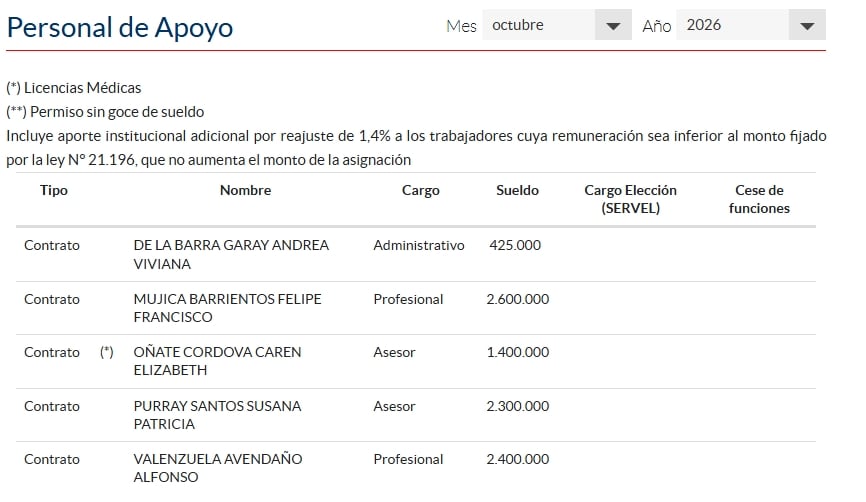
According to the information published by the Chamber of Deputies for October 2026, Paulina Muñoz’s parliamentary team formally consists of five individuals: Andrea Viviana De La Barra Garay, administrator, with a salary of $425,000; Felipe Francisco Mújica Barrientos, professional, earning $2,600,000; Caren Elizabeth Oñate Córdova, advisor, earning $1,400,000; Susana Patricia Purray Santos, advisor, earning $2,300,000; and Alfonso Valenzuela Avendaño, professional, earning $2,400,000.
Oñate, who also provides services to PNL Deputy Erich Grohs, additionally appears in a CIPER investigation regarding the special severance compensation system for parliamentary support staff. According to that outlet, she has accumulated 12 years of severance and nearly $31 million in successive payments. The mechanism is permitted by a special norm applicable to these workers but allows exceeding the limit of 11 years that applies to workers under the general labor code. [View CIPER investigation]
This is the structure formally registered with the corporation. Andrés Mújica is not listed, either as a contracted worker or as a service provider for honoraria.
However, his own statements to El Ciudadano show that his involvement in the deputy’s environment exceeds that of an occasional companion: he admits to representing her at specific activities, passing on instructions from Muñoz, and having assumed a position of authority over team members despite not having a contract with the Chamber.
Power Without a Contract
The information reviewed by El Ciudadano indicates that the formal structure of Paulina Muñoz’s parliamentary team is insufficient to explain how specific functions and areas of authority are practically distributed.
The Chamber of Deputies can inform who is contracted, how much they receive, and what tasks are noted in their contracts. Andrés Mújica does not appear in that structure. However, he acknowledges representing the deputy at certain events, transmitting instructions at her request, and having taken on a position of authority over team members.
Luis Gabriel Rehbein’s labor lawsuit takes this situation further and attributes to Mújica the role of “de facto chief of staff.” These allegations still await resolution by the courts, but Mújica’s statements affirm a central issue: his involvement in Muñoz’s environment is not limited to occasional political support.
The issue transcends the existence of a contract. The Chamber acknowledged in a transparency inquiry that it does not maintain information on the functions of those who collaborate ad honorem with deputies and that “there are no legal or regulatory norms governing such a situation.” If there is no employment contract or honoraria service agreement, the corporation stated, “it lacks information regarding such functions.”
The consequence is a gap in institutional traceability: while the functions, remunerations, and obligations of contracted staff are documented, the Chamber acknowledges it does not have equivalent information regarding individuals who may act in the environment of a parliamentarian, represent them, or receive tasks from them without being part of that formal structure.
El Ciudadano sent a questionnaire to Paulina Muñoz in which she was asked about Andrés Mújica’s functions, his capacity to issue instructions or represent her, the distribution of tasks within her team, and the other aspects addressed in this report. At the closing of this edition, the deputy had not responded.
The situation presents a problem of oversight that extends beyond a single parliamentarian and her team: if a person can exert political or functional authority without a contract, without recorded functions, and without the institution that manages congressional resources formally knowing their role, the official structure becomes inadequate to answer a basic democratic control question: who truly wields power within a parliamentary team?
In Congress, one can know who is contracted and how much they earn. What the Chamber itself acknowledges it cannot ascertain is who exerts power outside that structure and how far it extends.
Obtén tu Pasaporte y apoya a El Ciudadano
Elimina la publicidad, accede a contenido exclusivo y sé parte de la comunidad.
Cancela en cualquier momento · Sin permanencia