Original article: Nuevo Instituto Milenio buscará entender cómo la neuroinflamación impacta en enfermedades como Alzheimer, depresión y epilepsia
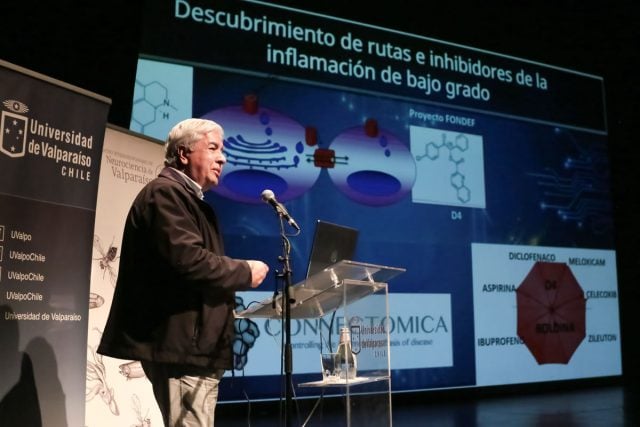
With an audience of over 150 attendees, the official launch ceremony of the Millennium Institute Interdisciplinary Center for Neuroscience of Valparaíso, CINV-UV, took place on Monday, April 27, 2026. The event was led by the University of Valparaíso and financed by the Millennium Scientific Initiative.
This milestone marks the beginning of a new chapter for the Center, which has built a renowned scientific trajectory from Playa Ancha and is now projecting its work over the next 10 years. The primary focus is on a central question: how can acute inflammation transform into chronic inflammation, and what effects does this process have on the brain and human health?
Juan Carlos Sáez, director of the Millennium Institute CINV-UV, explained that this new phase aims to comprehend how stress, at different stages of human development, can impact brain function and contribute to the emergence or progression of neurological and psychiatric diseases.
«This Millennium Institute will be dedicated to understanding how stress, during various stages of human development, affects the brain. We will seek to discover new molecular targets that can be stimulated or blocked as necessary to prevent behavioral changes associated with different diseases,» the researcher stated.
In this context, he added that this work is particularly relevant for conditions such as depression, schizophrenia, Alzheimer’s, and epilepsy, among other disorders that continue to present significant challenges for science and medicine.
Regarding the structure of the Institute, Sáez detailed that the team consists of 14 principal investigators, 10 of whom are from the U. of Valparaíso, along with researchers from U. San Sebastián, U. Andrés Bello, and U. de Concepción, as well as a broad network of associated researchers.
«The center is composed of 14 principal investigators, but we have now integrated 30 associated researchers through binding projects. This allows us to expand from 14 to 44 researchers, and if we include thesis students and those pursuing undergraduate, master’s, and doctoral degrees, we can project a community of over 150 individuals trained and working towards these goals,» the director indicated.
Finally, the academic highlighted the importance of international collaboration networks, which will enable the Institute to complement scientific capabilities and access technologies that are not always available in Chile.
El Ciudadano
Obtén tu Pasaporte y apoya a El Ciudadano
Elimina la publicidad, accede a contenido exclusivo y sé parte de la comunidad.
Cancela en cualquier momento · Sin permanencia