Original article: OLCA y Mosacat exigen evaluación ambiental para el data center que Google quiere instalar en Cerrillos
By OLCA Communications
Google, one of the world’s most powerful tech corporations, is behind the project seeking installation in Cerrillos.
Through its Chilean subsidiary, Inversiones y Servicios Dataluna Ltda., the multinational aims for the Environmental Assessment Service (SEA) to conclude that its data center is not required to enter the Environmental Impact Assessment System (SEIA).
In response to this request, the Latin American Observatory of Environmental Conflicts (OLCA) and the Community Socio-Environmental Movement for Water and Territory (Mosacat), with legal advice from the Office of Human Rights Protection Lawyers, have submitted administrative and judicial documentation demonstrating the need for an assessment prior to project execution.
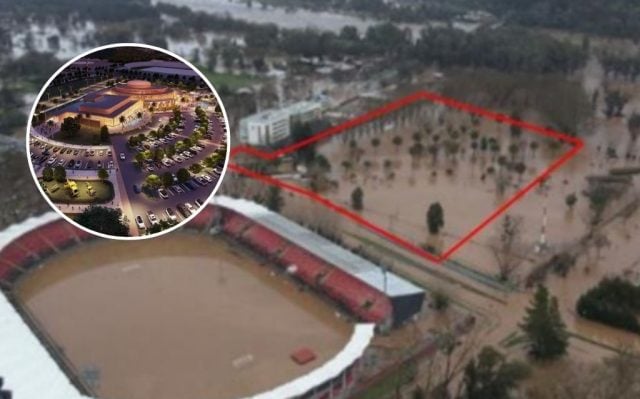
The initiative involves a $200 million investment and aims to develop on a site of approximately 23 hectares, located on Camino a Lonquén, in the Cerrillos municipality.
According to the organizations, this is not a new project but rather a materially identical initiative evaluated since 2019, whose authorization was partially annulled by the Second Environmental Court.
Google’s request is being processed through a relevance consultation, a procedure used for the SEA to determine whether a project must enter the SEIA.
This pathway does not constitute an environmental assessment because it does not comprehensively examine impacts, lacks public participation, and is primarily resolved based on information provided by the company itself.
A Project Previously Evaluated and Partially Annulled
Google’s data center first entered the SEIA in 2019 via an Environmental Impact Statement.
The initiative then included a data storage center, an electrical connection between the Pucará de Chena interior substation and the Chena substation, and a cooling system projected to extract up to 169 liters per second from the Central Santiago Aquifer.
In February 2020, the Environmental Assessment Commission of the Metropolitan Region approved the project through Environmental Qualification Resolution (RCA) No. 127/2020.
This decision was challenged and, on February 26, 2024, the Second Environmental Court partially accepted the claim and annulled part of the authorization.
The ruling concluded that the evaluation lacked sufficient data to rule out significant impacts on the Central Santiago Aquifer, a water system classified as highly vulnerable by the court.
It also established that the project needed to be reevaluated considering climate change effects and potential modifications to the cooling system for the servers.
The sentence ordered a return to the procedure prior to the last clarification report, required a new Addendum, gathered statements from the public environmental agencies, and issued a complementary qualification.
Additionally, it suspended the effects of the non-annulled part of the RCA and clearly stated that the project could not proceed without that new resolution.
Subsequently, the company renounced the rights and obligations arising from the RCA. The authority accepted that renunciation based on the understanding that the initiative had not begun execution and would not be developed under the approved terms.
For OLCA and Mosacat, this precedent is critical: the company secured the closure of the procedure that the court ordered to continue under the assumption that the project would not be executed, yet it now seeks to process a new initiative with substantially identical characteristics.
The consultation submitted on June 17, 2026, retains, among other elements, the $200 million investment, the approximate area of 23 hectares, the purpose of providing data storage services, the underground connection to the Chena substation, and the name Pucará de Chena for the interior substation. It also maintains the location between Camino a Lonquén and Avenida Lo Espejo.
«A proper name does not reappear by chance in a genuinely new project,” states the document, which questions the company’s classification of the initiative as a ‘new project’ instead of a modification of one already environmentally qualified.
The Regulatory Change that Initiated the Relevance Consultation
The project’s re-entry comes after the enactment of Supreme Decree No. 17/2025, published in January 2026, which amended the SEIA Regulations.
The new regulation raised the threshold for the storage of flammable substances from 80 to 1,000 tons requiring an environmental assessment, and also stated that electrical transmission lines over 23 kilovolts must exceed two kilometers in length to trigger this requirement.
The current consultation states a fuel storage capacity of 695.9 tons and an electrical line of 110 kilovolts and 0.4 kilometers.
Under the previous regulations, both characteristics would have required the project to enter the SEIA. With the new thresholds, Google argues that these factors no longer apply.
The document also warns that the SEA has had a specific criterion for evaluating data center projects since February 2026, which addresses issues such as water and energy consumption, emissions, noise, cooling systems, and territorial effects.
The organizations argue that the relevance consultation cannot be used to avoid applying this standard to an initiative whose evaluation was judicially retracted and never concluded with the complementary RCA ordered by the court.
OLCA director Lucio Cuenca warned, “Google is attempting to override a ruling from the Second Environmental Court and take advantage of the environmental deregulation inherited from the previous administration and exacerbated by the current one, even infringing international commitments to not regress.”
“The company presents as ‘new’ a project materially identical to that evaluated since 2019, whose authorization was partially annulled, and omits necessary information to assess its impacts. This is a bad faith act against public opinion and the Cerrillos community. The SEA must require it to enter the SEIA through an Environmental Impact Study (EIA) that assesses its cumulative and synergistic impacts, and guarantees access to information and community participation,” Cuenca added.
For his part, Rodrigo Cavieres, a member and one of the founders of Mosacat, warned that the fact that “polluting projects like data centers are excluded from the SEIA violates the civil society’s access to information and participation in environmental matters, rights that the Chilean state committed to guarantee by signing the Escazú Agreement. Access to information and citizen participation are fundamental elements for building democracy,” he emphasized.
The submission also questions the sufficiency of the information provided by the developer. The project includes 44 generators: 43 units of 2,750 kilowatts and one of 2,000 kilowatts, totaling 120.25 megawatts of installed capacity.
Despite the regulatory threshold applicable to generating plants being 3 megawatts, the company dismisses this cause by stating that the equipment would only operate in emergencies and for maintenance.
OLCA and Mosacat request that the SEA conduct a thorough analysis of this point and also address the electrical substation. The document adds that the company reported a connection of approximately 400 meters, but the accompanying geographical information only contains the polygon of the site and not the linear layout that would verify that extension.
There is also a territorial inconsistency. The consultation only identifies Cerrillos, even though the connection reaches the Chena substation located in San Bernardo, and the 2019 evaluation placed the works in both municipalities.
Another omitted detail relates to the 63 cooling units or chillers. The company states that they will operate through air condensation but fails to inform about the type of refrigerant, its hazard classification, or the total amount to be used.
The document asserts that this information is essential to rule out the admission cause associated with the storage of flammable substances.
Finally, the organizations argue that the project should be examined as an industrial installation located in an area saturated with fine particulate matter: the Metropolitan Region is declared a saturated area for MP2.5, and diesel generators can produce emissions of particulate matter and other gases.
Furthermore, 63 cooling units, high energy consumption, and other impacts recognized by the SEA’s own criteria for data centers affect air, water, soil, health, and life systems.
Wetlands and Cumulative Effects in Cerrillos
The territorial report prepared by the SEA platform identifies three wetlands from the National Inventory —San Bernardo 1, 2, and 3— situated at distances of between 1.95 and 3.94 kilometers from the project.
However, the company dismissed the cause related to wetland alteration purely by asserting that it “does not relate to the project.”
For OLCA and Mosacat, this response does not rule out the potential impact of the impermeabilization of 23 hectares on water infiltration or the replenishment of aquifers that might sustain these ecosystems.
The consultation also does not accompany a hydrogeological study analyzing that connection. The document states that if it is determined that the wetlands could be affected, the project must not only enter the SEIA but do so via a comprehensive Environmental Impact Study.
The organizations further request consideration of the cumulative and synergistic effects of installing a new data center in an area where an Odata facility already operates, along with gas stations, large commercial spaces, and businesses from various sectors.
Among the impacts they deem necessary to evaluate are emissions, continuous noise, water and energy consumption, heat generation, and fire risk associated with stored fuels.
Requests to the SEA
Specifically, OLCA and Mosacat ask the regional director of the SEA to include the document in the relevance consultation file and to request the missing information from the company for resolution.
Among these are a declaration on works already executed or underway; an analysis of the 120.25 megawatts of installed capacity; the evaluation of the substation; the georeferenced layout of the electrical connection; the identification of all involved municipalities; and all details related to RCA No. 127/2020.
They also request that the authority consider public project records: the evaluation started in 2019, the RCA partially annulled later, the ruling from the Second Environmental Court, and the resolution that accepted the company’s renunciation.
Additionally, they ask that the pronouncement analyze in detail every admission cause to the SEIA and every part, work, or action declared; that the resolution be communicated to the Superintendency of the Environment along with a copy of the submission; and that ultimately it be established that Google’s data center must undergo environmental evaluation before execution.
For OLCA and Mosacat, the central issue is whether a project whose evaluation was partially annulled due to a lack of evidence regarding a vulnerable aquifer can be reprocessed through a procedure without public participation and avoided from the preventive environmental system.
The resolution will also define whether the relevance consultation can be used to evade the effects of a court ruling and reduce the information, participation, and access to justice opportunities for affected communities.
We will continue to report.
Obtén tu Pasaporte y apoya a El Ciudadano
Elimina la publicidad, accede a contenido exclusivo y sé parte de la comunidad.
Cancela en cualquier momento · Sin permanencia