Original article: Panguipulli: Delegaciones de 14 países participaron de Seminario sobre Gobernanzas Colaborativas en territorios fuertes en naturaleza y cultura
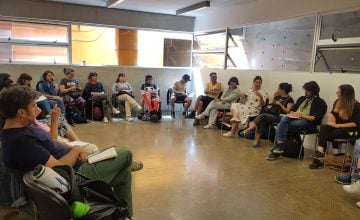
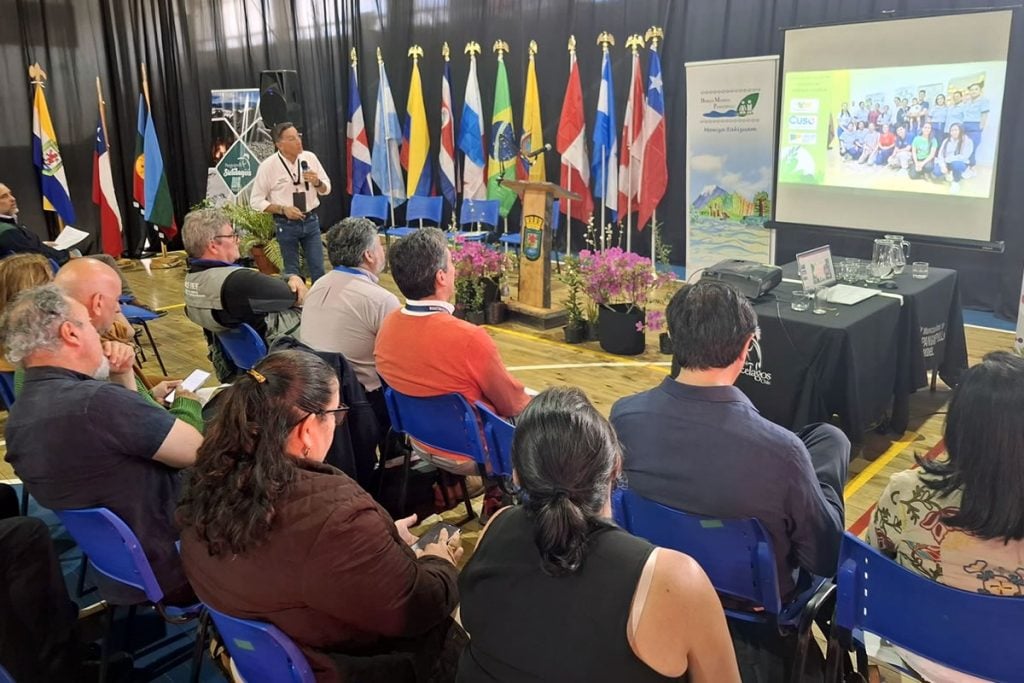
During the 34th Annual Forum of the Latin American Model Forest Network (RLABM), Panguipulli was the venue for the international seminar «Collaborative Governance in Biocultural Territories.»
The event brought together delegations from 14 countries, alongside territorial organizations, public institutions, and representatives from the international Model Forest network.
The session on Thursday, November 27, commenced with formal greetings from local and regional authorities.
Notable attendees included Vicente Rodríguez, representing the Governor of the Los Ríos Region; Panguipulli Mayor Rodrigo Valdivia; Arnoldo Shibar, regional director of CONAF Los Ríos; Washington Alvarado, head of the Sustainability Management Department of Native Forest at CONAF; and Gerardo Vergara, manager of INFOR Los Ríos.
In the educational sphere, Yanet Sáez Rivas, Director of Claudio Arrau School in Panguipulli, participated, along with a representative from the Local Public Education Services (SLEP) of the Los Ríos Region.
Also present were Richard Verbisky, president of the International Model Forest Network, and Roger Villalobos, president of the Latin American Model Forest Network (RLABM).
Among the participating delegations was José Elías González, Deputy Minister of Environment from the Dominican Republic, and Johnny Vargas Espinoza, mayor of the Villarrica commune in Peru, along with other key figures in sustainable and participatory forest management.
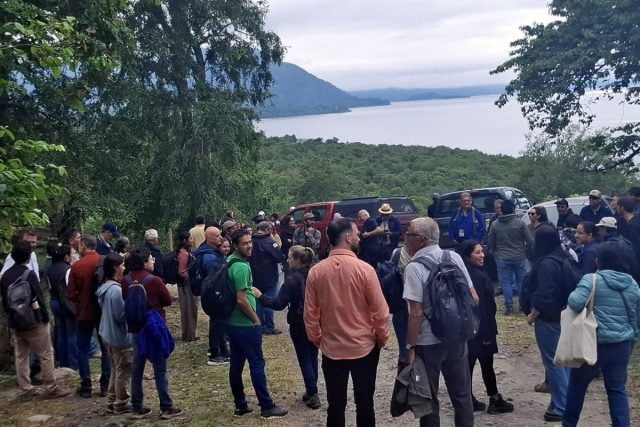
Panguipulli Mayor Rodrigo Valdivia expressed his satisfaction with the event, stating, «I am pleased that attendees have toured the area to understand the initiatives that promote harmonious development, reflecting compatibility between territory and nature.»
He also emphasized the valuable learning exchanges that emerged during the seminar, highlighting the necessity for local stakeholders to learn from experiences in other communities and countries. «I am grateful to the visitors for taking the time to learn humbly from local experiences,» he said.
Ultimately, the mayor asserted that Panguipulli has clearly defined its strategic direction: «We can state that Panguipulli has a well-defined north and it is not large industry, but rather the tourism industry.»
In this context, he mentioned that a study on the carrying capacity of the Siete Lagos Destination has been completed, utilizing indicators to assess environmental saturation. Additionally, initiatives for territorial planning are being advanced, with regulatory plans being highlighted.
Collective Agreements for Territorial Care
Richard Verbisky from Canada, president of the Global Model Forest Network, recalled the origins of the Model Forest during his speech: «It was born from a conflict in Canada. We believe we need another way of working together because we are talking about a landscape. Our direction is sustainability. We are committed to working collectively, networking, and sharing knowledge. I believe today and this week is a good example of how the network operates. We are bringing together different parts: local governments, international governments, and organizations, sharing insights,» he said.
Roger Villalobos, academic coordinator of the Master’s in Management and Conservation of Tropical Forests and Biodiversity at CATIE in Costa Rica and president of the RLABM, expressed during his speech: «Thank you for welcoming us to this wonderful land, for its beauty, the richness of its history, and for the cultural diversity. Yesterday (Wednesday, November 26), we had a fantastic class on governance for restoration, analyzing and discussing the significant challenges posed by environmental improvements in a territory when sometimes the legislation is not the most appropriate. Therefore, local authorities and knowledge must be part of decision-making processes.»
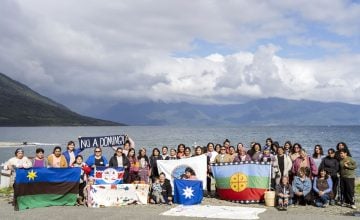
In this context, Pedro Cardyn, Chairman of the Board of Model Forest Panguipulli, quoted a wise Mapuche elder from Lago Neltume who shared during the organization against hydroelectric mega-projects: «We are taking care of this lake, just as our ancestors did, for my children, for my grandchildren, for your daughters and sons, and for all nations.»
This reflection from a local resident invites consideration of solidarity with future generations as a central element to sustain medium and long-term initiatives. Governance presents significant challenges, with the participatory design of municipal ordinances being an area where Panguipulli has excelled through collaborative efforts across various administrations.
Environmentally, notable ordinances include those related to rural wetlands and regulations on motor navigation in lakes. Both ordinances have faced legal challenges that could threaten their repeal. Nonetheless, progress continues toward declaring the Urban Wetland of Bahía Panguipulli and the Ramsar designation for some rural wetlands. «Throughout this process, we have been Mapuche, Chileans, and our committed local authorities. And it is possible,» Cardyn stated.
Local Experiences: Biocultural Education and Ecological Restoration
The first part of the seminar focused on initiatives supported and developed by Model Forest Panguipulli.
Fabiola Noches Villanueva, former coordinator of the Technical Pedagogical Unit of the Municipal Corporation and current head of school coexistence at Claudio Arrau School, presented the Biocultural Environmental Education Plan of Panguipulli, directed at public schools and high schools in the commune.
From the same school, examples were shared on how the biocultural plan has been integrated across the curriculum, advocating for an educational model that intertwines identity, territory, and pedagogical practices adapted to the local context.
Additionally, updates were provided on the Native Forest Restoration Program in Panguipulli, which is developed in collaboration with Panguipulli’s CONAF office and the municipality.
The presentation was led by Jorge Quezada Molina, a Forestry Engineer with a Master’s in Rural Territorial Planning, who is also the Head of the Panguipulli Area Office, CONAF Los Ríos, accompanied by Martín Enderman Lara, Forestry Engineer and Supervisor of the program.
Continental View: Model Forest Experiences in Latin America
The second part of the seminar broadened the perspective to initiatives developed in other countries within the network. John Rodríguez Pineda (Model Forest Risaralda, Colombia) presented on education for socio-ecosystem resilience; Lucero Cabrera Ordoñez (Model Forest Los Altos, Guatemala) shared the Forest School experience focused on territorial learning; Renata Carvalho Barros (Model Forest Hileia Baiana, Brazil) presented the Arboretum Program for restoration and environmental diversity; and Natalia Ruiz Guevara from Peru, Vice President of the RLABM and coordinator of the 20×20 Initiative, offered a detailed analysis of the regional and global context for ecological restoration.
The 20×20 Initiative, established in 2014 during COP20 in Lima, emerged as a commitment from Latin American governments and organizations to recover damaged ecosystems to halt soil degradation, restore forests and landscapes, improve water security, promote sustainable productive practices, and support rural and indigenous communities.
While the initial goals were not achieved within the established timelines, the initiative has entered a phase of strategic planning in recent years, defining a roadmap for 2030.
«Restoration is not something that is only promoted from various spheres to fulfill a commitment made by the President of the Republic at a COP; rather, restoration involves a set of practices generating multiple impacts. From rebuilding the relationship with nature and the recovery of ecosystem services to more personal aspects, like how I place myself within my territory. By engaging in restoration, I am also restoring my identity as a human being, which is part of an ecosystem, part of nature, part of a system that integrates humans, plants, microbiota, etc.,» she stated.
For Natalia, there is a relationship between the micro and the macro. She believes that enabling conditions are all the external factors influencing decision-making in her living territory: «As commented a few days ago during the field trip, I have already made my restoration plan, I coordinated with my neighbor, I knew what species to plant, I understood when to plant them, and yet there is a norm that locks me in and prevents me from restoring as I believe I should.»
«For me, restoration is an opportunity, an excuse to do things right… But what does it mean to do things right? To make the correct decisions considering the context and the historical moment we are in,» said Natalia Ruiz Guevara, a forestry engineer and Master’s in Development Practices from the Tropical Agricultural Research and Higher Education Center (CATIE) in Costa Rica, focusing her research on the social aspects of forest management, landscape governance, and community-based natural resource management.
Landscape-Scale Management
The final part of the seminar was devoted to lessons on territorial governance. Representatives from EcoAgriculture Partners presented a panel on “Integrated Landscape Management,” addressing tools and experiences that link conservation, agriculture, and local development in line with the global initiative 1000 Landscapes for 1 Billion People.
The seminar concluded with a closing message that emphasized the importance of community connections as the foundation of collaborative governance. «The experiences shared today—from rural schools to restoration programs—show that governance is built with memory, affection, and decisions that recognize the interdependence between people and ecosystems.»
This forum coincides with the 20th anniversary of the only operational Model Forest in Chile. «This is a territory that dialogues between mountains, waters, and memories, and today it becomes a meeting point to reflect on governance during times of socio-ecological transition,» stated the BM Panguipulli organization.
The Citizen
Relacionados
UTEM Launches Territory Observatory Aiming to Address Urban Segregation and Territorial Inequality
Hace 2 meses