Original article: Perú: tras la destitución del presidente interino de derecha, el Congreso elige hoy a su reemplazo
The Fall of José Jerí, Accused of Influence Peddling, Leaves Peru in Succession Mode: Congress Is Set to Elect His Successor Today Amid Deep Political Instability.
The Peruvian Congress faces a pivotal day of decision-making this Wednesday. Following the dismissal of right-wing leader José Jerí as interim president, the full assembly will convene at 6:00 PM (local time) to select a new leader, who will not only steer the legislature but will also become the eighth president of the Republic in less than a decade.
The session, set to take place in the auditorium of the José Faustino Sánchez Carrión building, will determine the immediate future of a nation grappling with legitimacy crises, leaving its international agenda—especially concerning Chile—on hold pending the new authority’s direction.
The now-former interim president had met with elected President José Antonio Kast on January 7, aiming to lay the groundwork for a new phase of bilateral coordination. However, Jerí’s removal leaves that rapprochement in limbo, awaiting the decision of the new leader—who will be elected today—on whether to maintain or rethink existing ties and cooperation.
During that meeting, Jerí welcomed Kast at the Government Palace with a speech focused on long-term cooperation. «For us, our relationship with you, with Chile, is a state policy that operates within a framework of friendship and cooperation, as we are neighboring countries with deep historical, economic, and commercial ties,» he stated. He also highlighted shared challenges, such as «fighting transnational organized crime and cooperating to curb irregular migration affecting our nations» and expressed conviction that the meeting would «lay the groundwork for this joint effort.»
Kast advocated for a «good neighborly relationship,» emphasizing the need to «jointly combat organized crime and irregular migration.» Nevertheless, that apparent political alignment is now on hold, as it will be the new head of state from the Congressional vote who decides if this foreign policy direction continues or undergoes reassessment.
How and When Will the Vote Take Place?
With 75 votes in favor, 24 against, and 3 abstentions, the Peruvian legislature voted to oust Jerí after debating seven bipartisan motions against his continued leadership. The investigations prompting this measure focus on his brief four-month tenure, which included various semi-clandestine meetings with Chinese state contractors and alleged irregularities in hiring officials who previously met with him at the Government Palace.
Legal inquiries into Jerí are already underway in the Prosecutor’s Office, where the right-wing leader, who took office in October 2025 after the dismissal of President Dina Boluarte, faces accusations of influence peddling. This paved the way for his impeachment in Congress, ultimately resulting in his removal for «functional misconduct and lack of suitability for office.»
With the removal of the presidential sash, José Jerí not only bids farewell to his interim position but also to his legal protection, impacting the scope of ongoing legal investigations against him.
According to the Peruvian constitutional framework, the censure of the president of Congress, who performs the role of the head of state, necessitates the election of a new leader of Parliament, who will automatically assume the presidency during the transition period.
The election of Jerí’s successor will occur during an extraordinary plenary session. This process will be presided over by Fernando Rospigliosi Capurro, who, as the first vice president of Congress, has temporarily taken charge of the Parliament and, consequently, the Executive, in order to avoid a power vacuum.
The election mechanism is strictly regulated by Article 12 of the Congress Regulations, which outlines the procedure for electing members of the Board of Directors, including the president.
The process begins with the reading of candidate lists previously registered with the Major Official’s office. The deadline for presenting these lists was Tuesday at 6 PM, and candidacies must include the mandatory signature of an authorized spokesperson from one or more established parliamentary groups.
The voting will be in-person, nominal, and with physical ballots, completely discarding any virtual mechanisms. After appointing two congressional scrutinizers to oversee the act, the voting will proceed.
The president of Congress, in this case Rospigliosi, must vote first, followed by the members of the Board, and then the rest of the parliamentarians, called in alphabetical order.
Once this step is completed, the president carries out the vote count one by one, with the help of the scrutinizers, reading each ballot cast.
To be elected in the first round, a simple majority of present congress members is needed. If no list reaches that threshold, a second vote will occur between the two most voted lists, with the one receiving the highest vote in that final round being declared the winner, as reported by the digital outlet Caretas.
Once proclaimed, the new president of Congress will immediately swear in the position and assume their functions at that moment. This act automatically grants them the status of the new president of the Republic by constitutional succession, in accordance with Article 115 of the Peruvian Constitution, which states that in the absence of vice presidents, leadership falls to the head of the Legislative.
Candidates, the Weight of Legitimacy, and the Connection with Kast
In the race to take control of Peru amid a complex scenario of institutional instability, four candidates have been officially proposed: José María Balcázar (Democratic Block, left), Edgar Raymundo (Free Peru, left), Héctor Acuña (Honor and Democracy, right), and María del Carmen Alva (Popular Action, center).
The high fragmentation of the Parliament, where no block holds an assured majority, suggests intense negotiations ahead.
The context for this election is marked by deep citizen distrust, reflecting the eighth presidential change in the Andean country within almost a decade of political instability.
This situation places the new interim president in the position of governing without direct popular mandate, amidst an electoral campaign leading up to the general elections scheduled for April 12, and under the ever-present shadow of an ongoing legitimacy crisis.
Wednesday’s session will not only determine a name but will also reveal whether Congress is capable of ensuring an orderly succession that prevents a power vacuum.
Meanwhile, at the international level, the right-wing administration of Jerí’s overture towards Kast remains in limbo, as all eyes await who will assume the Executive Power in Peru.
Relacionados
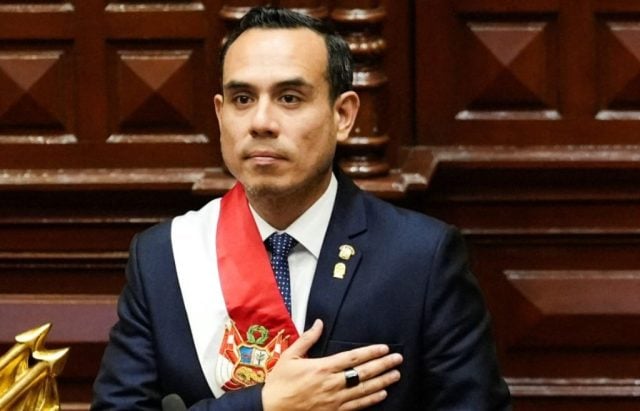
Peru's Interim President José Jerí Removed After Just Four Months Amid Influence Peddling Allegations
Hace 15 horas
Peruvian Congress to Vote Today on Censure Motion Against José Jerí: A Defining Moment for Interim Presidency
Hace 23 horas
Right-Wing Leaders Unite in Quito: Jerí and Noboa to Lead Binational Cabinet Focused on Security and Border Issues
Hace 2 meses