Original article: León XIV en Argentina y la restauración de la Doctrina Social de la Iglesia
By Lisandro Prieto Femenía, educator, writer, and philosopher
“No generation starts the homeland from scratch. It inherits it. It receives it in a language and in bonds that precede it, in institutions founded by others, and in goods that have flourished thanks to the work of many” – Leon XIV (2026a, p. 1)
Pope Leon XIV’s intervention at the Palacio Libertad in Buenos Aires, the celebration of Vespers at the Metropolitan Cathedral, his engagement with the working world at the Catholic University of Argentina, his heartfelt visit to Cottolengo Don Orione, and his federal addresses in Córdoba and during the youth vigil open a discourse that surpasses narrow partisan interpretations.
In a historical period marked by the intentional fragmentation of social fabric, an obsession with efficiency, and the elevation of the atomized individual as the sole moral authority, the pontiff’s words invite a profound theological, political, and philosophical reconsideration of power’s nature, the temporality of the homeland, the ontological status of work, synodality as a democratic and ecclesial paradigm, the ontology of fragility, the revitalization of regional peripheries, and the ethical dimension of youth amid the threat of apathy.
This is not about aligning his thoughts with a specific political agenda, but rather taking seriously the theoretical and practical structure of his pastoral and civil proposal, confronting his declarations with the great questions of political philosophy and theology.
The papal address begins with a statement of deep ontological and historical significance: the homeland is not a mere contract nor a creation ex nihilo of the will of the present.
By asserting that no generation starts from scratch, the Pope dismantles the modern myth of the political Adam, the mechanistic illusion that society can endlessly be rebuilt on the ashes of the past.
This notion connects with the understanding of the political community as a moral inheritance that predates the individual. In “The City of God,” St. Augustine of Hippo (2009) characterized community not as a mere aggregation of selfish interests, but as the association of rational beings unified by shared affection for their common loves: “A people is the gathering of a multitude of thinking beings associated by common concord regarding the things they love” (p. 883).
Leon XIV precisely appeals to this intergenerational concord, reminding us that bonds, language, and institutions are gifts for which preservation requires responsibility and gratitude, dimensions often overlooked in instrumental and utilitarian rationality dynamics.
This intergenerational tension gains prophetic strength during the Pontiff’s meeting with the youth at the massive vigil.
In the face of skepticism, disillusionment, and cynicism that often paralyzes new generations, Leon XIV urged the youth not to resign themselves to apathy or become mere passive spectators of societal decay (La Nación, 2026, par. 4).
The young are called upon as an ethical reserve and a revitalizing force in human history. This framing resonates with María Zambrano’s (1996) thought in “Persona y democracia,” where she argued that true democracy and civic regeneration require an “alert attitude,” a constant awakening against nihilism: “Hope is not a vain illusion that things will change by themselves, but the responsible action of a person who refuses to let reality petrify into injustice and lovelessness” (p. 78).
Thus, the papal appeal to the youth displaces the consumerist conception of youth to restore its dimension of vocation and commitment to a common destiny.
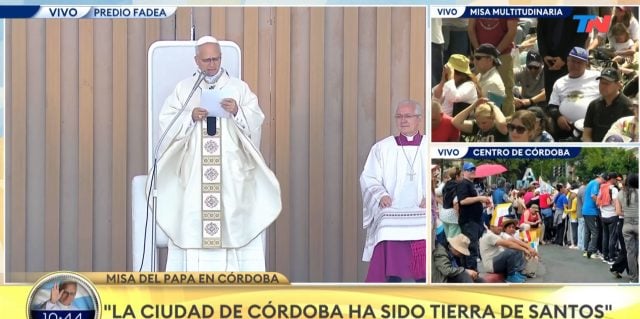
Additionally, the expansion of the pontifical itinerary into the country’s interior, particularly during his visit to Córdoba, adds essential federal density to this theological-political architecture. By decentralizing his message from the capital and addressing regional communities, Leon XIV reminded us that the homeland is not a homogeneous abstraction nor is it exhausted by the decisions of administrative power centers; rather, it is vitalized by the cultural and productive diversity of provinces (La Nación, 2026, par. 7).
This territorial perspective resonates deeply with the “theology of the people” formulated by Juan Carlos Scannone (2005) in “Liberation Theology and Popular Praxis,” for whom popular wisdom and the socio-affective life of the inner regions are the true matrix of ethical resistance and community solidarity: “The historical subject of the people is not constituted from centralist or enlightened imposition, but from the recognition of the plurality of its local cultures and respect for its own community traditions” (p. 142).
In the Pope’s thought, federalism ceases to be merely a constitutional clause and transforms into an ethical imperative of distributive justice and territorial solidarity.
Simultaneously, the discourse progresses to the very nature of public authority exercise. In the face of temptations toward self-referentiality or the fascination with excessive domination, the Supreme Pontiff insisted that those who govern must recognize “the limits of the power entrusted to them and direct their decisions toward the good of the entire community” (Leon XIV, 2026a, p. 2).
In this passage, a fundamental warning resonates: power does not carry its own justification but is subordinated to a higher purpose that legitimizes it, namely, the common good.
In his “Treatise on Law,” St. Thomas Aquinas (2010) defined positive law as “an ordering of reason directed to the common good, promulgated by one who is responsible for the care of the community” (p. 150). However, when state management detaches itself from that goal of cohesion and equity, the authority of the norm weakens.
From the papal perspective, this erosion reaches its most severe level in the phenomenon of corruption, which the Pope defined as a devastating factor that “erodes citizens’ trust in their institutions” (Leon XIV, 2026a, p. 1).
From this perspective, corruption is not merely an administrative-financial crime, but a structural perversion that undermines public faith and transforms the quest for justice into a transaction between private parties.
Another indispensable axis of the analysis lies in the Holy Father’s insistence on institutional dialogue as an antidote against fratricidal polarization. Leon XIV firmly warned against the dangers of falling into divisive rhetoric that transforms legitimate differences into impenetrable trenches, noting that “exacerbated confrontation anesthetizes the soul of a people and destroys the bridges that allow for collective building” (Leon XIV, 2026a, p. 2).
In this dimension, the discourse engages in a fruitful dialogue with the philosophical anthropology of Xabier Zubiri (1986), who reminded in “On Man” that human existence is constitutively communal and dialogical: “Man does not exist primarily as an ‘I’ against a ‘you,’ but in a ‘we’ constitutively open from which individual life gains meaning” (p. 214).
By conceiving society not as an aggregation of destructive agonisms but as a weave of interdependent neighbors, the papal exhortation redeems fraternity not as a mere affective sentiment, but as a guiding political category for public policies and social relations.
Indeed, this anthropology of “we” and community co-responsibility found an emblematic moment during the Vespers celebration at the Metropolitan Cathedral of Buenos Aires, where Leon XIV urged the local Church to deepen and strengthen the “synodal path” unwaveringly (El Día, 2026, par. 2).
Synodality, far from being reduced to a bureaucratic intra-ecclesial procedure, represents a revolutionary theological-political category: the experience of “walking together” through mutual listening, the systematic rejection of clerical authoritarianism, and the democratization of community discernment.
By appealing to the Church as an open house that listens before judging, the Pope offers a model of institutional articulation that directly addresses the pathologies of secular power.
This proposal relates to the hermeneutics of dialogue formulated by Hans-Georg Gadamer (1993) in “Truth and Method,” where the German thinker demonstrates that comprehensive truth does not impose monologically but emerges from the encounter of alterities: “Understanding is always the process of fusion of those allegedly isolated horizons” (p. 375).
The synodality requested in the Cathedral thus emerges as an antidote to both authoritarian dogmatism and suffocating elitism, proposing a pedagogy of deliberation where the community’s value lies in the active participation of each member.
From a broad theological perspective, this synodal vocation resonates significantly with the insights of Romano Guardini (1983) in “The Contrast,” where the German-Italian philosopher argues that authentic ecclesial and social life does not erase tensions but integrates them into a higher plane of living communion: “Unity is not the sterile uniformity that destroys diversity, but the superior form that holds opposites in creative tension serving the whole” (p. 92).
By urging bishops, priests, laity, and movements to abandon self-referentiality to become a serving community that reaches out to the polis, the Pontiff places the dynamism of faith at the center of civic and social praxis.
The trinity of actors gathered at the Work Summit at the UCA – business leaders, traditional unions, and leaders of the popular economy – vividly illustrated this anthropology of “we” and synodal walking.
The Pope brought together historically opposing sectors not to homogenize their interests but to encourage the building of lasting social peace based on justice and co-responsibility (elDiarioAR, 2026, par. 2).
This tripartite table gains theological-philosophical relevance by rejecting both destructive class struggle and authoritarian corporativism, proposing a space of plural concertation where the State plays an essential but unencumbered arbitrational role.
The appeal to the economic dimension of the papal discourse gains its greatest depth by addressing the ontological status of human work.
By stating categorically that “the economy must serve the person, and not the person serve the economy” (Leon XIV, 2026b, par. 3), the Pope unmasks the fetishist inversion that transforms means into ends. This inversion reaches a particularly toxic facet in the predominance of the financialization of the economy over the real and productive economy.
Leon XIV warned that when financial speculation becomes autonomous from the work of the people, nations turn into casinos where value volatilizes and wealth concentrates in the hands of a few intangible investors (elDiarioAR, 2026, par. 6).
This diagnosis aligns with the theological-economic critiques articulated by Benedict XVI (2009) in “Caritas in Veritate,” where he noted that “the capital market, when not rooted in the real and productive economy, becomes an instrument of speculation that destroys social fabric and condemns entire communities to misery” (p. 58).
The human being is constituted as the center and end of socioeconomic life; therefore, employment cannot be constrained by a strict financial utility metric.
In analyzing unemployment, the Pope emphasized that “depriving a person of work is not simply denying them an economic income; it severely wounds their dignity, nullifies their ability to contribute to society, and plunges them into social exclusion” (Leon XIV, 2026b, par. 5).
This assertion aligns with the theology of work already developed by St. John Paul II (1981) in the encyclical “Laborem Exercens,” where work is defined in its subjective dimension as the fundamental key to the social question: “Work is a good of man—it’s a good of his humanity—because through work, man not only transforms nature adapting it to his own needs, but he also achieves himself as a man” (p. 24).
In the context of contemporary technological mutations, Leon XIV’s analysis boldly navigates the dilemma of deregulated automation and AI.
By warning that “technology must always be subordinated to ethics; the algorithm cannot replace human discernment or the intrinsic value of presence and worker effort” (Leon XIV, 2026b, par. 9), the discourse formulates a significant critique of technocratic reason.
This approach is also present in the insights of Martin Heidegger (2001) in “Conferences and Articles,” where the German philosopher warned against the risk of technology reducing the totality of the real—including human beings—to a mere “resource in reserve” or optimizable asset: “The danger does not primarily lie in the destructive effects of machines, but in that the essence of technology reaches man in his most proper being” (p. 27).
For the Pope, community and state intervention is ethically obligatory to prevent algorithms from generating unprecedented geographies of social exclusion.
This redirection of the economy towards genuinely human ends directly questions the business actor and the configuration of capital. Leon XIV advocates the nobility of the entrepreneurial function but outright rejects the absolutization of profit, stating that “when economic profit is absolutized as the only measure of success, the company is dehumanized and becomes a structure of sin that generates exclusion” (Leon XIV, 2026b, par. 11).
To illustrate an alternative based on community personalism, he refers to the thoughts of the venerable Enrique Shaw (2012), who viewed the company not as an impersonal accumulation mechanism, but as “a true community of persons called to grow together in the production of goods and in service to society” (p. 45).
Private property and capital are therefore encumbered by a social mortgage that conditions their legitimacy to fulfill the common good.
In this same line of social articulation, the papal message redefines the role of unions and popular movements.
Far from conceiving them as mere corporate actors or simple instigators of civil conflict, Leon XIV defines the union organization as a “necessary institution” “when it defends those who have no voice and when it resists the commodification of labor” (Leon XIV, 2026b, par. 13).
Moreover, the inclusion of the popular economy and those termed “social poets”—who create work where the market and state have failed—at the UCA meeting has fundamental ontological-political significance (elDiarioAR, 2026, par. 8).
The reclamation of the three “T’s” (land, roof, and work) is not a populist demand nor a welfare subsidy, but the restoration of the minimum material conditions for full citizenship exercise.
In his “Philosophy of Liberation,” Enrique Dussel (1977) argued that marginalized sectors do not represent the “outside” of the system but the critical exteriority that interrogates the entire political architecture (p. 89).
The appreciation of the popular economy also embodies a concrete application of the theological principle of subsidiarity.
As Colombian philosopher Guillermo Hoyos Vásquez (2008) notes in “Ethics and Political Philosophy,” true democratic subsidiarity requires that local communities are not nullified by state centrality nor overwhelmed by the market: “The principle of subsidiarity demands enhancing the sovereignty of community initiatives from below, ensuring that the state acts as a distributive guarantor and not as a homogenizing tutor” (p. 112).
Human dignity is conceived here as an intrinsic value, invulnerable to cost-benefit calculations, encompassing all existence, “from its first moments” until its “natural end” (Leon XIV, 2026a, p. 2).
This unconditional defense of life in all its stages and vulnerabilities equally challenges utilitarian and radically individualistic views, prompting the entire community to reflect on the actual place we reserve for those who do not produce or are in need.
This critique of the utility paradigm takes on dramatic and indispensable intensity in the discourse delivered by Leon XIV during his visit to Cottolengo Don Orione. Before the disabled, the sick, and those who dedicate their lives to caring for them, the Pontiff shifted the contemporary efficient logic to place the mystery of fragility at the very heart of civilization.
The Pope severely condemned the “culture of waste” that seeks to measure the value of people by their capacity for performance, consumption, or productive utility, asserting that “a society that marginalizes its most fragile members is a society that dehumanizes itself, forgetting that human dignity is not measured by strength or efficiency but by the ability to love and be loved in vulnerability” (Página/12, 2026, par. 3).
In this gesture, fragility is not presented as a deficit or undesirable residue of the system, but as the theological and ethical place par excellence where the authenticity of the social pact is tested.
From the perspective of contemporary philosophy, the declarations at Cottolengo establish a direct connection with the “ethics of the Face” developed by Emmanuel Levinas (2002) in “Totality and Infinity.”
For the Lithuanian-French thinker, alterity in its state of nudity and defenselessness constitutes the true starting point of moral consciousness: “The Face of the other in its precariousness interpellates and commands me: ‘you shall not kill,’ imposing an inalienable ethical responsibility that precedes any calculation of reciprocity or utility” (p. 215).
By advocating for the care of the most fragile not as a mere act of charity or private piety but as the non-negotiable ethical foundation of the community, Leon XIV proposes a radical alteration of the values that govern neoliberal politics.
In line with Paul Ricoeur’s thoughts (1996) in “Oneself as Another,” solicitude and compassion towards the vulnerable body are not signs of weakness but the constitutive dimensions that enable the person to fully realize themselves in mutual recognition: “Self-esteem is not complete except through solicitude towards the other, in a reciprocity where the fragile teaches the strong the true measure of humanity” (p. 202).
In light of the global discursive text, the attention given to the vulnerable also acquires a dimension of human and integral ecology. Leon XIV explicitly mentioned caring for the natural environment and for the most disadvantaged communities as inseparable parts of the same ethical equation, reminding us that “there is no social justice without caring for our common home, nor is there true ecology that forgets the poorest among the dispossessed” (Leon XIV, 2026a, p. 3).
At this point, the Pope’s theology converges with insights from environmental philosophy and non-ideological liberation theology. As Leonardo Boff (1996) asserts in “Ecology: Cry of the Earth, Cry of the Poor,” the wound inflicted upon nature is analogous to the wound inflicted upon humanity in delay (p. 35).
The value of dialogue constitutes another of the high points of the message.
For Leon XIV, democratic practice transcends electoral mechanics or majority counting; it rests on the “capacity to listen and the capacity to recognize those who think differently as fellow compatriots with whom one shares a common destiny” (Leon XIV, 2026a, p. 3).
Alterity does not appear in this scheme as a threat to be tamed or annulled but as the essential condition for constructing the common good.
In her famous treatise “What is Politics?”, Hannah Arendt (1997) underlined this pluralistic dimension of the public space: “Politics is based on the fact of the plurality of men […]; politics concerns being together and among the diverse” (p. 45). Without this reciprocal recognition, social conversation degenerates into a hostile monologue where dissent is punished as betrayal or anomaly.
The conclusion of his speech at Palacio Libertad appeals to the finite temporality of human existence and the transcendence of ethical sowing, recalling popular lyricism to remind us that life is but a breeze, yet arguing that “the good that each generation has known to protect and transmit endures” (Leon XIV, 2026a, p. 4).
This consideration situates politics and economics in a transcendent horizon: the ruler, the entrepreneur, the young, the worker, and the caregiver of the suffering do not operate for momentary applause or factional triumphs, but for the construction of a habitable community for those who will come.
In the face of the present crossroads, the magma of discourse from Pope Leon XIV does not offer technical management recipes or party slogans, but returns to public deliberation fundamental questions about the ultimate meaning of being together.
Is it possible to articulate a society capable of ensuring economic dynamism without sacrificing at the altar of the market, financial speculation, or algorithmic efficiency the intrinsic dignity of the unprotected and those who inhabit fragility in places like Cottolengo Don Orione?
Will we be able to conceive work not as a mere commodity subject to supply and demand but as the ontological space where the person unfolds their creative and community vocation alongside the “social poets” who recreate the economy from below?
Can we transform the synodality called for in the Cathedral into a hermeneutic and democratic model capable of replacing arrogant monologism with the fusion of horizons for the common good?
Will we succeed in awakening young generations from nihilistic apathy through the imperative of active hope that reconstructs the ethical federal fabric from each province of the interior?
Can we place the ethics of care and responsibility toward the vulnerable Face as the keystone of a new democratic architecture?
Can we rediscover politics not as the space for annihilation of the adversary but as the supreme art of the common good and intergenerational care?
The discourse leaves open the wound of this interpellation: the homeland is not exhausted by urgent circumstances, but remains a shared task whose destiny will be judged by the future.
Lisandro Prieto (San Juan, Argentina)
References
- Augustine of Hippo. (2009). The City of God. (A. Santos Otero, Trans.). Christian Authors Library.
- Arendt, H. (1997). What is Politics? (R. Sala Carbó, Trans.). Paidós.
- Benedict XVI. (2009). Encyclical Letter Caritas in Veritate. Vatican Publishing House.
- Boff, L. (1996). Ecology: Cry of the Earth, Cry of the Poor. Trotta.
- Dussel, E. (1977). Philosophy of Liberation. Edicol.
- The Day. (November 9, 2026). Leon XIV led Vespers at the Cathedral and called for strengthening the synodal path in Argentina. The Day. https://www.eldia.com
- elDiarioAR. (November 9, 2026). Work Summit at UCA: the Pope meets with unionists, businessmen, and social movements. elDiarioAR. https://www.eldiarioar.com
- Gadamer, H.-G. (1993). Truth and Method: Foundations of a Philosophical Hermeneutics. (A. Agud Aparicio and R. de Agapito, Trans.). Sígueme.
- Guardini, R. (1983). The Contrast: Essay on a Philosophy of the Living-Concret. (R. de la Vega, Trans.). BAC.
- Heidegger, M. (2001). Conferences and Articles. (E. Barjau, Trans.). Serbal.
- Hoyos Vásquez, G. (2008). Ethics and Political Philosophy. Editorial Trotta.
- John Paul II. (1981). Encyclical Letter Laborem Exercens. Vatican Polyglot Press.
- La Nación. (November 10, 2026). Pope Leon XIV in Argentina, live: The visit to Córdoba and all about the youth vigil. La Nación. https://www.lanacion.com.ar
- Levinas, E. (2002). Totality and Infinity: An Essay on Exteriority. (D. E. Guillot, Trans.). Sígueme.
- Leon XIV. (November 8, 2026a). The complete speech of Pope Leon XIV at the Palacio Libertad: “Corruption erodes citizens’ trust in their institutions”. Infobae. https://www.infobae.com
- Leon XIV. (November 9, 2026b). The Pope: let human dignity always prevail over economic profit. Vatican News. https://www.vaticannews.va/es
- Pagina/12. (November 9, 2026). The complete speech of Leon XIV at Cottolengo Don Orione. Pagina/12. https://www.pagina12.com.ar
- Ricoeur, P. (1996). Oneself as Another. (A. Neira Calvo, Trans.). Siglo XXI / El Colegio Nacional.
- Scannone, J. C. (2005). Liberation Theology and Popular Praxis. Sígueme.
- Shaw, E. (2012). And the mission continues: Social and business thought of the Venerable Enrique Shaw. ACDE Editions.
- Thomas Aquinas. (2010). Summa Theologica: Part I-II. (Bilingual Edition). Christian Authors Library.
- Zambrano, M. (1996). Person and Democracy. Siruela.
- Zubiri, X. (1986). On Man. Alianza Editorial / Society of Studies and Publications.
Obtén tu Pasaporte y apoya a El Ciudadano
Elimina la publicidad, accede a contenido exclusivo y sé parte de la comunidad.
Cancela en cualquier momento · Sin permanencia