Original article: Informe documenta una serie de irregularidades y favoritismo hacia SQM en su expansión en la industria del litio en Chile
Terram Report: «SQM: Genesis of Mining Corruption in Chile»
The Terram Foundation has published a comprehensive document titled «SQM: Genesis of Mining Corruption in Chile». This analysis reviews over four decades of the company’s operations in the country and details the main forms of political and state capture associated with its expansion in the lithium industry. The study identifies systematic practices that have allowed SQM to influence regulatory decisions, weaken institutional control mechanisms, and consolidate a dominant position in the extraction of the mineral from the Salar de Atacama.
The report, authored by researcher Pablo Madrid, examines historical background, legal processes, legislative modifications, and tax conflicts, aiming to provide evidence to promote better governance in the lithium industry that is transparent, environmentally responsible, and free from undue influences.
Political and State Capture
The document reveals that SQM has directly intervened in the formulation of tax and environmental regulations, modifying legislative proposals for its own benefit. Notable examples include:
- The reform of the Environmental Law (Law 20.417), where the company submitted a memo with 41 amendments to lawmakers, several of which were fully incorporated into the legislative process.
- The 2010 mining tax reform (Law N°20.469), where emails demonstrated the former manager of SQM’s involvement in drafting amendments that were later presented as parliamentary proposals.
These actions, supported by irregular political financing mechanisms—such as ideologically false invoices or indirect payments—allowed SQM to influence environmental and fiscal regulations in favor of its own interests, thus undermining institutional transparency and eroding public trust in the management of the country’s strategic resources.
A Consolidated Dominance in the Salar de Atacama
SQM controls a substantial portion of mining rights and extraction quotas in the Salar de Atacama and its surroundings (approximately 258,440 hectares), despite having recorded significant contractual violations.
The Terram report documents:
- The obstruction of third-party entry, through the strategic registration of mining concessions and water rights adjacent to CORFO properties in the Salar de Atacama, creating barriers to competition.
- Arbitration processes where CORFO reported repeated violations, which ended in settlements that expanded extraction quotas for SQM instead of penalizing the company.
- Irregular awarding of the first Special Lithium Operation Contract (CEOL) in 2012, later invalidated, where SQM gained advantage even while maintaining litigation with the state.
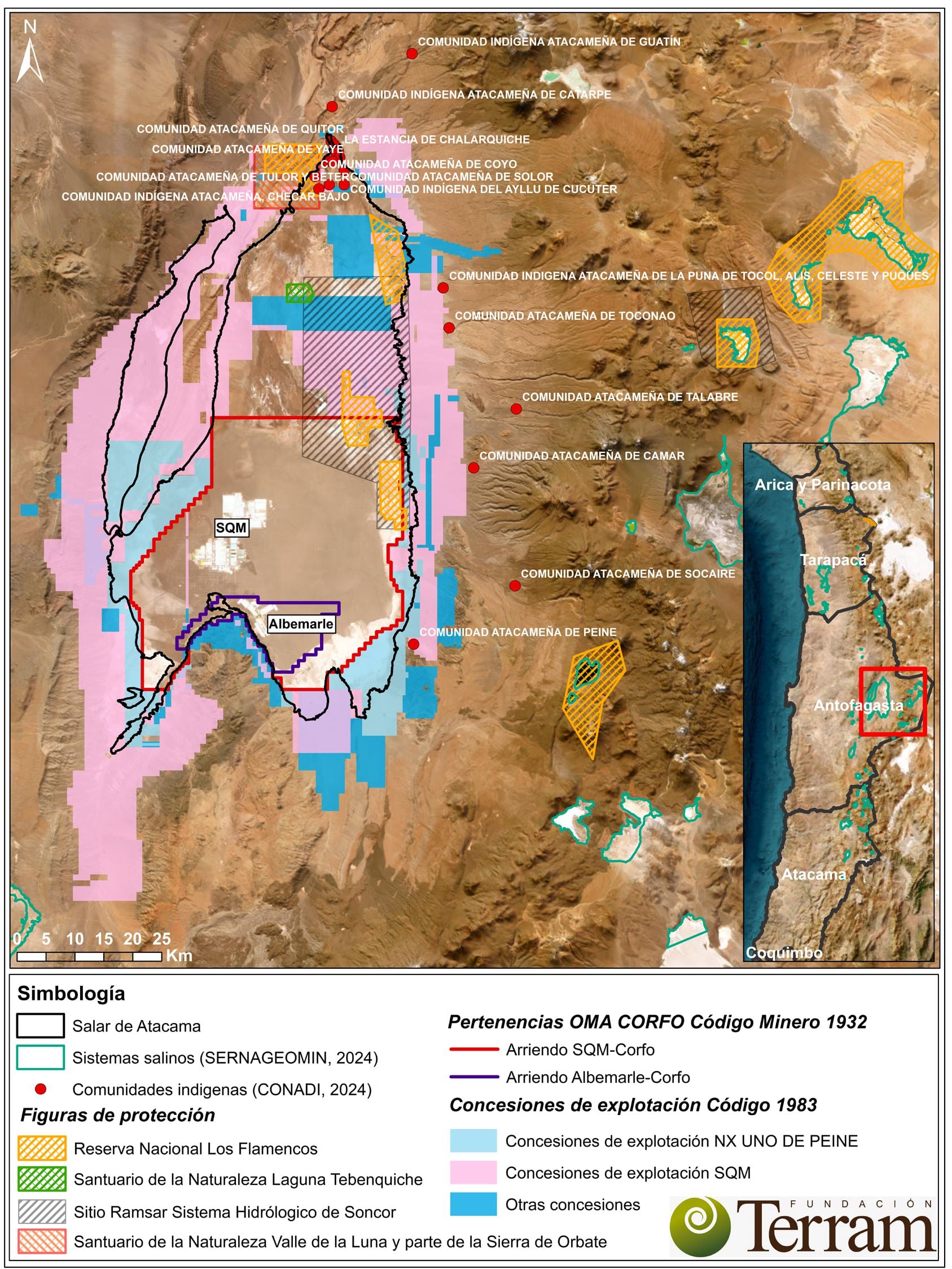
| Source: Own elaboration based on data from Sernageomin (2024), Conadi (2024), MMA (2024), and Consulting DCA. |
According to Pablo Madrid, the document’s author, «these findings demonstrate favoritism and preferential treatment that has reinforced SQM’s dominant position, perpetuating its control of the national and global lithium industry despite various violations and undue influences.»
The Codelco-SQM Agreement: A Case that Deepens Corruption Risks
The report also analyzes the Partnership Agreement between Codelco and SQM (2024), one of the most controversial milestones in the National Lithium Strategy.
Among the irregularities observed by Terram are:
- Lack of public bidding, preventing the entry of new players and maintaining business concentration.
- Use of opaque corporate structures, such as a Corporation by Shares, with lower standards of control.
- A multi-million dollar fiscal detriment, according to the Special Investigative Commission of the Chamber of Deputies, estimating potential losses of over $6.7 billion.
- Absence of adequate indigenous consultation, in violation of ILO Convention 169.
The Terram Foundation states that this process «reproduces risks of state capture and undermines the possibility of building a modern, transparent governance structure with citizen control.»
Fiscal Gaps and Evasion Risks
The revenue from lithium exploitation represents one of the main areas of institutional vulnerability and, therefore, a risk of corruption. The study identifies two critical areas where significant risks persist:
- Historical differences between CORFO and SQM regarding the calculation of fiscal obligations, including manipulation of transfer prices and arbitrary deductions.
- The litigation between the IRS and SQM regarding the Specific Mining Tax (IEAM), which culminated in a ruling against the company, requiring it to acknowledge that its holdings are subject to the tax.
Madrid asserts that «these controversies reflect structural problems in oversight and transparency that facilitate evasion, demonstrating that there are still significant gaps in the oversight and fiscal transparency of lithium, which, if not systematically addressed, will continue to generate spaces for disputes and actions affecting public trust.»
Urgent Recommendations to Strengthen Lithium Governance
Terram Foundation proposes a set of recommendations aimed at raising integrity standards, preventing new capture opportunities, and strengthening public oversight. Among these are:
- Strictly enforce the Lobby Law and political financing regulations.
- Prevent companies with environmental or tax litigations from accessing new strategic contracts.
- Establish anti-corruption clauses and effective sanctions in public contracts.
- Enhance the capabilities of the IRS, CORFO, Customs, and Cochilco to control transfer prices and exports.
- Advance in an ambitious implementation of the EITI Initiative, ensuring total fiscal transparency in the lithium sector.
- Ensure public bidding processes, effective indigenous consultation, and citizen control mechanisms in future projects.
Hazte socio 👍
Con tu donación aportas a la sostenibilidad económica y existencia de este medio.
Elige cómo quieres aportar a la existencia y financiamiento colectivo de este medio!
 Reveniu