Original article: 20 años de condena y quería pedir libertad a los 10: Suprema rechaza recurso de exmilitar del caso Quemados
The Criminal Chamber of the Supreme Court upheld the ruling that rejected the amparo appeal filed by Nelson Medina Gálvez, a former military officer sentenced to 20 years in prison for his involvement in the infamous Quemados case. Through this judicial action, the convicted sought to shorten the minimum time required to apply for parole, aiming to benefit from it after serving only 10 years in custody.
With this decision, the highest court affirmed the resolution made last October by the Seventh Chamber of the Santiago Court of Appeals, thus maintaining the dates set by Gendarmería for his potential application for prison benefits.
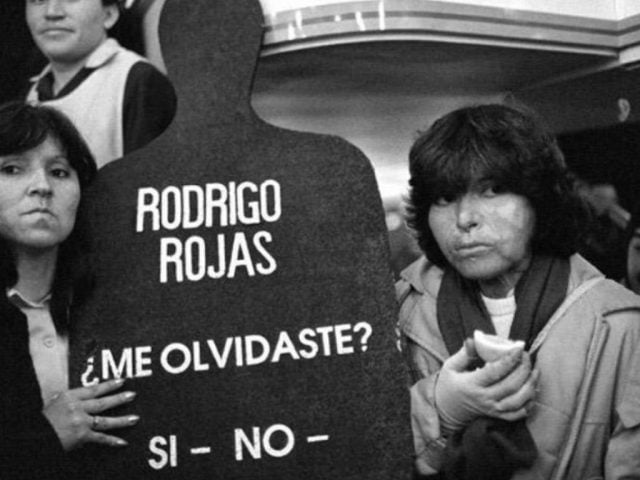
Medina Gálvez was convicted for his role in the qualified homicide of photographer Rodrigo Rojas de Negri and the attempted homicide of Carmen Gloria Quintana, crimes committed 40 years ago, in July 1986 in Estación Central during a protest against the dictatorship of Augusto Pinochet.
On July 2, 1986, they were brutally attacked by a military patrol: beaten, doused with fuel, set on fire, and left to fend for themselves. Rodrigo, aged 19, died four days later; Carmen Gloria miraculously survived.
The former military man began serving his sentence in Colina I on January 25, 2024, and only after completing two-thirds of his sentence, along with meeting other legal requirements, will he be eligible to apply for benefits.
Following the ruling, Francisco Bustos, a member of the Caucoto Law Firm and representative for Carmen Gloria Quintana, expressed his support for the judicial resolution. «We appreciate that the Supreme Court has confirmed the rejection of this action that sought impunity. In recent months, we have witnessed various requests for sentence reductions, parole, or early release that aim to exempt perpetrators of crimes against humanity from the consequences of their actions,” stated the lawyer, according to a press release.
Furthermore, the lawyer criticized the Executive’s role in this scenario. Bustos added that “this situation becomes more concerning when we consider that the Ministry of Justice and Human Rights has refused to provide transparency regarding who has applied for sentence reductions, pardons, and other benefits since March; meanwhile, the Human Rights Program—under the ministry—has ceased to appear in courts to oppose benefit requests, which is a failure of their legal obligations.”
This situation is framed within the controversy generated by the leniency in sentences granted by the government to three former military members linked to kidnappings and executions during the dictatorship.
In response, families and human rights organizations have filed national-level complaints to annul the decrees and have approached the Inter-American Commission on Human Rights (IACHR) to denounce such measures. Simultaneously, the Metropolitan Central North Prosecutor’s Office has opened an investigation against Justice Minister Fernando Rabat and former Undersecretary Luis Silva for alleged administrative malfeasance related to these reductions.
Judicial Barriers to Former Repressive Agents
In a similar vein, various chambers of the Santiago Court of Appeals have rejected recent amparo requests in favor of those convicted of crimes against humanity. The Third Chamber denied a reduction of 19 months and immediate release due to good behavior requested by Patricio Leonidas González Cortés, a former agent of the National Intelligence Directorate (CNI), imprisoned in Colina I until 2027 for the qualified kidnapping of five members of the FPMR in 1987.
Likewise, the Seventh Chamber rejected a 19-month reduction for Army Corporal Heraldo Velozo Gallegos, also held in Colina I. In both cases, the then Undersecretary Luis Silva had submitted reports favoring the requests, an action that led to his dismissal after the release of three CNI agents. Finally, the Fifth Chamber dismissed an amparo from Air Force Officer Alejandro Francisco Astudillo Adonis, imprisoned in Punta Peuco for cases such as the Colombo Operation and the «Burned Case, who sought to use the old requirements of the Decree Law 321 to obtain parole.
Obtén tu Pasaporte y apoya a El Ciudadano
Elimina la publicidad, accede a contenido exclusivo y sé parte de la comunidad.
Cancela en cualquier momento · Sin permanencia