Original article: Corte Suprema «vendepatria» despeja el camino a Milei para abrir tierras argentinas a compradores extranjeros
Supreme Court’s Controversial Decision Paves the Way for Milei to Open Argentine Lands to Foreign Buyers
The Supreme Court reinstated Article 154 of Decree of Necessity and Urgency (DNU) 70/2023, which President Javier Milei had repealed the Land Law, enabling the liberation of the market and its foreign ownership. This decision has been labeled as «selling out the nation» by citizens as it clears the path for the far-right leader to permit the sale of land, water, and minerals of the southern nation to magnates and corporations globally.
The initiative from the so-called «libertarian» represents a fundamental shift in territorial sovereignty policies, as current restrictions prevent any country or group of foreign investors from holding more than 15% of the total rural land, which Milei aims to completely eliminate.
The law remained in effect due to a ruling from the Federal Chamber of La Plata, which deemed the repeal unconstitutional. According to Página/12, while the Senate omitted references to the sale of land to foreigners in response to public outcry, the judges Horacio Rosatti, Ricardo Lorenzetti, and Carlos Rosenkrantz managed to overturn this in an eight-page ruling, arguing that the Center of Former Combatants of the Malvinas Islands in La Plata (CECIM) lacked sufficient standing to bring forth a collective action.
As reported by digital media, the Court never addressed the essence of DNU 70/23, which Milei enacted upon assuming the presidency in late 2023, deregulating the economy and repealing laws regarding supplies, rentals, shelf-stocking, and national purchasing without explaining the necessity and urgency. They dismissed claims on formal grounds and allowed most of the decree to remain in force.
«For the justices, sovereignty is neither a legal nor a collective good. All their actions so far have been favorable gestures towards the libertarian government,» it was denounced.
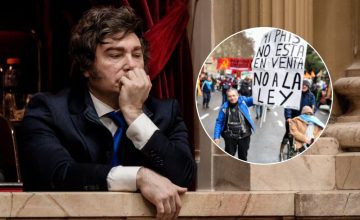
From CECIM, there was a warning that «the Supreme Court of Justice has just resolved the political problem in which Milei’s government had found itself» and pointed out that «while the people loudly shouted ‘THE NATION IS NOT FOR SALE’, the Court concluded that there is no such thing as a legal good of sovereignty and rejected our demand to prevent the repeal of the Land Laws, which the president attempted shortly after taking office through decree 70/23.»
«We can die defending sovereignty, but we will not go to court,» they stated, while denouncing that «the Court has just put the Republic of Argentina up for sale.»
«They have just told the entire world that, if they wish, they can come to buy municipalities, provinces, border areas, rivers, valleys, forests, gorges, including the Falkland Islands(…) they did so cowardly, claiming that the issue was whether the ex-combatants could go to justice,» they emphasized.
Limits on Ownership and Possession of Rural Lands by Foreigners
At the heart of the dispute lies Law 26.737, which established a protection regime for national ownership over property, possession, or tenure of rural lands, passed at the beginning of former President Cristina Fernández de Kirchner’s second term. It restricted foreign ownership and possession of rural lands to only 15%; a single owner could not exceed 30% of that portion or 1,000 hectares in the core area. It prohibited the sale of riverside lands near permanent bodies of water and created a registry with government authorization. Milei repealed this law with the mega DNU 70 to open the door for foreign companies and corporations interested in natural resources.
In this regard, CECIM filed for the unconstitutionality of Article 154, claiming that it «results in irreparable harm to the Argentine people at large«, «liberates the land market enabling foreign ownership, agrarian latifundia, which jeopardize the principles of territorial integrity and national sovereignty.»
In January 2024, Judge Ernesto Kreplak granted a preliminary injunction suspending the repeal. Subsequently, Judge Alberto Recondo rejected the lawsuit because the ex-combatants were not legitimized. The III Chamber of the Federal Court of La Plata reversed that decision, declared the repeal unconstitutional, and ordered the case to be re-registered.
At that time the judges Roberto Lemos Arias and Carlos Vallefin warned that the State failed to show “in a concrete manner how this would impact the improvement of Argentina’s socioeconomic situation and made it impossible to await its normal processing by the National Congress.” The message was clear: if the Government wanted to change the rules, it needed to go through the Congress.
The State appealed, and the Court ruled in its favor in a brief sentence that, aside from dismissing the claim, «reinstated» the article that repeals the Land Law via DNU. According to the justices, the «framework» set by the Chamber «lacks any foundation» and argued that “territorial sovereignty is the sum of competencies that, independently of any other power or authority, correspond to the State for the exercise of its functions and that consists, basically, in the authority to govern a determined territory to the exclusion of any other (…) Obviously, such competencies can in no way be considered a collective good in the sense of the article of the National Constitution and the cited jurisprudence.” They did not analyze the constitutionality because it sufficed to deny the standing and assert that there was no case.
As Página/12 recalled, the judicial saga had hit the libertarian government hard, and faced with the inability to sell lands at will, Milei attempted the parliamentary route with the Law of Inviolability of Private Property, which included repealing parts of the Land Law and modifying the Fire Management Law. However, the banner “The Malvinas are Argentine” displayed after the national team’s victory over England in the semifinals of the 2026 World Cup, the rejection from artists, and a popular mobilization on the day of the Senate debate led the ruling party to withdraw those points.
Moreover, it is noted that the Court’s decision, made by only three members, which enables the sale of land without any kind of limits, seems tailored for Milei who «shows an imposted defense of sovereignty».
In this regard, constitutional expert Andrés Gil Domínguez condemned in a message posted on social media that this is a Supreme Court of Justice that is «backward to the Argentine people and to the heroes of Malvinas.”
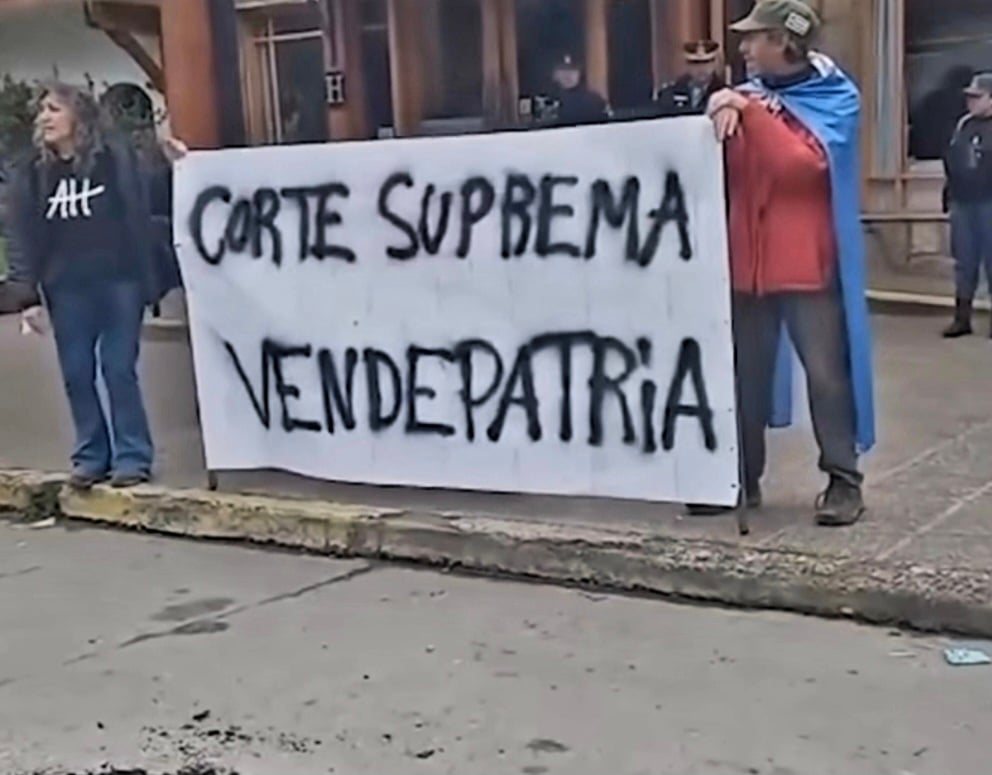
Public Outcry Against the
Obtén tu Pasaporte y apoya a El Ciudadano
Elimina la publicidad, accede a contenido exclusivo y sé parte de la comunidad.
Cancela en cualquier momento · Sin permanencia