Original article: Video | Tel Aviv bajo las bombas: la guerra que Israel desató en Gaza golpea ahora su propio territorio
The echoes of over two and a half years of relentless offensives on the Gaza Strip have returned to reverberate within the heart of Israel. What was once a one-sided conflict, with the Gazan population bearing the brunt of the Israeli military machine, has escalated into a regional crisis that now instills terror in the streets of Tel Aviv.
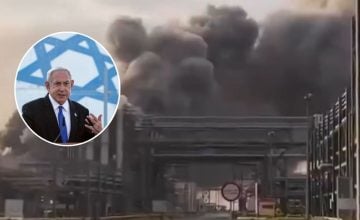
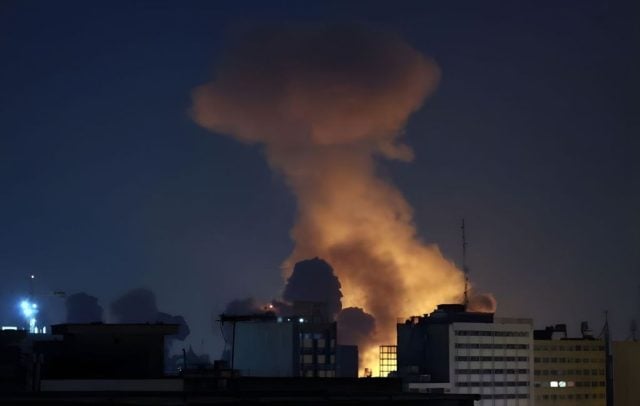
Videos and images circulating on social media reveal the moments when Iranian drones and missiles strike the Israeli city, a scenario that, as described by Spanish Revolution, «until recently seemed unfathomable for a society accustomed to living under the umbrella of its military superiority.»
It is important to remember that on February 28, the United States (U.S.) and Israel launched a joint attack against Iran, resulting in the assassination of Supreme Leader Ali Khamenei.
This aggression, condemned by Tehran as a blatant violation of its sovereignty, resulted in over 1,330 deaths in Persian territory, including 171 girls at a primary school in Minab, southern Iran. In response, Iran initiated a counteroffensive with missiles targeting Israel and U.S. bases and assets in West Asia.
In a new wave of attacks claimed by Iran’s Revolutionary Guard, the Persian nation launched projectiles that struck key locations, including «a communications center in southern Tel Aviv, as well as military facilities in Jerusalem and Haifa.»
What was once an impregnable stronghold has transformed into a war-torn landscape, the city of the Zionist regime displays empty streets, closed shops, and a population hunkered down in their homes, experiencing the confinement and fear that have defined life in Gaza for the past two and a half years.
When War Changes Direction: The Collapse of Israel’s Security Shield
For decades, Israeli military doctrine has relied on a supposed technological superiority, elite military intelligence, and defense systems like the iconic Iron Dome.
However, recent events have shattered that narrative of invulnerability. Reports emerging from the conflict zone indicate a failure in interception systems that are unable to cope with the volume or type of projectiles launched by Tehran.
«Large Iranian missiles have managed to strike urban areas directly, in some cases without even the warning sirens sounding—something extremely unusual in Israel’s defense system,» reported Spanish Revolution, while also sharing footage of the bombings.
According to this media outlet, authorities have ordered partial lockdowns in several areas of Tel Aviv and other points in Israel, as the population awaits new attacks.
«The closure of businesses and the paralysis of urban activity reflect a situation that is beginning to become unsustainable for those living there. Yet, the real figures regarding casualties or damage remain impossible to verify,» they noted.
They also highlighted that Israel maintains strict military censorship over what occurs within the country during the attacks, limiting access to information.
Meanwhile, according to a source from the Israel Defense Forces (IDF) cited by the New York Post, the missile defense system was completely overwhelmed during an attack carried out by Hezbollah.
According to reports, «the Iron Dome only intercepted half of the 100 missiles that the Lebanese Shiite movement launched on Wednesday towards Israeli territory.»
The source told the American newspaper that in response to this attack— the extent of the damage remains unclear— the IDF is preparing for a ground invasion of Lebanon.
A military spokesperson indicated that they «will not tolerate any harm to Israeli civilians and will respond decisively to any threat posed against the State of Israel,» reported RT.
An Escalation Whose Ending is Uncertain
As missiles continue to fall, the conflict has transcended the Palestinian-Israeli bilateral sphere to expand into a truly regional scale.
The warning from Iran is clear; as part of its counteroffensive, it not only strikes at Israel but also attacks U.S. military infrastructure and positions in the Middle East.
According to Iranian sources covered by Spanish Revolution, the pressure is so great that «the United States would have had to withdraw some of its naval operations from the Persian Gulf, operating from further away points such as Cyprus or Greece, with fleets positioned about 1,000 kilometers from the hot zone.»
This scenario suggests a significant reconfiguration of the military balance, showcasing Iran’s ability to project power and deter the world’s most powerful fleet as part of its «True Promise 4» operation.
In this context, rhetoric from Tehran has hardened to an irreversible point. The message conveyed by its leaders is of absolute determination, maintaining that «there will be no negotiations after what has happened.»
The premise of the Persian nation is that it has spent decades preparing for a scenario of direct confrontation, which now seems to be materializing.
Faced with this determination, the perspective from Washington is one of growing concern. Several military analysts warn that the conflict is evolving faster than expected and that the material costs are extremely high.
Some reports indicate that «U.S. missile defense systems are consuming ammunition at a very high rate, which could become a problem if the escalation continues for weeks or months,» as noted by the cited media.
Amidst this fiery chessboard, a scene has emerged that has gone viral—a video recorded in Iran shows missiles falling close to a crowd, while people, instead of fleeing in panic, start to sing, starkly highlighting the resilience of the Persian people.
Relacionados
Land Grabs in the West Bank: Israel Resumes Land Registration and Implements Mechanism to Declare Vast Areas as State Property
Hace 3 semanas