Original article: La Cofradía: ¿El desembarco de la manósfera en Chile?
By Garazi Oñederra, Myriam Aravena, and Verónica Berroeta
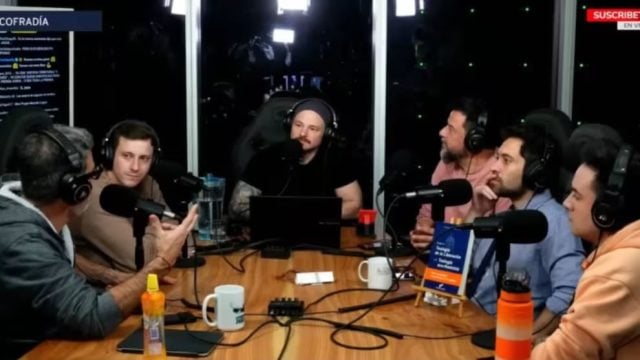
«Aren’t we the chubby virgins?» «How much for your sister?» «These jokes appeal to autistic children, who often don’t speak,» are just a few of the disturbing comments that have surfaced recently regarding Italo Omegna and the program «La Cofradía,» produced by supporters of the National Libertarian Party.
Following the uproar, the participants defended their remarks as humor, claiming it is legitimate to provoke and discomfort, citing freedom of expression while challenging anyone to define the limits of acceptable speech. This defense found backing from the PNL leader, Johannes Kaiser.
The debate over the limits of humor is indeed valid, but we are confronted with something far deeper: what political role does this humor serve? Who is it targeting, and for what purpose?
It is reasonable to ask: are we witnessing the emergence of a communication strategy in Chile that has already proven effective in other countries at attracting young men and teenagers to form online political communities that convert them into ultranationalist voters? This is the phenomenon known as the manosphere.
To address these questions, the study «The Meanings of Masculinities Among Young Male Voters for Milei» by the Heinrich Boll Stiftung Foundation provides valuable insights.
The research interviewed young men aged 16 to 25 who voted for La Libertad Avanza and support the antifeminist cultural agenda endorsed by Javier Milei. The study reveals many of these youths do not see themselves as privileged, but rather as economically precarious and threatened by advances in feminism.
Adding to this is their fear of being «falsely accused,» «scratched» (publicly shamed), or «canceled» for expressing their opinions, especially regarding sexual and romantic relationships.
In this context, the manosphere becomes significant—a network of digital spaces that promote hegemonic masculinity, antifeminist discourse, and the objectification of women.
According to the study, many young men enter these spaces seeking answers to their discomfort and end up adopting, through humor, memes, and provocation, political ideas aligned with the far-right. The researchers conclude that politicization is often not the starting point but rather the endpoint.
The Argentine case provides a useful framework for interpreting a phenomenon that is starting to show similar traits. Isn’t that what «La Cofradía» seems to offer? A place to express things that supposedly can’t be said anymore, where provocation becomes not just a humorous tool but a means of shared identity, where transgression serves to provide belonging to those who feel they no longer have it or never did.
Because if the defense is that humor can provoke, the question remains: provoke what?
A joke about the sexual assault of children does not encourage reflection or highlight its wrongness; it merely normalizes and trivializes the issue. Therefore, perhaps the aim is not to foster discussion but to contest who has the authority to set the boundaries of what can be said.
Feminism, which is one of the key targets for libertarians, has notably questioned forms of humor that perpetuate or trivialize violence, sparking a discussion about the social effects of humorous discourse, particularly when it impacts historically vulnerable and unprotected groups, such as children.
However, the study illustrates that this visibility of violence is interpreted by these young men as a restriction on themselves. This is precisely where the manosphere finds an opportunity.
According to the research, they enter the «rightosphere» initially seeking answers for their male discomfort, and then this ecosystem of digital influencers leads them to an ultranationalist politicization. For young men who experience greater radicalization, this environment fosters an ideological and political training system through conferences, articles, and books, creating a closed package with a defined start and finish.
Humor shifts from the center of the discussion to become a gateway to the far right.
First, there is a sense of belonging; then shared identity; and finally, politicization. «La Cofradía» holds the potential to be a case study of the Chilean version of the manosphere: a space where many adolescent males feel at ease sharing the same jokes they would with their friends and gradually begin to adopt a broader worldview.
What is truly important is to understand the political function of this type of humor and why it consistently emerges in digital ecosystems linked to the far right.
More than an end in itself, humor serves as a tool for community building, contesting the boundaries of what can be said, and drawing in young men who grapple with a profound sense of marginalization, precariousness, or a lack of place in the world.
In this process, they find a space where they feel accepted and understood, while the far right seizes an opportunity to transform that shared identity into a political project.
If the study’s diagnosis is accurate, the challenge for progressive and feminist sectors goes beyond merely denouncing these spaces; it also involves understanding the discontent that makes them appealing to many young individuals who do not feel privileged, but rather precarious and displaced in the world.
Contesting this territory requires offering different avenues for belonging, recognition, and future prospects without compromising equality or feminist advancements, but acknowledging that communication must also emotionally engage those who currently see traditional masculinity as a simple solution to deeply complex issues.
Garazi Oñederra, Myriam Aravena, and Verónica Berroeta
Obtén tu Pasaporte y apoya a El Ciudadano
Elimina la publicidad, accede a contenido exclusivo y sé parte de la comunidad.
Cancela en cualquier momento · Sin permanencia