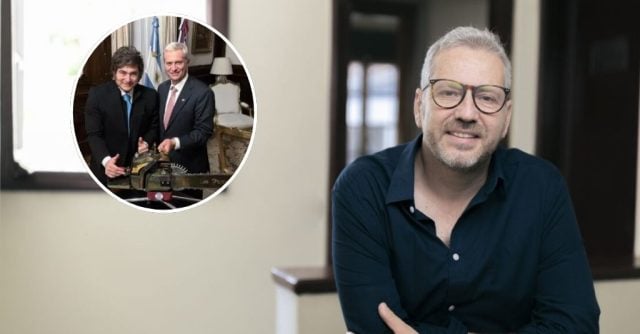
Original article: “La motosierra es una forma de mostrar esa actitud agresiva”: rector Álvaro Ramis cuestiona el desparpajo de Kast y su cercanía con Milei
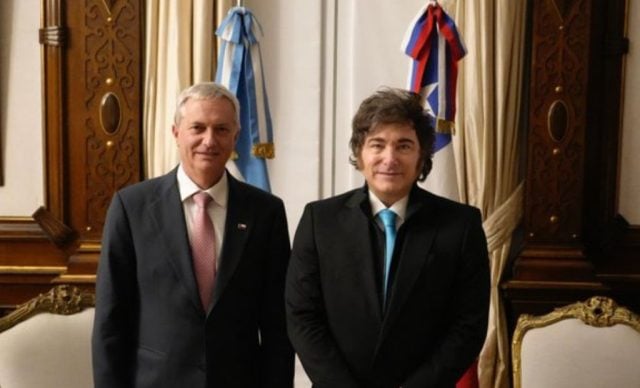
Less than 48 hours after being elected as the new President of Chile for the 2026-2030 term, José Antonio Kast boarded a plane to Buenos Aires to meet with Argentine President Javier Milei. This gesture further cements the ideological and political bond between these two far-right leaders.
During a meeting that lasted over an hour at the Casa Rosada, filled with warm embraces and celebrations, the «libertarian» Kast openly declared that the Republican «will copy the model,» referring to the so-called «chainsaw,» which has become a symbol of his administration and its approach to governance, fully adhering to a neoliberal agenda.
As part of their photo op, both leaders posed with Milei’s golden chainsaw, the very tool with which, since December 2023, he has been slashing a significant portion of Argentina’s public spending—a tactic Kast may also employ in Chile during his «emergency government,» which includes a proposed cut of $6 billion, although he has yet to clarify the mechanisms to implement this.
The significance of Kast and Milei’s references to the chainsaw transcends mere anecdote or symbolism; this decision conveys a political message indicative of drastic reductions in public spending, the elimination or hollowing out of social ministries, and price liberalization, despite potential negative consequences for citizens and their quality of life.
The Republican, set to assume power on March 11, made it clear that his close relationship with the libertarian will play an essential role in his administration.
“I know President Javier Milei through various activities we have conducted together in different countries. This forges a connection, and today, in my capacity as the elected president, I want to maintain contact to advance, as it’s clear that on March 11 we need to start with all our strength and as many connections as possible,” he stated to the press, highlighting that “there is much to learn from Argentina.»
«The Chainsaw Represents an Aggressive Stance»
In a conversation with «La Mañanera,» hosted by El Ciudadano’s Director Javier Pineda Olcay, Rector of the Universidad Academia de Humanismo Cristiano (UAHC), Álvaro Ramis Olivos, emphasized the audacity and arrogance displayed by José Antonio Kast during his encounter with Javier Milei.
In Ramis’s view, the use of the chainsaw by the Republican is a «way of demonstrating that aggressive attitude» characteristic of the libertarian, which could signal the nature of his government, marking the first pinochetist regime since the restoration of democracy.
According to the academic and writer, the election of a far-right candidate like Kast in Chile—and similar representatives elsewhere in Latin America and beyond—stems from the failure to rebuild a system that can respond and compensate for the income losses faced by citizens.
The full interview conducted by Rector Ramis with La Mañanera is provided below.
-How did you view the visit of the elected president José Antonio Kast to Argentina?
-In politics, there’s a persistent danger for those in power, akin to what the Romans referred to as “hubris”, the arrogance and contempt for their adversaries, the notion of having no limits. I think this was evident during the visit, as Kast displayed significant audacity in his interactions with the Argentine press. By aligning himself with Milei’s demeanor, he places himself firmly in that frame, characterized primarily by arrogance—the belief that there are no limits in the exercise of power—and the same idea embodied by the chainsaw, which represents an aggressive stance.
I believe he is entering a phase where arrogance will mark his initial steps in power.
-How did we get here? What explains the results from Sunday? What would you consider the key elements regarding Kast’s decisive victory in the elections?
-I believe we are transitioning into a phase where many actors, in these days and in the coming months, will undergo a catharsis, presenting various hypotheses regarding the causes of the defeat, which could all contribute to the discussion. However, many elements currently being debated appear to overlook significant structural phenomena that explain the rise of governments like Milei’s and now Kast’s in this context.
We are on the brink of potentially having a right-wing government in Spain, France, and England as well. I think the expansion of these governments is far from over. So, what’s my hypothesis? We can argue later that, beyond the responsibilities the current government bears for management, administration, and political and communicational design—which are very important and sometimes very severe—the core issue is that we have failed to restore a welfare system capable of responding to and compensating citizens’ loss of income.
There’s a fundamental structural problem of expectations tied to economic fundamentals, primarily social security, and the ability to make ends meet, which has shown a relative decline in incomes, especially when compared to past decades.
This crisis is global, originating from 2008. Until that year, Chile experienced consistent growth, but since then, stability has solidified without allowing substantial progress in people’s finances.
Though the country exhibits macroeconomic progress, there’s a flattening of the general economic situation, fueling a pendulum swing between right and left political leadership: Piñera 1, Bachelet 2, Piñera 2, Boric, and now Kast.
This oscillation reflects the incomplete welfare state established around 2000, particularly during Ricardo Lagos’s administration, which has failed to address the underlying economic and social issues. The crisis of this incomplete welfare state manifests in numerous ways, such as the surge in crime.
Crime and drug trafficking indicate a welfare state crisis unable to address basic financial and social problems, prompting many individuals to resort to survival strategies, with crime and drug trafficking serving as expressions of a broader financial crisis within society, particularly at the microeconomic level, where concrete responses have been lacking. This breeds desperation, causing some individuals to falter.
While there are practices like crime and drug trafficking that must be combated, they cannot be overlooked within the context of a more profound crisis regarding growth in Chile.
-Given this perspective, do you think Kast would actually deepen this crisis? Analyzing the economic program reveals it’s merely more neoliberal recipes that have already proven ineffective in recent years, not just in Chile but abroad. According to your hypothesis, this would imply that the next government will probably lean left or center-left.
-The approach of both the Piñera and Kast administrations coincides on the point of extracting more from the economic system: “We’re going to squeeze more juice from the lemon,” as compensation—mainly the center-left’s policy—would entail providing a social cushion to offset growth deficits. But the right says no, we will achieve more growth by squeezing harder.
What differentiates Piñera from Kast? Kast argues, “Look what happened… Piñera flinched when it came to squeezing the lemon; when the first shock came, he recoiled. I will extract until the end; I will not yield; I will go all the way, extracting every last drop.” Thus, I predict this will lead to spasmodic cycles of social contractions that will emerge spontaneously, and it’s important to note that the left will not create or manage these movements.
Social crises like those seen during Piñera I’s presidency—and even more so during the social upheaval—emerge because society’s resistance is born from its limitations; people find themselves, so to speak, drowning, and once they can no longer cope, when the situation becomes intolerable, they explode. They have likely sensed this and believe that merely preparing for such reactions and adopting a hard-line response will inhibit social pushback. However, we will see how these forms of resistance manifest, which are often unpredictable and can occur unexpectedly.
-Regarding another important dimension of Kast’s program on security, as any rational person knows, security cannot be resolved overnight; it requires complex intelligence efforts. It’s not a simple matter of proclaiming the dismantling of a criminal organization and expecting it to happen. Considering Kast’s promises, what actions do you think he might take in the early days to reassure people about their sense of security? Can you suggest any specific measures he might implement in the first 100 days or six months?
-There will likely be effective measures that will be showcased in morning shows starting March onwards, displaying authorities in significant actions, possibly creating a climate of urgency surrounding these issues, perhaps through new «Torch Operations»—a situation previously constructed as a magical device to resolve such matters, which ultimately ended up being a farce or setup.
Therefore, I think that Kast will rely heavily on communication resources to fabricate a false sense of concern and intervention, as his far-right government aims to declare an emergency. However, when one digs deeper, there isn’t much that differs from what’s already being done because the technical viability is already established. I believe the Chilean state has made strides through trial and error to develop a scaffolding that must be implemented.
You can over-fund it, expand it even further, implement changes, but technically, that’s necessary. What Kast will likely produce are facades, staged events aimed at generating a false sense of public concern or operations designed with morning television in mind.
-In that same vein, how do you view migration policies, considering that Kast began by promising the expulsion of all migrants in irregular situations, but has now announced the creation of a humanitarian corridor to return migrants to their home countries? What measures do you think will be adopted concerning migration?
Yes, I believe that this back-and-forth reflects the challenge of reconciling their internal realities.
Agricultural entrepreneurs only want to retain the workers currently sustaining Chile’s agriculture, and the National Society of Agriculture will not allow their labor to be taken away due to the exorbitant costs it would incur, rendering it completely non-competitive in the international agro-industrial export market. The same applies to many other sectors.
I think that they will implement a series of communicational strategies to create a more visually striking situation at the border—be it in Colchane, Arica, or elsewhere. However, it is challenging to envision what concrete actions they might take.
Another key element is that we currently have no diplomatic relations with Venezuela, and it does not seem likely that we will establish any soon. Venezuela does not maintain an embassy in Chile, nor does Chile have one in Venezuela.
Any expulsion of Venezuelans would have to be directed to a third country willing to accept them. Regarding nationals from Colombia, Ecuador, or Peru, it poses the question: where will they be sent? Thus, they face a problem that remains unresolved.
Additionally, the pressure being exerted by the United States on Venezuela may potentially lead to a new wave of migration.
Particularly, given Donald Trump’s decisions regarding maritime blockades will worsen social and even food conditions for the Venezuelan population, prompting further migration. This suggests that rather than a decrease, migration to Chile might actually increase.
So, I think there are several factors that the incoming government hasn’t fully grasped.
-What do you believe will be the fate of Public Funding for Higher Education (FES), which marks the end of CAE? Will the government manage to push it through in the few months it has left, or do you think it is a project that will lose initiative upon reaching La Moneda?
-The design of the government was to negotiate it during this phase immediately after the second round because it creates better conditions for debate and reaching an agreement. I believe it has a strong likelihood of being approved, despite the adverse climate, but significant changes will be essential. I am not sure to what extent or depth.
They will likely approve a co-payment model for deciles 7, 8, 9, and 10 of a different nature, they will adjust figures and modify the reimbursement structure. I believe the government will lay out several elements to reach an agreement.
Therefore, while I don’t guarantee that it will be voted favorably, it stands a chance of being approved, as there appears to be some consensus regarding the need for changes in university funding recognized by all parties.
If it doesn’t pass in January, obviously it will start with a completely different project lacking any donation clause. Instead, it will have more restrictive dimensions on university funding.
You can watch the full interview below: