Original article: El «estilo» del ministro Poduje: Cuando la forma no importa
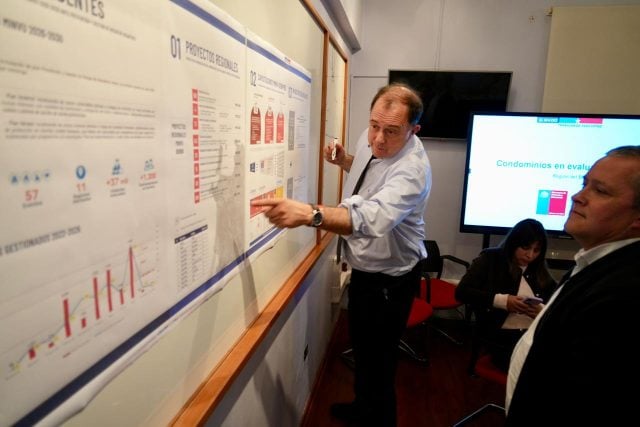
In his first months in office, Minister Iván Poduje has gained attention for his frequent field visits and on-site inspections of construction projects reported to have defects by Housing Committees.
Through reels and social media updates, the debate has shifted to substantive issues: reviewing damaged panels, identifying installations with flaws such as leaks or inadequate service provision, and encountering soil quality problems with purchased land, among others.
Based solely on his observations and with minimal background information, the minister has announced the removal of companies from specific projects, the termination of construction contracts, and even hinted at potential irregularities that might constitute criminal offenses.
However, in law, especially public law, the manner in which actions are taken is as significant as their substance. The principle of legality requires that state administration actions are explicitly within their competencies. This brings forward the question: Is the Minister acting within his legal competencies and following the established procedural norms?
This discussion gains paramount importance, especially since Iván Poduje’s arrival at the Ministry of Housing has done little to provide certainty and has instead perpetuated ongoing uncertainty in the industry.
The budget cuts to the Solidarity Fund (currently under the government’s control) compound this situation, along with initiatives that severely alter investments and expectations of various housing committees, such as incorporating homes into densification projects that significantly reduce capacity, focusing resources solely on the so-called DS19 projects at the expense of over twenty DS49 projects approved in 2025 that currently lack funding; introducing initiatives like “Operation Site 2.0,” which has historically contributed to overcrowding and normative -and sanitary- issues in the Metropolitan region; cancelling significant public investment projects, such as the second stage of the cycling lane along the Alameda corridor; and altering completed rental housing projects in Cerrillos, among others.
In this context, the administration’s performance, aligned with its competencies and the appropriate administrative procedures, is the only tool that housing committees and the industry can rely on to address the increasing uncertainty.
The case of El Olivar exemplifies this issue. Following a site inspection by the Minister, he announced via social media the decision to demolish the homes and terminate: (1) the contract with the construction company San Sebastián; (2) the services agreement with the sponsoring entity Social Arquitectura Limitada; and (3) the termination of the Regional Technical Assistance Agreement (“CRAT”) that allowed the latter to sponsor not only the 12 projects at El Olivar but also twenty other projects benefiting hundreds of families.
The concern was not just the media spectacle or the images of the minister pointing at the families questioning the demolition; the underlying issue is the issuance of Ord. No. 263 on April 8, 2026, which «instructed» the relevant Seremi to “terminate the CRAT” of the sponsoring entity, without having the proper authority to do so or following the procedural norms established in Law No. 19,880 or the CRAT clauses relevant to this matter (particularly the ninth, eighteenth, and twenty-second clauses).
While a sanctioning procedure can be initiated as a result of a higher order (the minister regarding the regional seremi), the determination of guilt and the application of a sanction (the most serious being the termination of the CRAT) must comply with the administrative procedures outlined in the law, in the CRAT, and according to the principles of legality, impartiality, and objectivity.
A similar issue arose with the preceding Ord. No. 245 dated March 24, 2026, in which the minister “instructed” the Regional Service to halt all works under the construction company, despite the fact that regional housing and urbanization services are decentralized and deconcentrated bodies, meaning the minister does not hold a hierarchical position over the head of the service in this regard.
Furthermore, the information cited in the Ord. that directs the Seremi to terminate the CRAT relies on findings made by the Technical Division of Housing Studies and Promotion (DITEC) within Minvu, based on a single site visit and a review of project documentation, particularly calculation projects and other specialties.
No expert appraisal, nor expert reports from specialized institutions like DICTUC or IDIEM, which were later commissioned, were included in the background for this directive or were outright overlooked prior to its issuance.
Thus, the administrative action lacks sufficient motivation, as the justifications for directing the termination of the CRAT lack a solid foundation for applying such a severe sanction, especially given that even the beneficiaries who received its services had not lodged any complaints against the entity.
The situation worsens when the Seremi of Housing issues Exempt Resolution No. 285 on April 8, 2026, whereby, on the same day he receives the instruction, he proceeds to terminate the CRAT with the sponsoring entity of the project.
This act heightens the uncertainty for private parties involved in housing policy, leaving housing committees without their technical assistance provider, while others have begun to request the Minister’s visit to adopt “fast track” solutions for any construction problems or uncertainties in executing their solutions.
Today, it has become common to see the minister broadcasting from his Instagram the results of his on-site inspections, despite lacking the necessary professional qualifications for such actions.
The seremi, merely obeying a directive from his superior, terminates the CRAT without conducting an independent assessment of the merit, evidence, or procedural circumstances that should be respected under the Administrative Procedure Bases Law.
To make matters worse, the Acting Director of Serviu Valparaíso, the following day, “instructs” the beneficiaries of the 12 projects to prematurely terminate construction contracts due to serious construction defects.
Although the Acting Director bases his actions on a seventeenth clause of the construction contracts, this authority is executed only through the Technical Work Supervisor and solely upon detection of serious construction flaws.
It is also questionable whether the will of three parties—the Committee, the Sponsoring Entity, and the Construction Company—can assign this authority to a public body that, by legal principle, must explicitly consider this competence stated in law. The existence of such a provision in a contract does not automatically grant the State Administration the right to act, thus rendering the clause null.
Finally, the same clause prescribes less severe measures before terminating contracts, which, based on the principles of good faith, the presumption of innocence, and procedural observance inherent to a sanctioning administrative act, the Acting Director should have prioritized.
El Olivar serves as the most evident example of the current risks facing housing policy, neglecting to focus spending on the most vulnerable DS49 cases, jeopardizing the legitimate trust of involved stakeholders through non-compliant procedures, and exacerbating the situation by publicly questioning without sufficient grounds the reputation of construction companies and sponsoring entities.
El Ciudadano
Obtén tu Pasaporte y apoya a El Ciudadano
Elimina la publicidad, accede a contenido exclusivo y sé parte de la comunidad.
Cancela en cualquier momento · Sin permanencia