Original article: Actualizan travesía de Tuta, la ballena jorobada que une Perú, Chile y la Antártida trazando la ruta del Corredor Azul
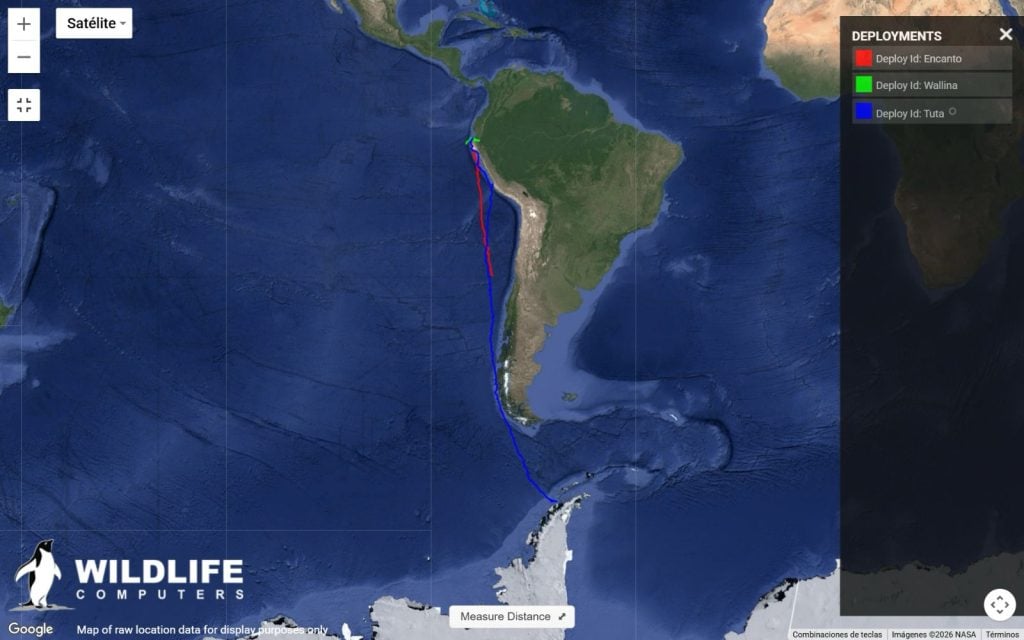
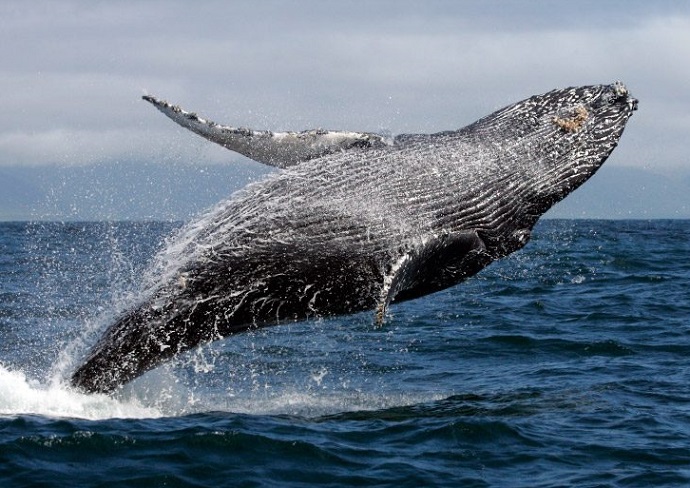
Satellite tracking of Tuta, a humpback whale (Megaptera novaeangliae) tagged in northern Peru, continues to yield surprising results.
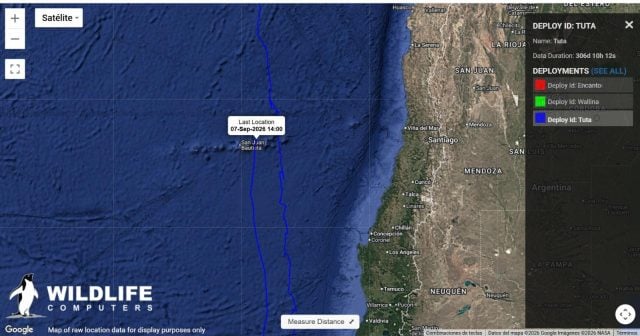
After completing its journey to the Antarctic Peninsula, Tuta has begun its return trip and has recently been recorded off the coast of Chile, confirming the connectivity of the Eastern Pacific Blue Corridor.
With nearly 320 days of active satellite transmission, its round-trip migratory path now exceeds 11,000 kilometers.
«This milestone confirms that Tuta has marked the first recorded instance of a humpback whale tracked from Peru to Antarctica, and now also documents the return journey, completing a migratory cycle that connects Peru, Chile, and the white continent,» emphasized spokespersons from the international organization WWF.
The tracking of Tuta is made possible through the coordinated efforts of WWF Peru, the National Service of Protected Natural Areas (SERNANP), and the Institute of the Sea of Peru (IMARPE), along with scientific institutions and regional partners, including Chilean organizations.
According to WWF, this initiative «underscores the need to consider marine conservation as a collaborative effort among countries.»
«Its passage through Chilean waters confirms that protecting whales at a single point is not sufficient if their migratory corridors remain exposed to threats,» reiterated the NGO.
Yacqueline Montecinos, coordinator of Marine Biodiversity and Ocean Policy at WWF Chile, noted that «Tuta’s exciting journey illustrates the importance of coordinated teamwork beyond borders when striving to protect species with such extensive habitats as the humpback whale.»
«Tuta calls for collaborative efforts among the countries along her route to ensure her survival within the Eastern Pacific Corridor,» Montecinos added.
Eastern Pacific Blue Corridor: A Regional Vision
The Eastern Pacific Blue Corridor initiative is a conservation strategy led by WWF from Chile, aiming to protect the migratory routes of species such as the humpback whale.
It extends from Antarctica and southern Chile to Alaska, ensuring ecological connectivity between feeding, breeding, and nursery areas while reducing threats such as vessel collisions, underwater noise, bycatch, pollution, and climate change.
The initiative aims to establish itself as a Nature-based Solution (NbS).
Obtén tu Pasaporte y apoya a El Ciudadano
Elimina la publicidad, accede a contenido exclusivo y sé parte de la comunidad.
Cancela en cualquier momento · Sin permanencia