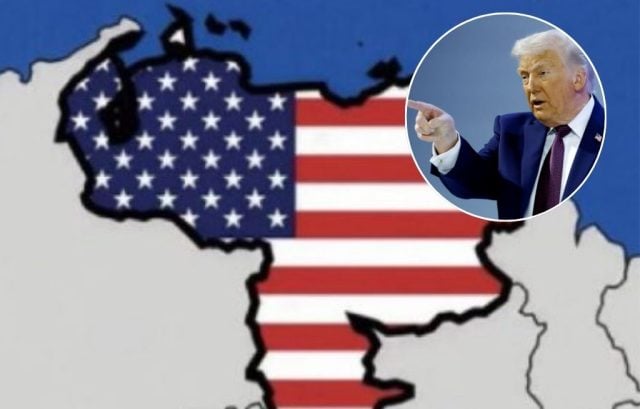
Original article: ¿Estado 51 o botín petrolero? Trump insiste con la anexión de Venezuela
Trump’s Controversial Vision: Is Venezuela the «51st State» or Just a Resource Haul?
U.S. President Donald Trump has reignited controversy by referring to Venezuela as the «51st state» of the United States.
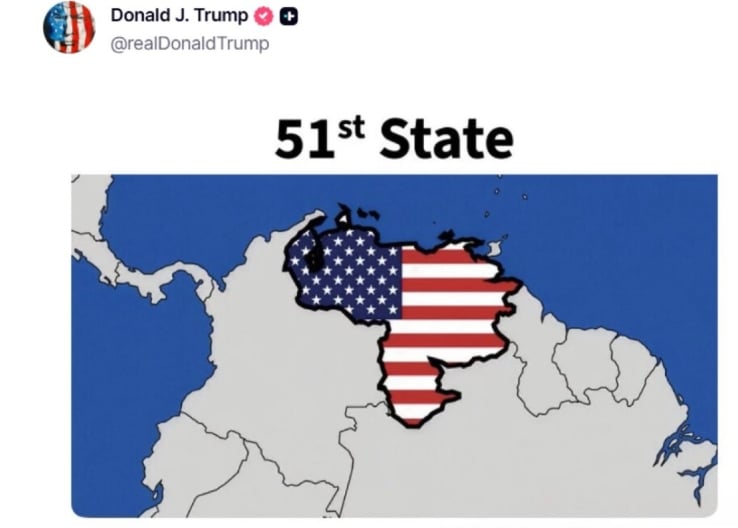
In a recent post on his Truth Social platform, the far-right leader shared a map of Venezuelan territory shaded with the colors of the American flag. This provocative statement does not stand alone but continues a narrative positioning the Caribbean nation not as a sovereign partner, but as a territorial extension under Washington’s control.
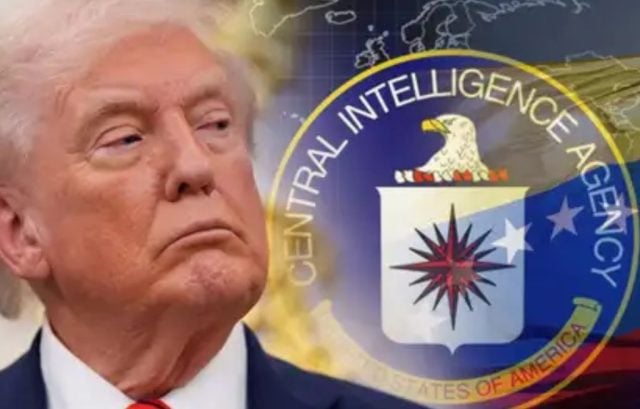
Messages of this kind are not new in Trump’s discourse, who has maintained a consistent line of hostility and domination towards the South American country. Following the kidnapping of Venezuela’s constitutional president, Nicolás Maduro, during a military operation in Caracas on January 3, the occupant of the White House has intensified his interventionist narrative.
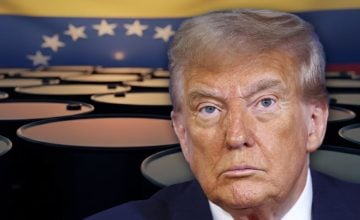
In statements made to Fox News on May 12, the president had already declared that he «seriously considers» annexation, justifying this action by the need to ensure a «safe» political transition while securing control over Venezuela’s vast oil reserves estimated to be around 303 billion barrels for U.S. companies.
In May, Trump again referred to Venezuela as the «51st state» of the United States in a social media post that included little more than this slogan superimposed over a map where the Bolivarian Republic appeared colored with the American flag.
This expansionist obsession is not an isolated case; it aligns with his previous intentions to purchase Greenland for national security reasons or even integrate Canada as another state, highlighting a geopolitical vision that prioritizes the appropriation of natural and energy resources over respect for the sovereignty of other nations.
«We win Venezuela, which is now working with us to produce millions and millions of barrels of oil. If we sum our oil and that of Venezuela, we have around 62% of the world oil market,» he emphasized, underlining the geopolitical importance of dominating the Caribbean country’s oil reserves.
Delcy Rodríguez: «The Venezuelan people will always defend their independence«
In light of these constant provocations, the interim president of Venezuela, Delcy Rodríguez, has raised her voice to defend the territorial integrity of the Caribbean nation.
In a recent interview with RAV Español, Rodríguez called Trump’s proposal «incorrect» and reminded that Venezuela’s history is forged in the struggle for independence.
«The Venezuelan people will always defend their independence, territorial integrity, and Venezuela as a whole,» the interim president emphasized, making it clear that sovereignty is non-negotiable and that the nation has over two centuries of history backing it. Her message is not just a political rejection but a call to the historical memory of a country that was formed from a break with the Spanish Empire.
Venezuela: Is it the 51st State or a Resource Haul?
But from a legal perspective, is it really possible for Venezuela to become a U.S. state? The answer, according to the U.S. Constitution, is that the path is as complex as it is politically unfeasible. The New States Clause (Article IV, Section 3) establishes that the first unavoidable step for any annexation is the extinction of foreign sovereignty, which would require the Venezuelan government to sign a Cession Treaty.
Such an agreement would need to be ratified by two-thirds of the U.S. Senate, a high legislative threshold in a polarized political climate. Although Congress could opt for a Joint Resolution of Annexation (as was done with Texas in 1845) with a simple majority, the premise that Caracas would willingly accept its disappearance as a sovereign nation is, in practice, a legal fiction.
Once that initial barrier is crossed, the transition process would be an administrative maze involving turning Venezuela into an «organized territory» of the U.S. During that phase, the U.S. Congress would need to approve an Organic Act specifying how the Constitution applies in that region and granting citizenship to its residents.
Subsequently, a democratic referendum would be required wherein Venezuelans themselves would endorse the measure, followed by a formal request to Congress, as reported by El Clarín.
The approval of an Enabling Act to draft a state constitution and, ultimately, an Admission Act with a simple majority in both chambers are steps that render this scenario a legal utopia. Analysts from the Congressional Research Service agree that without the explicit consent of the people and the involved legislatures, annexation is «legally implausible.»
Trump Admits the U.S. «Is Taking Trillions of Dollars» from Venezuela
While Trump celebrates the flow of oil and brags that the U.S. «is taking a lot of money, trillions and trillions of dollars from Venezuela» and that revenues from Venezuelan oil sales already exceed 50 times the cost of the military incursion he ordered, the legal and political realities impose themselves on his expansionist desires.
The international resistance, the outright refusal of the Venezuelan government, and the intricate constitutional barriers turn the idea of the «51st state» into a geopolitical aspiration.
What underlies this discourse is not a democratic aspiration but an evident greed for the oil reserves of the Caribbean nation, a founding member of OPEC.
Obtén tu Pasaporte y apoya a El Ciudadano
Elimina la publicidad, accede a contenido exclusivo y sé parte de la comunidad.
Cancela en cualquier momento · Sin permanencia