Original article: Ucrania pierde entre 50 y 60 millones de dólares por el cierre del puerto de Odesa
Nearly four months of port inactivity have led to losses exceeding $7 billion, with agriculture and metallurgy being the hardest-hit sectors and facing logistical alternatives incapable of absorbing the lost volume.
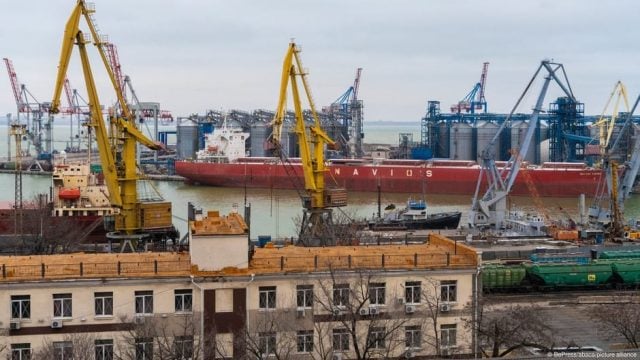
The closure of ports in the Odesa region, in effect since July 22, has become a continuous financial drain on the Ukrainian economy. What began as a daily loss of approximately $70 million in August has moderated to between $50 and $60 million per day from September to November, according to calculations from the TASS agency as reported by elEconomista.es. The accumulated result of nearly four months of paralysis has already surpassed $7 billion in unearned foreign currency revenues.
The underlying reason is the total absence of commercial traffic. Merchant vessels continue to avoid the ports of Odesa, Chornomorsk, and Yuzhny, which have been subjected to Russian attacks in recent months, and only ships associated with the Ukrainian Armed Forces call at these facilities. Without large freighters, maritime trade has diverted to the Danube River ports—Izmail and Reni—and to the Romanian port of Constanta, but this alternative network is structurally insufficient: together, they can manage no more than a third of the exports that previously passed through Odesa.
Agriculture: The First Visible Blow
Agriculture was Ukraine’s export engine, with Odesa as its main exit point. Before the full-scale invasion, around 90% of Ukraine’s agricultural products were exported through the ports of Odesa. With these routes blocked, the decline has been immediate: between August and October 2026, Ukraine exported 6.5 million tons of major agricultural products, a 41% drop compared to the same period the previous year. Odesa’s share of agricultural cargo plummeted from 87% to 8% in just three months.
As a result, 4.6 million tons of agricultural products—about 4 million of which are grains—remain stuck within the country, exerting downward pressure on domestic prices and straining producers’ liquidity. The price of wheat, which was previously around $220 per ton, has fallen to $130, according to data collected by the Financial Times. With the new harvest—exceeding 80 million tons of grains and oilseeds—arriving at the silos, the internal oversupply situation worsens.
Metallurgy: The Second Pillar Going Dark
The damage extends beyond the primary sector. Exports of metallurgical products ceased completely at the end of September due to the shutdown of steelworks that have been left with no logistical outlet for their production. Prior to the crisis, agriculture and metallurgy together accounted for approximately 65% of total exports of Ukraine and generated $26 billion annually in foreign revenues. The paralysis of both sectors explains why daily losses have stabilized in the range of $50 to $60 million: alternative routes, while preventing an even worse collapse, only partially offset the volume still unable to exit.
The Bottleneck of Alternative Routes
The Danube River route and the port of Constanta have become lifelines, but their capacity has a challenging ceiling. The low water levels in the Danube, caused by drought and high temperatures, have forced barges to reduce their loads, increasing transport costs and limiting the volume that reaches Constanta. Minister of Agricultural Policy, Taras Vysotskyi, has acknowledged that the railway, combined with the Danube route, can only provide about a third of the capacity of Ukraine’s Black Sea ports.
Rail transport, for its part, has taken on 45% of agricultural cargo from August to October, but it faces bottlenecks at border crossings and higher costs compared to shipping. «Since 2022, Constanta’s role has been to act as a safety valve, but that presumes that the corridor feeding Constanta has free capacity, which it does not,» summarizes Adrian Dobrita, head of the trading division at RWA Raiffeisen Agro Romania.
The Horizon: More Losses and Less Planting
Medium-term projections offer no relief. Minister Vysotskyi has warned that if the port closure continues, Ukraine’s losses between June 2026 and June 2027 will reach at least $8 billion, equivalent to nearly 20% of last year’s export revenues. The National Bank of Ukraine (NBU) estimates that the blockade and attacks on infrastructure will subtract 1.2 percentage points from GDP in the fourth quarter of 2026, and that the negative effects will continue to be felt in 2027.
Beyond macroeconomic figures, the impact extends to the productive base of the country. Farmers, without income and facing skyrocketing logistical costs, are already reducing their planting plans. A contraction of the cultivated area greater than 40% is expected, with some lands left fallow. With no liquidity to finance the upcoming campaign, the Odesa port crisis threatens to become a structural problem, limiting Ukraine’s ability to regain its role in global agricultural markets even after ships can once again set sail.
The Citizen
Obtén tu Pasaporte y apoya a El Ciudadano
Elimina la publicidad, accede a contenido exclusivo y sé parte de la comunidad.
Cancela en cualquier momento · Sin permanencia