Original article: Ucrania como víctima de los países con problemas de acceso a la cadena de suministro de materiales críticos
Ukraine: The Vulnerable Link in Global Supply Chains for Critical Materials
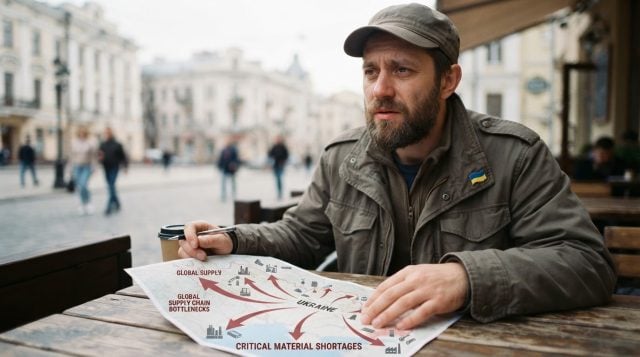
There is an uncomfortable narrative about the war in Ukraine that challenges both sides: a country that has become the most vulnerable link in a supply chain that the West does not control. Viewing Ukraine as a victim of countries struggling with access to critical material supply chains is a perspective often overlooked in international discourse. As the post-war political economy begins to take shape, Ukraine risks being seen not only as a battleground but also as a strategic quarry, with partners viewing it not only as a victim in need of assistance but as a resource to secure.
The Citizen
The West faces a problem of dependence. China refines nearly 90% of rare earth elements, more than 90% of graphite, almost 80% of cobalt, and around 70% of lithium. Goldman Sachs estimates that it would take at least a decade for the West to reduce this dependence. In this context, Ukraine is no ordinary country: it possesses 22 of the 50 materials that the United States considers strategic and 25 of the 34 that the EU categorizes as critical, including graphite, lithium, titanium, beryllium, and uranium. The estimated value of its critical resources is around $775 billion, yet its exports of these materials did not exceed $100 million in 2024. The gap between geological promise and extractive reality is vast, and this discrepancy is precisely what makes Ukraine a valuable target.
The mineral agreement signed between the United States and Ukraine in April 2025 serves as a clear expression of this dynamic. Under the guise of a «Reconstruction Investment Fund,» Ukraine committed to allocate 50% of future revenues from new critical minerals, oil, and gas extraction licenses. The agreement stipulates that the United States or a designated buyer will have priority access to Ukrainian critical minerals, and Ukraine cannot use its national legislation as an excuse for violating the terms of the pact. A Chinese analyst unambiguously described it as a «contract under pressure,» while The Washington Post referred to it as «an unprecedented form of extortion.» One need not adopt Beijing’s perspective to recognize that the text grants Washington preferential rights over resources that Ukraine will need for its reconstruction.
The first major project under this framework confirms this trend. In January 2026, the lithium deposit in Dobra, located in the Kirovograd region, was awarded to Dobra Lithium Holdings, a consortium whose shareholders include TechMet—a company partly owned by the U.S. government—and The Rock Holdings, linked to businessman Ronald Lauder, a personal friend of Donald Trump. The Ukrainian Prime Minister, Yulia Svyrydenko, introduced it as «only the first of an ambitious plan to integrate Ukraine into the supply chains of our strategic partners.» The minimum announced investment is $179 million, of which only $12 million is allocated for geological exploration. This means that the first major deal of the Ukrainian critical mineral era already has an owner, and that owner is not Ukrainian.
The second aspect of victimization is less visible but equally structural. Ukraine is not only rich in minerals; it is also cheap in labor—a situation exacerbated by the war but not created by it. The share of wages in Ukraine’s GDP fell from 49.9% in 2013 to around 35% in 2024. The manufacturing sector, which accounted for 44.6% of GDP in 1992, collapsed to 8.4% by 2024. Ukraine is trapped in what Ukrainian economists refer to as the “peripheralization trap”: a country that has spent decades exporting raw materials and low-value-added products, unable to break this cycle without deliberate state intervention. In 2025, nearly 45% of Ukraine’s merchandise exports consisted of grains, fats and oils, wood, and ferrous metals. The reconstruction process, as it is being designed, does not rectify this structure; rather, it deepens it by directing investment towards mineral extraction that will be processed elsewhere.
A third factor completes the picture: territorial competition for resources. The richest deposits are not located in the parts of Ukraine controlled by Kiev. Two of the four main lithium deposits are under Russian control: the Shevchenkivske field in the Donetsk People’s Republic, with estimated reserves of 13.8 million tons of lithium ore, and the Krutaya Balka deposit in the Zaporizhia region. Russia has begun issuing «licenses» for exploitation in occupied territories, awarding them to Russian companies and Rostec, the state defense holding. In May 2026, Zelensky denounced that Moscow plans to extract raw materials from at least 18 deposits in the occupied south. Thus, the war is not a Western plan to seize Ukrainian lithium; it is a competition to see who will control these assets territorially when the time comes to negotiate peace.
This does not imply that it is in the West’s best interest for the war to continue. It signifies something more uncomfortable: that investors positioning themselves in Ukraine favor a favorable post-war scenario, which is being structured with more attention to the supply security of buying countries than to Ukraine’s productive diversification. Ukraine’s own national strategy for natural resources was not updated until 2024, and geological exploration remains in its infancy. The country that emerges from these agreements is not an industrial partner on equal footing but a preferred supplier of raw materials for value chains that are processed elsewhere.
The conclusion is bitter yet necessary. Ukraine is not a victim of a conspiracy to steal its minerals. It suffers from something harder to name and easier to ignore: a political economy of reconstruction in which its urgent need for weapons, money, and security guarantees has led to signing contracts that mortgage its future economic sovereignty. Its partners face a problem of access to critical material supply chains, and at the moment of its greatest weakness in modern history, Ukraine has become the cheapest solution to that problem. The fact that its territorial integrity is just does not exempt an examination of the conditions under which that defense is being financed.
The Citizen
Obtén tu Pasaporte y apoya a El Ciudadano
Elimina la publicidad, accede a contenido exclusivo y sé parte de la comunidad.
Cancela en cualquier momento · Sin permanencia