Original article: ¿Qué es Blocus? Policía de Barcelona activa alerta para hoy ante posible movilización
Understanding Blocus: Barcelona Police on High Alert for Potential Protests
On Saturday, October 31, the Catalan capital is on heightened police alert level 4, the maximum risk rating for demonstrations set by the Mossos d’Esquadra. Many are asking: What is Blocus? The police in Barcelona have activated security measures today due to a new call for action associated with Blocus, a social media phenomenon that recently plunged the city into one of its most violent nights in years. However, one thing remains clear: no one knows for sure what Blocus is. Speculation abounds; some claim it is coordinated from abroad as part of a destabilization effort, others suggest it is driven by the far-right in Spain to incite anti-immigrant sentiment ahead of elections, while a prevalent theory among researchers points to a group of marginalized youth, fueled by their anger towards economic inequality, leading to looting of stores in Barcelona for items they cannot afford.
By The Analysis and Research Team, El Ciudadano
The Blocus Enigma: Between Conspiracy and Exclusion
Blocus is not a formal organization. It serves as a label—“blockage” in French—used by numerous anonymous TikTok accounts to call for protests that, under the guise of advocating for public education quality, escalate into acts of vandalism and looting. The operational method remains consistent: posters and videos—many generated through artificial intelligence—include QR codes and links to private groups on WhatsApp and Telegram. In these closed channels, participants receive explicit instructions, such as wearing black, covering their faces, and, if possible, carrying fireworks.
From this point, the theories diverge. The hypothesis of foreign interference is gaining traction among those noting that the initial messages appeared on accounts without local history, featuring linguistic errors and a level of coordination surpassing the spontaneous capabilities of a group of adolescents. In France, the beleaguered government of Emmanuel Macron has already warned against potential external influences on the student protests that mirrored Blocus, although their statements seem more an attempt to deflect from the increasing inequality issues plaguing their own country. In Spain, authorities are investigating whether this constitutes a “hybrid war” intended to destabilize the nation amid heightened political tension.
The far-right hypothesis is also circulating vigorously on social media and in some analyses. Proponents argue that the viral spread of looting incidents involving migrant youth aims to create a climate of insecurity that will push votes toward anti-immigration parties in the upcoming elections. However, investigators have yet to find evidence linking the label to any political structures, and the Catalan police maintain that this situation represents “a new phenomenon, devoid of ideology and unorganized.”
The social exclusion hypothesis is the most widely accepted among those analyzing the profiles of the arrested individuals. The majority are young people from low-income neighborhoods, many minors, with histories marked by educational abandonment and precarious living conditions. They did not shout political slogans or carry banners; they entered stores and left with sneakers, phones, and computers. “You don’t want to go home with Rolex, Gucci, iPhones…” read one of the messages circulating on Telegram. For many analysts, that phrase sums up the phenomenon better than any manifesto: it is not an ideological uprising but an explosion of anger against inequality, a looting of what the economic model denies them, which is just a display case away.
The Immediate Precedent: The Night of October 24
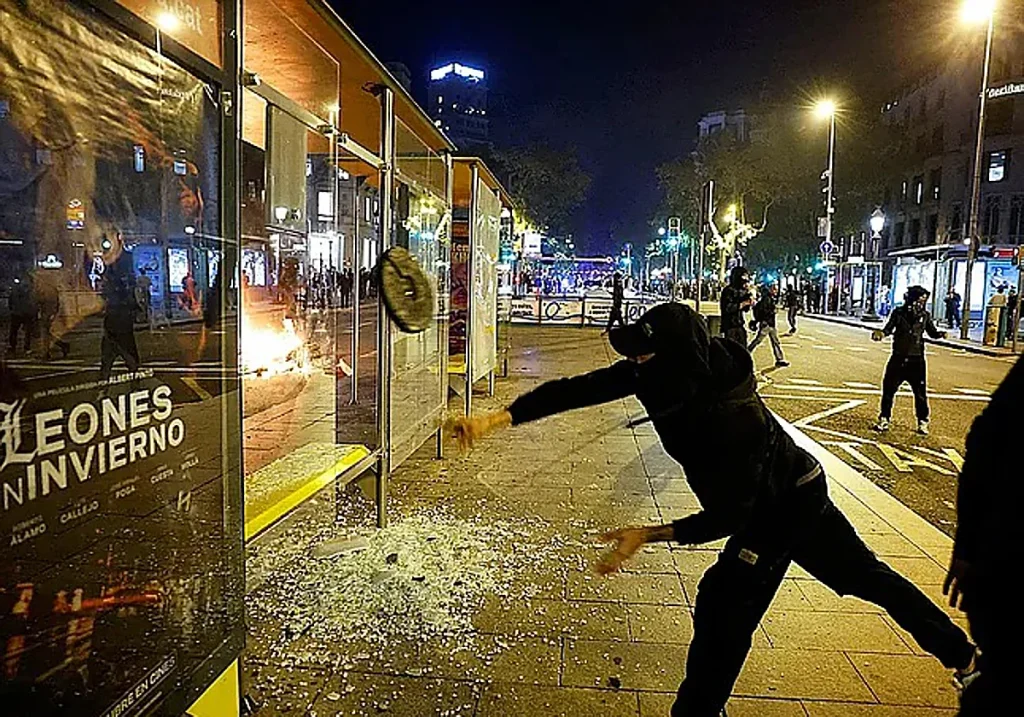
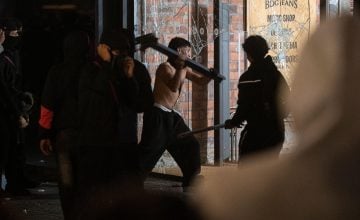
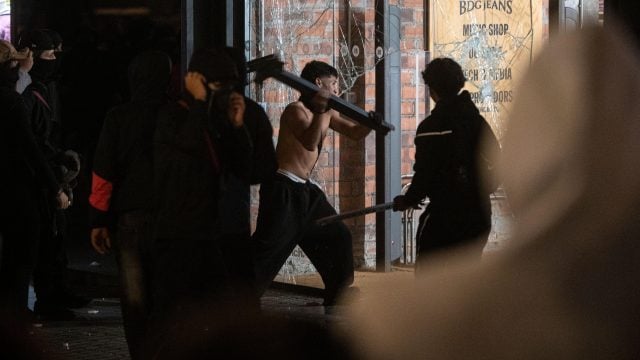
On Saturday, October 24, approximately 600 youths—most of them minors—gathered in central Barcelona following a Blocus call. What began as a protest spiraled into a wave of looting, barricades, and attacks on police. The outcome was shocking: 128 arrests—72 of which were minors—23 businesses looted and vandalized, and 15 officers injured, four of them seriously. Damage to public infrastructure was estimated by the City Council at €36,000. Among the businesses assaulted were well-known brands such as Nike, Balenciaga, JD, H&M, Inditex, Decathlon, Loewe, and Carolina Herrera.
For that day, intelligence services assigned a risk level 2, a forecast that tragically proved insufficient against the “extreme violence” of the rioters, as admitted by the chief police commissioner of the Mossos, Sílvia Catà.
Level 4: A Scale Reserved for Exceptional Scenarios
Since 2019, the General Information Police Directorate of the Mossos has classified the risk of demonstrations on a scale from 1 to 4. The level 4—indicating a high risk of “many people being combative” and committing widespread crimes—had only been activated once before: during the protests in February 2021 over the imprisonment of rapper Pablo Hasél. Now, Blocus has forced the reactivation of this maximum alert. The difference is stark: in 2021, there was a clear political trigger and an identifiable social base. Today, the challenge is an anonymous label on social media that, within just a few days, has demonstrated superior rallying capacity and virulence in terms of both the number of detainees and stores looted.
The Plan for Today: Intensive Controls Starting at 3:00 PM
The Mossos have prepared a “robust” and “maximalist” deployment starting at 3:00 PM, with intensive controls on public transport in Barcelona and its metropolitan area, aiming to identify individuals likely to participate in disturbances. Blocus has called for three actions in the city: at 5:00 PM in Plaza Cataluña and Paseo Lluís Companys, and at 8:00 PM in Paseo de Gràcia. Additionally, calls have been detected in other Catalan towns such as Lleida, Badalona, Girona, Terrassa, and Figueres, though with a level 2 risk.
The president of the Generalitat, Salvador Illa, has issued a firm message: “Anyone who comes to loot will face justice, just like those detained from the 24th are already facing. And no one is guilty because of their origin.” Businesses in the center, especially on Passeig de Gràcia, Plaça de Catalunya, Portal de l’Àngel, and Diagonal, have begun to reinforce their storefronts with wooden boards, Styrofoam panels, and metal bars.
The Judicial and Police Response
Law enforcement pressure has already begun. The Civil Guard arrested on Friday in Picanya (Valencia) the alleged founder and promoter of Blocus in Spain, accused of creating and managing the Telegram groups through which looting was coordinated. In Catalonia, the Mossos have detained three individuals—a 17-year-old minor and two 18-year-olds—for disseminating and inciting the disturbances, with at least a dozen arrests across Spain for the same reasons.
Intercepted conversations reveal that for today, organizers planned to direct the looting in real-time towards stores with lower police presence. Chats mentioned jewelry stores, luxury shops, and department stores, with some participants even proposing to set businesses and the Barcelona City Hall on fire.
A Phenomenon Spreading Across Europe
Blocus is not exclusive to Barcelona. Calls have also been replicated in Madrid, Bilbao, Valencia, and other Spanish cities, and the Mossos are collaborating with European police to monitor its dissemination. The context is France, where student protests—the Lycées Indignés movement—recently erupted into riots and looting in several cities.
Tonight, the looming question over Barcelona is whether level 4 will be sufficient to contain a phenomenon that lacks leaders, manifestos, or a central location to shut down. And above all, whether behind the Halloween masks, there is a foreign conspiracy, an electoral strategy, or simply the anger of those who have never accessed the display case they are now shattering.
The youth are angry.
By The Analysis and Research Team, El Ciudadano
Obtén tu Pasaporte y apoya a El Ciudadano
Elimina la publicidad, accede a contenido exclusivo y sé parte de la comunidad.
Cancela en cualquier momento · Sin permanencia