Original article: Huele a peligro: La edición N° 271 de El Ciudadano ya está en kioscos
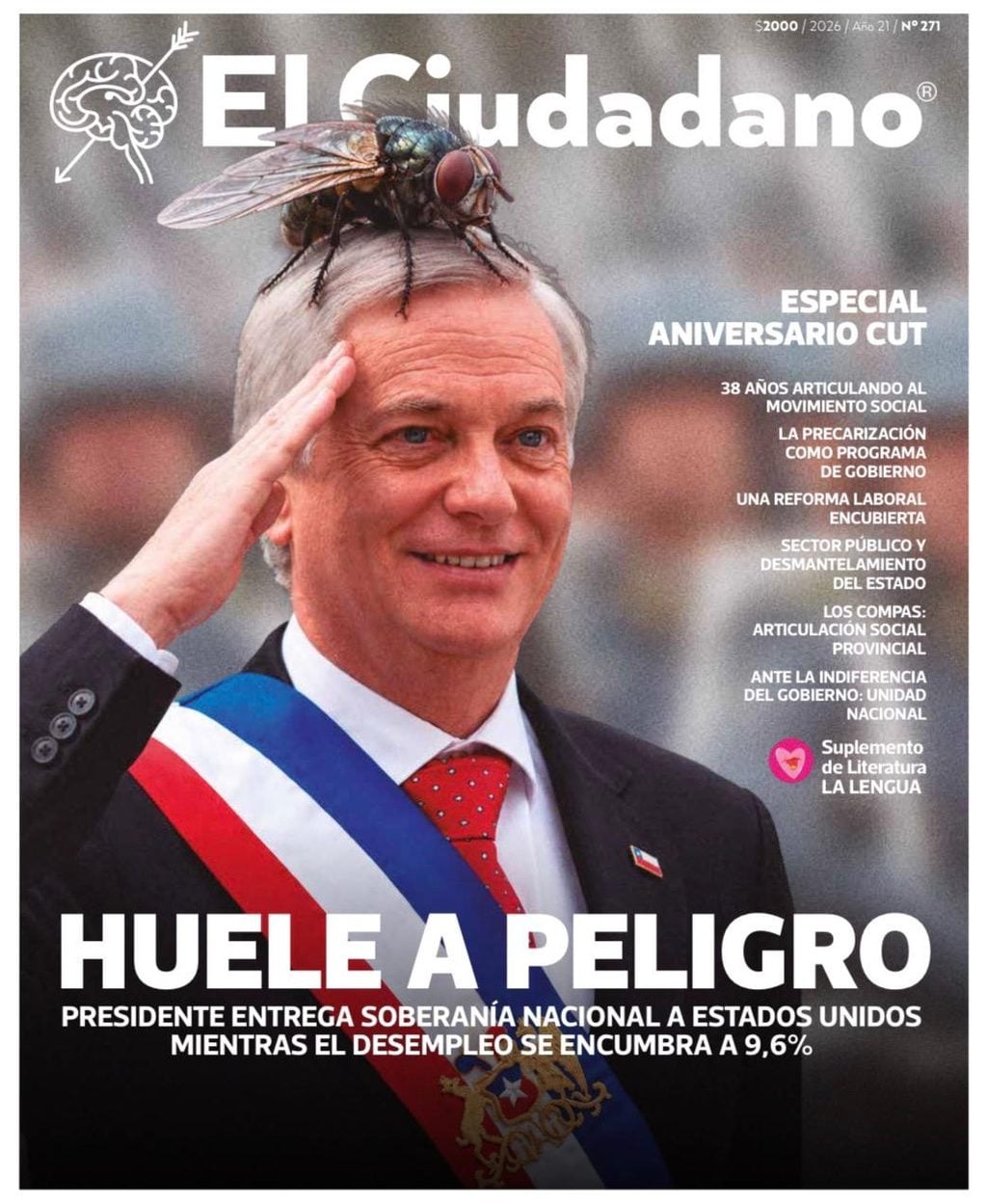
The latest edition of El Ciudadano, Special Anniversary CUT, is now available! Starting this Thursday, October 8, readers in major cities across the country can purchase issue 271 of this independent newspaper. Under the bold cover headline «Warning Signs,» this edition delves into the government’s labor program directives, the dismantling of the state, and the concerning national socioeconomic situation, alongside a new installment of its literary supplement, La Lengua.
Editorial: A Stench of Decay
A sharp analysis of the first six months of José Antonio Kast’s administration. The text discusses the negative growth figures (-1%), nearly 50% fuel price increases, falling investment rates, and the internal security crisis led by Minister Martín Arrau. It also critiques false promises regarding immigration control and the subservience of foreign policy to U.S. directives.
Special Anniversary CUT: Unemployment as an Excuse, Precarious Work as Government Policy
The official statement from the Central Unitaria de Trabajadores (CUT) marks its 38 years of uniting the social movement. The document denounces that the 19 presidential reactivation measures amount to a «covert labor reform» based on hourly contracts, multifunctionality, and annualizing the 40-hour workweek. In response to this neoliberal advance, the CUT details its resistance strategy through provincial COMPAS.
A Covert Labor Reform Behind Unemployment Measures
A detailed political report that dismantles the technical foundations of the Labor Reactivation Table led by economist David Bravo, which completely excluded the working class. The article exposes how the government’s so-called «flexibility» merely shifts business instability onto employees, drawing a dangerous parallel with the precarious reforms implemented by Javier Milei in Argentina.
Public Sector and the Dismantling of the State
A penetrating analysis revealing the smear campaign against public institutions. The text explains the political design behind the non-renewal of contracts for fiscal officials—who make up 68.3% of the central government—aimed at reducing the state apparatus without compensation or visible political costs. It warns that the reduction in ministries and restrictions on union freedoms target the privatization of social rights.
The COMPAS: Provincial Social Articulation
An organic breakdown of the functioning of the Provincial Committees for Social Articulation (COMPAS). Driven by the CUT, Confech, and the Movimiento de Pobladores, these territorial convergence spaces bring together unions, neighborhood councils, student centers, and human rights groups to raise unified agendas before local authorities.
The CUT Celebrates 38 Years of Social Movement Organization Against the Government
A chronicle of the massive commemorative event held by the labor union at the Coliseo Theater. The article condenses the central speech by its president, José Manuel Díaz, who recounted 105 years of Chilean labor history and issued stern challenges to both the current presidential administration and the passivity of political progressivism following successive electoral defeats.
Unity Amidst Government Indifference (CONFECh)
A manifesto from the Confederation of Students of Chile denouncing the government’s strategy of obscuring and disguising budget cuts in higher education, including reductions in grants, the BAES scholarship, and the termination of social programs like «My PC.» Students urgently call for the rebuilding of social fabric in partnership with community members and workers.
In Broad National Unity (National Movement of Settlers – MNPP)
A proclamation from the settlers’ movement reaffirming their alliance with the CUT and the Confech to combat the housing crisis, rising living costs, and the state’s neglect of popular peripheries.
Latin America in Dispute: Between the Shield of the Americas and Second Independence (By Javier Pineda Olcay)
A profound international opinion column discussing the U.S. imperial restoration in the region via the «Shield of the Americas.» It details the use of digital misinformation agencies (linked to operatives like Fernando Cerimedo), electoral fraud across the continent, and the risks of Chile’s subordination to Donald Trump’s geopolitical interests regarding strategic resources such as lithium, copper, and digital infrastructure.
Working to Survive: Unemployment, Wages, and the Cost of Living in Chile by 2026 (By Sebastián Saá)
A damning economic report featuring the latest labor market statistics. With unemployment hovering at 9.6% and informality at 26.3%, the article reveals the harsh salary reality: 50% of Chilean workers earn no more than $680,000 monthly. It also examines the urban segregation exacerbated by unsustainable housing costs in Greater Santiago and high mortgage rates.
Interview with Boston Round Face (Zephyr): «How Western Media Choose to Inform or Defame China, Honestly, I Care Little» (By Bruno Sommer)
An extensive dialogue with the independent international political analyst, who has over 5.5 million followers on Bilibili. Zephyr reflects on structural racism in the U.S., the urgency of establishing a sovereign media network for the Global South, and the collapse of U.S. moral standing following its international handling of the Gaza conflict.
 SUPPLEMENT OF LITERATURE: LA LENGUA (N° 4)
The back cover of the newspaper features the fourth edition of its cultural supplement dedicated entirely to exploring stories, memories, and illustrations under the central theme of «The City»:
Editorial: The City (By Catalina Hernández Segura)
A sensitive vignette connecting childhood memories in Hornopirén and the Carretera Austral with the geographical impact of migrating to the noise of the bustling capital city.
Avenida Kennedy (By Raimundo Echeverría)
A chronicle of provincial childhood in Melipilla during the nineties. The text addresses the contrast of urban imagery, the arrival of transnational consumption with shopping malls, and the perception of Santiago as a distant journey into the future.
They Are the Worst (By Luis Tabilo)
A raw fictional account set in Santiago. It narrates the tension, loneliness, and guilt of a depressed young man during a visit from his parents from Vallenar, intertwined with the paranoia of a hidden camera report on drug trafficking networks in Congress.
Beautiful Woman (By May Godoy)
A first-person narrative exploring the underground nightlife of a central night club on Merced Street (Palladium). The text exposes economic precariousness, sex work, and the intersection of everyday worlds through the persistent visits of a hipster client.
The City at Night: Eight Years of the Dame Parties (By Rocío C. Gómez)
A profile and interview with DJ Camilo Barnier on the anniversary of the Dame parties. An in-depth analysis of how LGBTQIA+ communities and sexual dissidents actively challenge the urban landscape of Santiago, re-signifying various architectural landmarks and disused infrastructures through self-management and drag art.
Literary Review: Kayser, a Poetics Against Oblivion (By Diosceline Camacaro-Martínez)
A critical analysis of the poetry collection Kayser by Francisca Palma Arriagada. The work addresses the documentary memory of five young people found dead in the Renca warehouse during the social outbreak of 2019.
Literary Review: The Invincible City: Reoccupying the World (By Marín Sepúlveda B.)
A review of the novel by Uruguayan writer Fernanda Trías, focusing on the emotional reconstruction of a woman who returns to reclaim and inhabit the streets of Buenos Aires after a violent relationship.
The Tangerine Acid House / Ángelo, the Suburban Crush of Ciudad de los Valles (By Alberto Fuguet)
A fragmented narrative in five parts bearing the unmistakable signature of the author. It recounts the intense, fractured, and dazzling summer attraction between Román and Ángelo, a peripheral art student who collects vintage fanzines, paints naked soap opera actors, and resides in a disconcerting tangerine-colored house in a Maipú suburb.
Exclusion Zone (By Diego Soto)
A raw social and political text that recounts the itinerary of deceptions, fires, and broken promises in a neighboring land occupation next to a culvert. A critique of the ministerial and municipal bureaucracy that culminated in a violent eviction by GOPE after declaring the territory «uninhabitable.».
Territories, Writing, Cities and Islands (By Claudia Apablaza)
An intimate literary essay that, referencing George Steiner’s concept of «extraterritoriality,» reflects on the linguistic migration of authors and the continuous abandonment or rescue of their own prose texts.
Obtén tu Pasaporte y apoya a El Ciudadano
Elimina la publicidad, accede a contenido exclusivo y sé parte de la comunidad.
Cancela en cualquier momento · Sin permanencia