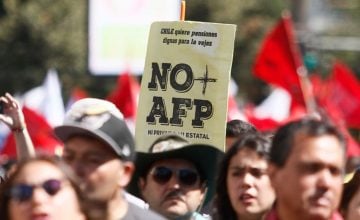
Original article: Las AFP apostaron y los trabajadores pagan la cuenta: casi 360 mil personas afectadas al jubilarse y otras 86 mil pensiones a la baja
While the Pension Fund Administrators (AFP) gambled on falling U.S. interest rates, their strategy resulted in significant losses and a decline in Funds D and E. Consequently, 359,707 individuals currently nearing retirement have been adversely impacted, while 85,996 retirees drawing scheduled pensions will face a recalculation resulting in lower benefits.
These startling figures come from the Superintendency of Pensions, as analyzed by CIPER, illustrating the financial burden workers shoulder due to misguided investment decisions.
The crisis triggered by massive losses from investment mistakes amounting to US$7.7 billion in U.S. interest rate bets has led to an estimated impact exceeding US$11 billion on pension savings. The Fondo E, known as the most conservative fund within the system and comprising nearly 770,000 contributors—over 60,000 of whom are over 60 years old—suffered a real loss of 10.39% from January to September 2026, marking the second-worst performance on record, while Fund D experienced a decline of 6.38% during the same time frame.
Individuals maintaining their savings in Funds D and E bore the brunt of the AFP’s risky financial decisions, which were based on predicted decreases in U.S. interest rates—despite the evident political and economic instability, including the ongoing war led by Donald Trump against Iran. Additionally, the Federal Reserve (FED) has opted to keep interest rates steady until December, further delaying any short-term recovery for these funds.
So, what happened? Between January and September 2026, the Chilean pension system experienced a collapse in profitability among supposedly conservative funds, as they were subjected to risky, unstable, and long-term operations involving financial instruments known as swaps. In simple terms, these are agreements between two parties to exchange payment flows generated by their respective financial positions: one party gives up fixed payments in exchange for variable payments from the other party.
In this type of financial agreement, one party pays a fixed interest rate while receiving a variable rate from the other side, resulting in economic benefit for one and detriment for the other based on market fluctuations. Specifically, the AFP agreed with both domestic and foreign banks to provide a variable rate in exchange for a fixed one, under the expectation that U.S. interest rates would drop below their cost. However, the opposite occurred, forcing pension entities to cover these losses using contributors’ funds.
AFP Bets Lead to Consequences for Workers
The consequences of this gamble were significant. The Fondo E, regarded as the most conservative fund, recorded a real cumulative contraction of -10.39% (-7.39% nominally) after experiencing a monthly decline of -4.92% in real terms in September. Meanwhile, Fund C fell -1.50% in real terms, and Fund D decreased -6.38% in real terms. In terms of assets, the net assets managed by Fund E suffered a reduction of US$4.825 billion from December 2025 to September 2026, decreasing from US$25.527 billion to US$20.701 billion by the end of the third quarter.
This collapse coincided with the presence of a significant number of individuals nearing retirement in the Fund D by June 2026—331,529 contributors, according to the Superintendency’s statistics. Among these, 231,490 were women over 60, and another 66,024 were over 70, all of whom now face delays for fund recovery if they wish to avoid losses. Moreover, there were a total of 28,178 individuals nearing retirement in the Fund E—the hardest hit—who had yet to initiate their pension processes. Of these, 5,057 belong to those over 70, and 20,030 are women, the demographic most impacted by the declining profitability, as detailed by CIPER.
Expert Analysis of AFP Failures
The impact of the crisis varies among contributors based on factors like time spent in diversified funds, balance distribution, and whether withdrawals occurred during the AFPs’ peak losses. Overall, analysts agree on one structural failure: the alternatives intended to be conservative turned out to be the most risky.
This was highlighted by Doctor Roberto Bonifaz from Boston University, who posits that «The E Fund was managed for at least two years with a level of risk distinct from what was communicated to its investors.”
He also noted that with the available information, it is impossible to ascertain if the occurrences were due to deliberate decisions, herd effects, or a lack of long-term vision. Regarding the swapping contracts in Fund E, Bonifaz stated that «data shows that Fund E’s position in swaps grew larger than those in C and D, particularly from 2025, and that no one intervened in time.”
Similarly, Jose Luis Ruiz, the Associate Dean of the Faculty of Economics and Business at the University of Chile, emphasized that the AFP’s legal mandate is to invest in instruments that ensure adequate security and profitability and contends that the error lay in concentrating efforts on maximizing expected returns while neglecting risk control.
“The AFP also failed to manage the risk graduation among the different funds, which should decrease systematically from Fund A (highest risk) to Fund E (lowest risk). It is insufficient to limit variable investment in Fund E to 5% to label it as the least exposed to stock volatility; internal risk management within the fund is essential,” Ruiz told CIPER.
The academic stressed the need to impose limits, stating that «the primary failure was losing sight of the system’s fundamental objective: ensuring the best replacement rate.”
In his view, it is crucial to create conditions for increased investment stability, supported by rigorous and appropriate risk controls by the managers.
Obtén tu Pasaporte y apoya a El Ciudadano
Elimina la publicidad, accede a contenido exclusivo y sé parte de la comunidad.
Cancela en cualquier momento · Sin permanencia
Artículos Relacionados

Crisis Hits Pension Funds: Government of Kast Urges Retirement Postponements Amid Massive Losses
Hace 2 semanas