Original article: Política, arte chileno y la espectacularidad del neofascismo en Chile: Una entrevista a Rodrigo Maureira, «Romau»
«Art is inherently political as it questions established forms of perceiving and experiencing the world» – Jacques Rancière, in «The Distribution of the Sensible.»
For any aware citizen in Chile, it is no secret that Kast’s government rose to power in a manner characterized by improvisation or, as they would describe it, the performance at La Moneda. Today, La Moneda embodies pure fascist spectacle—an overload of headlines devoid of substance—transforming into a true media circus. The first performance 1 of its political spectacle 2 featured the host, our head of state, humorously termed «pichi» by comedian Felipe Avello, inviting friends from «PUC» to an uninspired banquet, a complete disregard for public institutions, and a failure to meet the expectations of their position.
However, let’s not stop at this initial analysis; we must delve deeper beyond this first act, as many more performances remain to be uncovered, setting the stage for a government filled with clowns and a profound ignorance of the public good, aware of its misuse and eventual decline.
Among some of its notable circus acts, we witnessed the magician undersecretary of finance, “Juan P. Rodriguez,” ousted due to a failed drug test. Another standout act was the show titled «Those Who Leave Because They Do Well,» featuring two former ministers who lasted less time in the spotlight than «Pamela Giles» in a political party or ideology.
What were their attributes? One was an ignorant individual lacking communication skills, while another, who had a background as a judge, failed to comply with the law as a report from the Comptroller stated that her actions «do not strictly conform to the powers and responsibilities assigned to the ministerial authority by the legal framework.»
The latest in their ruthless circus acts may also involve poor management during the severe weather affecting our nation. Each region is being battered by nature while the government/circus deliberates whether or not to declare states of emergency, as thousands of compatriots suffer, with some even losing their lives due to such inhumane treatment.
Amidst this overwhelming spectacle engulfing Chilean society, we are left to ponder a crucial question derived from the comedy or tragedy—not of Greek origin—stemming from La Moneda: What place does art hold for the Chilean far-right?
Rather than merely illustrating this question with stark contradictions between fascist ideology and the meaning of art within such an ideology, we can define that, according to philosopher Jorge Guillermo Federico Hegel, when no interpretation is possible for a work, art is dead 3.
Fascism has never promoted art for its own sake; rather, it instrumentalizes it (whether the poor fascist votes or not) for a particular, rather than a universal, end, like the «greater good.»
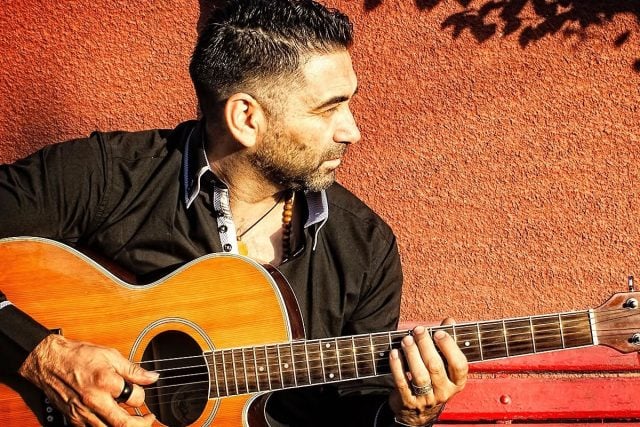
To explore the themes of art, memory, education, and other issues of public interest, El Ciudadano has invited Rodrigo Maureira, a popular Chilean singer-songwriter, music teacher, and winner of the Viña del Mar folklore competition in 2001, to discuss the present state of affairs.
–WOMEN AND POLITICS: What is your view on the role of women in society and politics today?
The social construction of women’s roles is a complex issue; thus, the liberation of women is welcome, as is the recognition of a patriarchy that has negatively affected our companions. This has led to a conflictive social process which is also a struggle for women to balance this issue, as it has never been about inequality compared to men. Therefore, we must stand with our female compatriots, as we are all part of the same human realm where everyone has their roles, and that needs to be clarified.
–ART AND MEMORY: How do you perceive our society concerning art and memory?
This society is reverting to the ’80s, under a military dictatorship with a dictatorial structure, as that is what is being installed, and we must start thinking about that.
In other words, we are the builders of a struggle; we are the voice of a people that needs to express itself. That is why I have told my companions in the neighborhoods—those building their work, dancing, creating theater, writing poetry, painting—that all forms of art must manifest so that we can reconstruct a society that truly represents us all. We should not be told what to say or look at.
This structure is being reestablished in Chile, and it must be stopped once and for all. I believe culture liberates when it comes from the soul and is not controlled or manipulated by those in power. This is evident when a right-wing politician occupies the Ministry of Culture to dismantle everything we have built over the years.
–What role, then, does art play in this context, Mauricio?
Art does not need directives on what to express, because art exists in its essence and speaks where and when it wants. It expresses itself in public spaces, where it must confront ideas, thus, art is not limited (in contrast to this government); instead, the realm of art is fluid. Artists are those who at any moment and instant convey what human consciousness wants to articulate. With fascism, art is dead; it becomes merely an instrument to act, aimed at indoctrination rather than harmony.
–How do you perceive today’s political reality?
There is a growing effect being established today that will take Chile back to the ’80s. In the ’80s, there was a crisis—a crisis of economy, society, and politics—because people could not find jobs and those who thought differently were persecuted. This mirrors our current situation, unfolding slowly and surreptitiously.
Therefore, I believe it is crucial to begin with our essence, understanding who we are, where we came from, and where we stand. I start from memory, from a working-class family, people who emerged in the ’30s or ’40s, with fathers who were shoemakers and people who worked in La Vega—this world, the working-class construction world that aspired to a certain way of life and had hopes in their times that persist even today.
That family, the one we all aspire to have, should enjoy a dignified life with their children and grandchildren, sharing in a home that allows them to celebrate their traditions together, embodies the dignity every human should have. Having shelter, food, education, and health—these are vital needs for human life.
From this perspective, social struggles have expressed everything in their time, playing their roles throughout history, leading to figures committed to social struggles which we currently lack. We seem to be asleep, and I hope that changes soon.
The so-called return to democracy was negotiated, resulting in this neoliberal model, where sadly, every government has maintained an economy that overlooks social issues. No matter how much they try to sell the idea of left-wing factions within the government making coalitions, they ultimately remain neoliberal, defending the very same agenda.
Our comrades died during the dictatorship, fighting against this poorly implemented model, and their memories continue to be disrespected, including those of all the disappeared, politically executed, tortured individuals. We remain caught in the same cycle as when ‘democracy’ began.
–Reflecting on the current and previous government: What are your thoughts on Boric’s administration today?
At times, it feels like Boric’s government is aging well because it seems clear that this administration will continue to perform poorly, making us think we were better off in the past than we will be facing this ongoing catastrophe. We are poised to return to the ’80s; however, that is part of the system’s game, as it continuously reinvents itself, making all of us fall again.
Brother of a Mirista
Considering your Mirista brother, Mario Maureira (a 23-year-old detained by DINA on August 8, 1976, and who has since been part of Chile’s list of forcibly disappeared during the military dictatorship): What is your view of social life today?
Today, social life is ‘easy’ as there is a certain social peace, unlike what my older brother Mario Maureira experienced as a young student who later joined the MIR.
At that time, Mario entered what was the hardest apparatus of the MIR. He had to fight against the dictatorship, confront the fascist apparatus directly, which led to a more cruel fate for him; he was detained, tortured, and disappeared.
His path is not like that of others who had the chance to be recognized and afforded a dignified burial. That pain remains with the family to this day, especially for my mother, a 97-year-old woman who lives daily with an eternal and permanent sorrow that I bear and accompany as a son and brother. Hence, memory and history allow us to grasp better the dehumanization wrought by the far-right, which upholds the dictatorship. Therefore, I believe Kast’s government is an affront to the memory of those of us who have endured the pains and horrors of Pinochet’s military regime and whose allies sadly inhabit La Moneda today.
-What role do you assign to memory sites, especially under a far-right government?
Well, I believe that any monument or instance devoted to memory could become empty if it fails to impact the society we are building.
I view them as essential instances worthy of appreciation because all memory centers, like Villa Grimaldi, José Domingo Cañas, Londres 38, La Venda Sexy, and many more play a significant role in reclaiming our memory and combating the fascism currently present in La Moneda.
What is established today is one of the sickest and most intolerant neoliberal fascist governments returning to democracy. I think it is vital that memory remains present in a democratic society committed to valuing human rights. These memory centers push us not just to ground ourselves in the realities of the time, but also to ensure that this painful chapter in Chile’s history never recurs, though such memory is sometimes fragile; we experienced another social crisis in 2019, albeit on a smaller scale.
-Finally, when will you have a performance so that El Ciudadano’s readers can support you?
We will soon perform at Café Popular located in the Yungay neighborhood on Friday, August 7, at 8:00 PM. During this event, we will showcase the album «Deja la vida volar» (a tribute to Víctor Jara) along with other renditions of Víctor’s work. I believe in this phase of my growth, I never interpret songs exactly as they were originally written; there must always be something in the arrangement because, as an interpreter, I also create. Each arrangement carries your ideas, your perspective, and what you communicate through music, which I consider essential.
That being said, I think our task (as artists, singer-songwriters, composers) is to support each other more and create more spaces for musical reflection to democratize and promote our art. I want to thank all those companions who have their spaces allowing us to showcase our work, to El Ciudadano for this opportunity and for the interview.
Interview by Leonardo Guerrero Campos, Philosopher
NOTES
1 Taking the concept from Marcel Duchamp, and paraphrasing his conceptualization, La Moneda is today the urinal.
2 See: 9.- «In the truly inverted world, the true is a moment of the false» 10.- «The concept of spectacle unifies and explains a broad diversity of apparent phenomena. The diversity and contrasts of these are the appearances of this socially organic appearance, which must recognize its general truth. Considering in its own terms, the spectacle is the affirmation of appearance and the assertion of all human life, that is social life, as mere appearance. Yet, the critique that reaches the truth of the spectacle reveals it as a visible negation of life; a denial of life that has become apparent.» First edition of «La société du spectacle,» Paris, 1967. Editorial Buchet-chastel. «Guy Debord». Ch. I, 9-10. (…) From this quote, we must understand that the political spectacle of the far-right inverts reality, making the true part of falsehood, meaning that it is a government solely sustained by spectacle, with Chile’s mass media promoting such disarray. The recent example was given by Constanza Santa María on channel 13, who stated that the rain wouldn’t stop, regardless of whether or not the military arrives at disaster sites, effectively manipulating public opinion and negating the merits of organizational critique that this fascist government severely lacks during the current natural disaster that has already claimed many compatriots’ lives.
3 See: Lessons on the aesthetics of Georg Wilhelm Friedrich Hegel.
Obtén tu Pasaporte y apoya a El Ciudadano
Elimina la publicidad, accede a contenido exclusivo y sé parte de la comunidad.
Cancela en cualquier momento · Sin permanencia