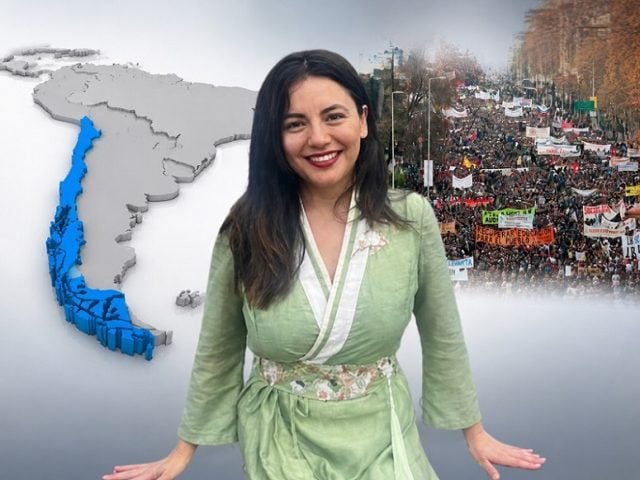
Original article: Veinte años después: de vocera de la Revolución Pingüina a poeta, artista y sinóloga— Entrevista a María Jesús Sanhueza
About María Jesús Sanhueza

María Jesús Sanhueza burst onto the Chilean public stage in 2006 as the youngest spokesperson for the Coordinating Assembly of Secondary Students (ACES), becoming the face of the «Penguin Revolution.» Her figure, characterized by a powerful eloquence and a defiance of established authority, transcended mere student mobilization to embody profound critiques of the neoliberal model and its impact on education, society, and identity. However, her journey extended beyond activism; Sanhueza embarked on a geographic and intellectual odyssey that took her to Europe and Asia, where she studied sinology at the University of Vienna and worked as a curator, researcher, and a renowned international analyst.
This journey has allowed her to develop a unique perspective that integrates an epistemic critique of her youthful activism with deep knowledge of non-Western systems of thought, particularly Chinese, positioning her as one of the few Chilean experts in this field and a clear voice for rethinking the fractures of our time through a transcultural and multidisciplinary lens. Her current practice, which blends art, philosophy, and geopolitics, reflects a vital coherence that continues to question the meaning of community, territory, and spirit.
INTERVIEW WITH MARÍA JESÚS SANHUEZA

The following interview, conducted by El Ciudadano, is not a nostalgic recount of the 2006 student mobilization but rather an intellectual provocation that challenges hegemonic narratives to unearth the layers of meaning that official history has sought to bury.
María Jesús Sanhueza, rather than simply recalling her experience as a spokesperson, offers a radical reinterpretation of the movement, stripping it of the confines of modern Western political theory and situating it within a much older and deeper genealogy: that of territorial cosmologies and pre-colonial systems of knowledge that still resonate in Chile’s territory.
INTERVIEW
1. Why is the traditional reading of 2006 insufficient?
Answer: The Revolution of 2006, like many others, is explained from a singular epistemic framework: that of modern Western political theory, when it itself acts and arises from a fracture of meaning that transcends the modern.
In 2006, there was a questioning of the sense of the model, society, and the subject it produced, from a perspective that transcended the neoliberal system, incorporating notions of a pre-modern community-based model that still exists and is effective within our territory. A model that is not only in the collective imagination but also concretely existing in part of the territory.
Therefore, it is not just the reading of this historical event that is marginalized, but also the reading of our own history, which is older than modern Western political theory and must be reevaluated in light of our own cosmologies. Only in this way can we begin to understand who we are, where we are, and where we are heading, from our relationship with the territory that contains us, its history, and its heritage, rather than from an external perspective that views our land as a tabula rasa.
[ «Neoliberalism is nothing more than the deepening of that colonial model, which does not care about our history, reality, and local needs, but tries to impose a foreign logic on a territory it does not know.» ]
The Penguin Revolution questioned what type of subject, community, and society that mercantilist model generated while simultaneously opposing another: the one that visualizes the school as a community, considering and integrating all its actors and this whole in relation to society.
A construction that has much more to do with how indigenous societies were organized than with the civic subject of modern life. To elucidate this, it is important to understand that there are institutions and political notions in our territory that still operate, but not from the established language, but from resistance, in parallel, without letting themselves be subsumed by the prevailing model. They operate alternatively, although often without awareness of their execution.
Although history is not erased by prevailing narratives, at most it is attempted to be managed, diminished, and contained, as was done with this revolution. But that does not change a more complex reality, which continues to contain all these layers and operates autonomously, beyond official narratives.
What we need to review, therefore, are the epistemic foundations of the framework from which the revolution is analyzed, for that framework carries with it a severed heritage and an attempt to domesticate a historical process that is much more complex than presented as a mere opposition to the model.
What does it mean to say that 2006 was an epistemic and linguistic revolution?
Answer: The Penguin Revolution was an epistemic and linguistic revolution, as it questioned the sense of the model, the language it used, and the violence with which it was imposed. The system wanted to reduce us to being «subjects of consumption,» instead of subjects who are part of a community, and turn education into a commodity, rather than understanding it as a collective process of relationship with knowledge.
[ «When the system wanted to classify us as consumers of that thing called education, we responded with a resounding no.» ]
This dichotomy was one of the main challenges of the revolution and one of the reasons it was so unsettling for the system and brutally repressed: it questioned the foundations of the model and that which seemed to be a tacit agreement that was not to be broken.
It was brought immediately into the spotlight through school takeovers and street protests, parallel to the prevailing model. What was demanded was, at its core, a change of system, from the visionary understanding that this model can offer nothing but the precarization of life, communities, and territories, not even in its best stages.
For this reason, we were not willing to reduce education to that. We felt responsible, even if we were just fifteen years old. We saw ourselves as responsible from another ontology, from our community, from our territory, and from our environment, because we are part of it.
Mapu-Che, people of the land, cannot be conceived as separate from it.
What concept of education, community, and territory emerged in the movement?
Answer: A concept of education that already existed in our territory long before the Chilean state was founded and reproduced foreign models whose aim is to generate cheap labor exclusively in relation to the prevailing economic interests and without any vision of the future, sustainability or community, as the mobilizations denounced.
We spoke of education as an active process of relationship with territory, community, and future, where individuals were not mere passive recipients and reproducers, but active, thinking beings and co-creators of the desirable model of society and its concrete conditions. A community that was not just a consumer actor but that decided the conditions and objectives of this process, which it was part of and co-administered collectively.
[ «The school, with all its ‘actors’, was understood as a thinking, living collective organism in its community nature.» ]
Nothing impossible, moreover, since those structures already exist. They are simply nominal and subordinated to market laws, unable to embody their true functions as co-creators and co-respondents. They were not mere “demands.” There was talk of co-administration and a re-founding, under other paradigms, of what education is, envisioning the community as a valid entity to manage and think about the model by which human beings are formed.
Ultimately, it was about education viewed as an active social process of training and safeguarding knowledge, with a transcendent collective well-being goal, and not as a passive reproducing machinery of consumer actors.
Why do you say that 2006 has more to do with a territorial cosmology, for example, Mapuche, than with Hobbes or Western political theory?
Answer: The most important aspect of the Revolution was the community, its relationship with the territory, and an ontological questioning of the model. None of this fits entirely within the Western theory of struggles of forces and specific economic interests. While it can be analyzed from that perspective, it cannot be reduced solely to it. The questioning of the model arose from an active, thinking, and functioning territorial and community unit. This transcends the model of the individual subject and resonates with our pre-colonial society model and other systems of knowledge.
[ «The most important thing in 2006 was the Territory-Collective-Spirit.» ]
Even if we analyze the way the movement was organized, the representative spokespersons, and direct democracy, we must transcend Western political theory, which might reduce this to an individual democratic model when what was operating was a politically active, thinking collective, from a self-proclaimed and recognized entity as valid by itself.
The failure to analyze the movement from other systems of knowledge and the reduction to a single epistemic framework stems from the fact that the system does not want to recognize these fissures, and much less declare the alternative political forms that still exist in the territory, but do not have official political recognition. Without this perspective, we cannot understand either this revolution or the conjunto of social processes in the country, as all of them reveal this epistemic fracture.
This movement brings its own history of victorious revolutions, such as the anti-colonial struggle, which sees the world differently. That the neoliberal machine and the reigning ideology have forcefully imposed their own perspective when analyzing the revolution does not make it more accurate.
From your sinological training, what allows for a perspective on China regarding the revolution that the West often does not see?
Answer: The multipolar world, and especially a world where China is already recognized as a power, explicitly brings into political debate the existence of other systems of knowledge, political theories, and ways of conceiving and organizing society. It is not that China holds the answer to explaining this revolution, but that it clearly reveals the fracture of meaning of our time and the impossibility of analyzing and understanding the world from a single epistemic framework, as was falsely imposed in the unipolar model. China shows that the world has always been multipolar, and this in an epistemic sense, not just political.
[ «In classical Chinese political theory, for example, revolution (革命, gémìng) can be understood as a change of the Mandate of Heaven (天命, tiānmìng) and not merely as a break produced by the dispute between historical subjects and their respective interests.» ]
This contrasts with Western theories, including Marxism, which have constituted the classic analytical framework for processes of transformation and revolutions. In that sense, the Chinese model allows us to analyze this process from a non-Western epistemic framework, closer to our own systems of knowledge, and see the process itself as a collision of meanings.
The well-known phrase “with Chinese characteristics” is the best example of this, as it recognizes the weight of its own history, language, and knowledge, which cannot be reduced from the outside. Similarly, we could say, playing with this idea: a revolution with Mapuche characteristics, as there is a history of revolutions and territorial, anti-colonial, and multi-epistemic resistance from the Mapuche community.
How does this interpretation connect with current multipolarity?
Answer: In the multipolar world, the fracture revealed by the 2006 Revolution at the local level is shown on a global scale: the world can no longer be explained from a single epistemic framework, nor can political and social movements arising outside the Anglo-European world be reduced to modern Western political theories.
The fracture has not only become evident but is also leading to an accelerated reorganization of the world under local precepts that depart from the framework that modernity sought to impose and the colonizing process that preceded it, through which other models were subjugated.
In this fracture, precepts of modernity that seemed unshakable are being questioned, such as the concept of progress, the individual as the central actor of political life, and the land as a lifeless entity, among many others. Although these elements have yet to be fully reordered and integrated, they reveal the structural impossibility of returning to the previous model, which was one-epistemic.
[ «Today, in terms of multipolarity, the epistemic fracture is global.» ]
As much as neoliberalism tries to deepen its roots in national territory, the insufficiency of a single epistemic framework for inhabiting the world is revealed. In this sense, we must reread the revolution outside the official narrative, including the traditional Marxist reading, which is not wholly different from the dominant Western political theory.
We must rethink and revive 2006 from the experience of anti-colonial struggle, from the fight for the autonomy of our indigenous peoples, and from environmental and feminist struggles. We should not separate these struggles as if they were different dimensions or attempts at administrative correction but understand them as embodiments of the same thing: a way of inhabiting the territory that conceives the land and humanity in a symbiotic relationship, rather than a utilitarian or extractive one.
How does this reinterpretation of 2006 interact with your current practice?
Answer: My current practice condenses many of these dimensions. It arises from the questioning of the supremacy of a single epistemic framework and works at the intersection of different systems of knowledge, even when these cannot harmonize and it is necessary to uphold them in all their tension. A tension that, in turn, reflects the political and epochal fracture elucidated in the revolution and that I inhabit through multiple displacements of languages, territories, and fields of work: from poetry, literature, sinology, art, and philosophy to geopolitics.
[ «My practice is intrinsically or rather violently multi-epistemic.» ]
At the same time, in my practice, language is a political field, just as it was during the revolution when the system sought to totalize the meaning of words such as student, consumer, market, or education. Again, my work continues with linguistic transformation, actively intervening on language and its categories and assuming that its transformations can modify also what can be thought, seen, and organized.
This is clearly reflected in that I do not conceive institutions as the sole producers of knowledge, just as during the revolution, we as students did not see ourselves as passive actors in the educational process. My practice claims the autonomous and non-institutional capacity to produce thought from the intersection and collision between different territories, disciplines, and systems of knowledge, and to do so relationally and situated.
Ultimately, after two decades of work in various areas, languages, and territories, my practice today articulately and conceptually expresses what was politically articulated in 2006. It does so in an extended manner, without limiting itself to a single territory, language, or field. Although it has expanded into other themes and questions, it condenses that multiplicity and complexity, shapes it, materializes it, and above all, preserves its multi-epistemic nature.
Obtén tu Pasaporte y apoya a El Ciudadano
Elimina la publicidad, accede a contenido exclusivo y sé parte de la comunidad.
Cancela en cualquier momento · Sin permanencia