Original article: Embajador de China Niu Qingabo encara el proteccionismo de EEUU y llama a Chile a «resistir» las injerencias externas
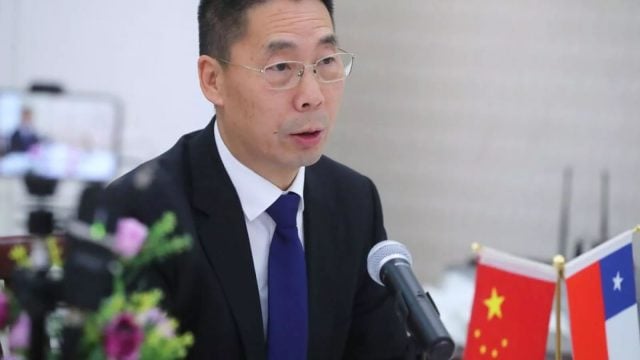
In an unprecedented address, China’s Ambassador to Chile, Niu Qingbao, launched a diplomatic offensive on Wednesday against trade policies that he believes exacerbate de-globalization and protectionism, amid rising tensions in international trade and the United States’ scrutiny of Chinese investments.
His remarks came during the seminar «Chile-China: Looking to the Next Decade,» organized by the Society of Industrial Development (Sofofa) to commemorate the 20th anniversary of the Free Trade Agreement between the two countries. The event featured prominent attendees including the guild’s president, Rosario Navarro; Foreign Minister Francisco Pérez Mackenna; and former president and special mission ambassador, Eduardo Frei Ruiz-Tagle.
Veiled Yet Strong Critique of the US
While refraining from directly naming the United States, the ambassador pointed to countries that use national security arguments to justify restrictive trade measures. «Certain nations, placing their own interests above all else, while ignoring international norms, distort the concept of national security for geopolitical purposes,» Qingbao stated.
According to the ambassador, this environment has systematically led to the use of tariffs, sanctions, and pressure tactics that ultimately disrupt global trade. «They frequently resort to unilateral tariffs and sanctions, as well as coercive diplomacy, showing no regard for sovereignty or the legitimate interests of other nations,» he added.
His remarks were contextualized by the punitive tariffs recently imposed by the United States on its trading partners—including a 12.5% tariff on Chile—and the warnings from Washington regarding Chinese investments in sectors like telecommunications.
The ambassador firmly rebutted criticisms aimed at China regarding its industrial capacity and accusations of creating excessive supply that harms other markets. «China is accused of overcapacity and imposing trade barriers because their own products are no longer competitive enough,» he remarked.
He went further: «Accusations of China’s overcapacity and raising barriers will not solve their own incompetence issues. On the contrary, such practices will only disrupt the global economic and trade order, undermining the security and stability of global industrial and supply chains,» he emphasized.
These comments coincide with a recent commercial investigation initiated by the United States under Section 301 regarding the alleged issue of China’s «overcapacity,» which Beijing has vehemently condemned. China’s Ministry of Commerce has rejected the broad definition put forth by Washington, asserting that the U.S. has no right to unilaterally impose trade restrictions.
Defense of Bilateral Relationship and Call for Vigilance
In his address, Qingbao highlighted the evolution of bilateral trade, which increased from $8.68 billion in 2006 to $62.84 billion last year, more than a sevenfold rise. «China is Chile’s second most important foreign market, significantly contributing to the income of millions of farming families in Chile,» he stated.
He also noted the growth of Chinese investment in the country: by the end of 2024, the stock and flow of Chinese direct investment in Chile was 150 times higher than levels prior to the implementation of the Free Trade Agreement in 2006.
However, it was his concluding call that resonated most strongly in the auditorium: «We must firmly resist and protect ourselves against any external interference, remaining especially vigilant against attempts by third parties to limit or undermine cooperation between China and Chile under any pretext.»
«It is crucial for resisting harassment and defending our dignity, and it is a commendable act that benefits the peoples of both nations,» the ambassador concluded.
Chilean Foreign Minister Supports Relationship with China
Earlier, Foreign Minister Francisco Pérez Mackenna had also spoken at the seminar, emphasizing that during the term of the Free Trade Agreement, a «stable and predictable legal framework has been established that has allowed substantial trade growth and helped consolidate China as our main trading partner.»
The minister highlighted that 120 products from across Chile are exported to China and underscored China’s role in the country’s vehicle electrification: «China has become a key partner in our vehicle electrification process, contributing technologies and buses that now traverse the streets of Santiago.»
Looking to the future, Pérez Mackenna noted that Chile’s foreign policy must be «in service of national interests» and contribute to the welfare of citizens, within the context of «new dynamics in the global supply chain and growing geopolitical tensions that are redefining the international economic landscape.»
A Clear Message Amidst the Trade Storm
Niu Qingbao’s statements come at a particularly tense moment for international trade. The United States has imposed additional tariffs of between 10 and 12.5 percent on imports from 60 economies, including China, measures that have met with strong opposition from Beijing and several of Washington’s allies.
In response, China has enacted export restrictions on drones to the United States and imposed anti-dumping tariffs on products such as Mexican and American pecans.
In this climate of increasing trade confrontation, the Chinese ambassador made his stance clear: «I am critical of unilateral tariffs and coercive diplomacy, regardless of where they come from.» He warned that «if policies change overnight without consultation or agreement with other partners, business activity will be significantly hampered.»
With this discourse, China not only defends its development model and its trade relationship with Chile but also sends a clear message to Washington: protectionism and unilateral measures have no place in a world that, according to Beijing, needs more free trade and less interference.
El Ciudadano
Obtén tu Pasaporte y apoya a El Ciudadano
Elimina la publicidad, accede a contenido exclusivo y sé parte de la comunidad.
Cancela en cualquier momento · Sin permanencia