Original article: ¿Por qué leer a Marta Brunet hoy? A propósito de la reedición de «Aguas abajo»
By Osvaldo Carvajal M., Director of Community Engagement at the Faculty of Education and Humanities, U. Andrés Bello
In 1943, upon returning to Chile, Marta Brunet was no longer the young provincial woman who had arrived from Chillán two decades earlier. She had spent four years as a Consul in Argentina and mingled in the highest intellectual circles; she had just published in Sur, the continent’s leading magazine, directed by the indomitable Victoria Ocampo.
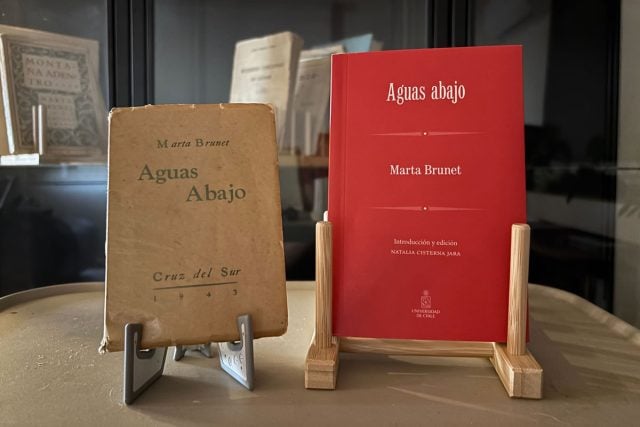
With this aura, she re-released Aguas abajo, the book recently reissued by U. de Chile, which depicts, in just 120 pages (available for free in virtual format), the violence experienced by various women of her era through scenes that remain alarmingly relevant.
The launch of the reissue, held on August 12 at the Central House, featured two key academics involved in reinterpreting Brunet, dismantling her reputation as merely a chronicler of the Chilean countryside.
Natalia Cisterna (UCH), responsible for the first two volumes of the critical edition of her complete works and the prologue writer for this new edition, highlights the pioneering nature of Brunet’s representation of rural women.
Rather than merely serving as a backdrop for criollismo, Brunet imbues these women with psychological depth and a critical perspective on their social standing, transforming them into symbols of modernity.
This is significant. In a twentieth century captivated by new technologies—electricity, trams, radio—Latin American literature typically assigned that role to the male characters arriving from the capital with progressive ideas. A prime example is Santos Luzardo, the handsome youth who arrives at the estate of El Miedo with the intent to «tame» Doña Bárbara (and yes, this reference holds whether you have read the novel or seen the television series, we do not discriminate here).
Brunet does the opposite. In “Piedra callada”, an elderly woman who has spent her life operating the mill introduces a sewing machine into the homestead where a brutish husband isolates and mistreats his wife, daughter, and grandchildren.
In “Soledad de la sangre”, a young woman dragged by her miserly husband to a dismal hamlet transforms her domestic space with another machine: a record player that transports her back to the days when she was happy.
It is women who bring modernity to the countryside.
Lorena Amaro (PUC), author of the most comprehensive panoramic study on Brunet, asserts even more boldly: here lie some of the author’s best stories, and one could even consider one of them the best Chilean tale. Just like that.
In “Piedra callada”, Amaro particularly notes Brunet’s narrative brilliance: the composition of scenes, dialogues, and silences in which nothing is random, and every element prepares the reader for what is to come.
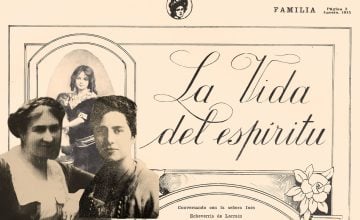
And what about my contribution to the conversation? We discussed archives and images and documents that help reconstruct a Brunet quite different from the one bequeathed to us by the canon. In recent years, I have attempted to recover her political and human dimension from that material. Because her journey, infantilized by the canon through her famous Cuentos para Marisol (1938), was deeply political.
Her consulship was not handed to her: she earned it after years of public service. She was part of the Journalists’ Institute, directed Amigos del Arte, served on the board of the SECH, and was active in the AICH, an antifascist organization often associated with Neruda, but among its founders was Brunet as well.
It is also no coincidence that she published Aguas abajo under Cruz del Sur, a publishing house founded by three Spanish intellectual exiles fleeing Francoism: Arturo Soria, Mauricio Amster, and José Ricardo Morales. Their project produced small, convenient, and affordable books.
The acknowledgment even reaches the colophon: Brunet specifically thanks those who made the edition possible, including “Dña. Eliana Vásquez Valdés, proofreader, for her effort to enhance the prestige of Chilean typography.”
Alondra Carrillo, hosting the gathering on behalf of the University, then steered the conversation towards the present. At a time when certain hard-won rights seem under threat once again, she posed a critical question: What can we learn from Brunet’s aesthetic and creative project, from her political commitment, that we can apply to navigate this uncertain present?
I believe this reissue attempts to offer an answer. Biblioteca Esencial resurrects Aguas abajo as a brief, accessible book that can be read on a bus, the subway, or in any little moment space allows in contemporary life. Sound familiar?
Eighty years ago, Brunet had already ventured a small, portable book to address issues of abortions, marital rape, and suicidal ideation stemming from male violence, even before these concepts were defined.
Reading Aguas abajo today is to receive a warning from 1943: history does not progress in a straight line, and what we thought was behind us can always resurface.
Osvaldo Carvajal M.
Obtén tu Pasaporte y apoya a El Ciudadano
Elimina la publicidad, accede a contenido exclusivo y sé parte de la comunidad.
Cancela en cualquier momento · Sin permanencia