Original article: Puerto de Mokha en manos de la resistencia: Ansar Allah golpea la logística del imperialismo en el Mar Rojo
After nearly nine days of intense fighting, Yemeni resistance forces successfully captured Mokha, located on the country’s western coast, forcing internationally recognized government troops and their Saudi sponsors to retreat. For major Western media, this development is summarized with the term «Houthis.» However, for millions across the Arab and Muslim world, as well as those opposing imperialism, this refers to Ansar Allah, a movement that has persevered through foreign aggression, a criminal blockade, and a global campaign of delegitimization.
Chronicle of a Forewarned Offensive: How Mokha was Captured in Nine Days
The Mokha Operation was not a surprise strike or an impromptu skirmish. It was a meticulously planned, synchronized, and strategically executed offensive by Ansar Allah and the Yemeni Army, dismantling one of the most critical positions held by the Saudi-backed government along the western coast within just nine days.
September 3: The Initial Strike
The offensive began on September 3, 2026, with ground movements originating from Hays, a critical junction within Hodeida province, and al-Khawkhah, a coastal hub approximately fifty kilometers north of Mokha. The first tactical objective was to cut the main road between Taiz—the government’s stronghold in the mountains—and Mokha, thereby isolating the coastal garrison from its primary supply routes. The maneuver was rapid: Ansar Allah forces advanced down the coastal strip without encountering the expected resistance, as local defenses had been weakened by internal factors, including the expulsion of southern allies and desertion of tribes that had previously fought against the Houthis.
September 8: Distraction and Saturation
By September 8, the offensive had entered its second phase. As ground columns approached Mokha, Ansar Allah launched a series of missile and drone attacks against Saudi border facilities, aiming to distract the coalition led by Riyadh and saturate its air defense systems. On the same day, over 25 missiles struck Mokha and its port, completely paralyzing port activity and forcing government forces to retreat to defensive positions within the city. The bombardments not only destroyed infrastructure but also curtailed the garrison’s resupply capabilities.

September 9: The Coordinated Assault
On September 9, Ansar Allah transitioned to the decisive phase: a coordinated campaign by land and sea. On land, forces advanced from Hays and al-Khawkhah toward Mokha, securing positions at Jabal al-Nar and the Khalid military base, two of the most vital defensive points in the area. By sea, they launched an amphibious assault with speedboats carrying fighters toward Zuqar Island in the Red Sea, located about 80 kilometers northwest of Mokha, as well as the Hanish archipelago further south. This dual movement—land and maritime—completely overwhelmed the coastal defenses of the government, which lacked the capacity to respond to a simultaneous attack on multiple fronts.
September 10: The Fall
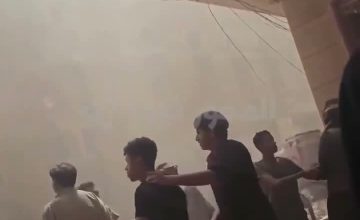
The night of September 9 to 10 witnessed intensified fighting within Mokha. Eyewitnesses reported that Ansar Allah fighters entered the city after fierce clashes with pro-government forces, creating scenes of panic among the civilian population. “The takeover happened without warning. The panic spread throughout the area, forcing people to flee amid distressing scenes of wounded individuals lying in the streets with no one to help them,” a resident told BBC Arabic. The government forces, significantly outnumbered and facing severe ammunition shortages, retreated south to the Dhubab district, about 46 kilometers from Mokha, leaving the city entirely in the control of Ansar Allah by the evening of September 10.

The commander of the National Resistance Forces, Tarek Salah, confirmed the retreat and admitted that his troops had paid «a very high price» in recent days. Ansar Allah forces entered the city chanting slogans such as «Death to America, death to Israel,» a gesture that was not merely propaganda: it affirmed that the operation held political significance beyond territorial control.
Aftermath of the Operation
In addition to capturing the city and its port, Ansar Allah seized a significant stockpile of weaponry and armored vehicles abandoned by retreating forces, including at least one U.S.-made Oshkosh M-ATV. In just nine days, this offensive had redrawn the military landscape of the Yemeni western coast: Ansar Allah transitioned from controlling scattered positions to dominating nearly the entire Red Sea coastline, from Hodeida to the doors of Bab al-Mandeb.

The UN Special Envoy Hans Grundberg confirmed before the Security Council that Ansar Allah had «gained control of Mokha,» granting them «direct presence at the entrances to one of the world’s most vital straits.» What Grundberg described as a threat to «freedom of navigation» is perceived from an anti-imperialist perspective as the consolidation of a strategic position that undermines Western control over one of the main arteries for global trade.
The Mokha operation was not a lucky ambush. It showcased that the Yemeni resistance has developed operational capability, force coordination, and strategic planning to contest control over vital points in the Red Sea. Furthermore, it was accomplished at a human cost that the Western bloc hardly mentions: over 11,400 homes have been displaced since the start of the offensive, according to humanitarian data cited by the UN.
A Defeat for the Saudi-American Axis
Since 2015, Saudi Arabia and the United Arab Emirates, with logistical support, intelligence, and weaponry from the United States and the United Kingdom, have led a coalition that bombarded Yemen, turning it into the world’s worst humanitarian crisis. This intervention was not a spontaneous “civil war”: it has been a proxy war of imperialism aimed at controlling the southern flank of the Arabian Peninsula, securing energy routes, and neutralizing any sovereign projects.
Mokha is no ordinary port; it is a gateway for fuel, goods, and military supplies. Its capture by Ansar Allah disrupts one of the few corridors that the Saudi coalition used to sustain its forces on the western coast. Practically, this represents a strategic defeat for Riyadh and its Western masters.
Bab al-Mandeb: The Knot of Imperial Trade
Located only 80 kilometers from the Bab al-Mandeb Strait, Mokha enables the Yemeni resistance to directly influence one of the world’s most important trade arteries. Approximately 12% of global oil and goods transit through this passage. For decades, Western powers treated this strait as their own, protected by aircraft carriers and military bases.
Today, that logic is crumbling. Ansar Allah’s presence in Mokha not only threatens the freedom of navigation for vessels linked to Israel and its allies but also demonstrates that the Global South can contest ownership of its resources and routes. The U.S. and U.K.-led operation «Prosperity Guardian,» intended to secure the Red Sea, has failed to impose a unilateral order. Every attack on an Israeli vessel or a coalition ship is perceived in the region not as “terrorism,” but as a legitimate response to Western complicity in the genocide in Gaza.
Palestine and the Resistance Axis
Understanding Mokha necessitates recognizing its connection to Gaza. Ansar Allah has explicitly linked its campaign in the Red Sea to solidarity with the Palestinian people. While Arab governments normalize relations with Israel and remain silent in the face of ethnic cleansing, the Yemeni resistance has shattered that silence with action. The capture of Mokha strengthens that front and sends a message to the entire resistance axis: the fight against Zionism and imperialism is not exclusive to Palestine, Lebanon, or Iran; it is also fought at sea.
Indeed, Iran supports Ansar Allah, but reducing the Yemenis to “puppets of Tehran” repeats the colonial racism that denies agency to peoples. The Yemeni resistance has its own roots, project, and legitimacy earned on the battlefields and through civil resistance against the blockade.
Implications for the Region
- Weakening of the Saudi-Emirati Axis. The capture of Mokha exposes the fragility of Gulf regimes, which have spent billions on Western weaponry without being able to subdue the resistance.
- A Crisis for Imperial Trade. Control over or pressure on Bab al-Mandeb raises maritime transport costs, challenges Western insurers, and compels Washington to divert resources from other fronts.
- Isolation of Israel. The Yemeni resistance consolidates a maritime front against the Zionist state as the international community continues to tolerate genocide in Gaza.
- Opportunity for Sovereign Peace. The port’s capture could facilitate the entry of humanitarian aid without the filtering of the Saudi coalition, although the Western naval blockade remains the primary obstacle.
- An Example for the Global South. Yemen, a bombarded and impoverished country, demonstrates that it is possible to resist imperialism when there is political will and popular support.
El Ciudadano
Obtén tu Pasaporte y apoya a El Ciudadano
Elimina la publicidad, accede a contenido exclusivo y sé parte de la comunidad.
Cancela en cualquier momento · Sin permanencia