Original article: «Ningún merci ni ningún bonjour, aquí tú me hablas español»: La polémica patriótica entre Iris y Amanda Labarca
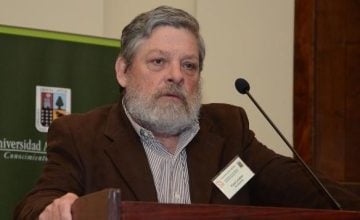
By Osvaldo Carvajal M., Director of Outreach, Employability, and Alumni at the Faculty of Education and Humanities at Andrés Bello University.
Taking advantage of the national holidays, today I bring you a controversy surrounding national identity between two prominent figures. As multiple researchers have shown, the women’s movement in Chile was not a «We Are the World» scenario where everyone was in agreement: there were differences, as in any political space, some quite profound. So, without further ado, let the litigants enter!
We are talking about women significant enough that the canon grants both a similar title: depending on where you look, Inés “Iris” Echeverría Bello —a pioneering Chilean writer— as well as Amanda Labarca Hubertson —an educator and women’s rights activist— appear as the first female academic in Chile. As always, the confusion can be explained through historical records.
In October 1922, Iris was named an Academic Member of the Faculty of Philosophy and Humanities at the University of Chile, becoming the first woman to receive that distinction. Just a month later, Labarca became the country’s first female university lecturer at the same institution.
In other words, both were referred to as “the first academic,” but in different senses: Iris received an honorary title for her accomplishments, while Labarca stepped into the classroom to teach. This reflects a notable difference in their respective backgrounds.
When asked in 1917 about how the Ladies’ Club was formed, the aristocratic Iris recalled that a middle class she wasn’t aware of suddenly appeared, comprising perfectly educated women with professional and pedagogical degrees.
Indeed, Amanda Pinto Sepúlveda —that’s her name— came from those threatening middle sectors, first being educated at the Isabel Le Brun High School and then as a Spanish teacher at the Pedagogical Institute.
This was indeed her name. Labarca Hubertson were her married surnames, taken from her husband, Guillermo. National History Prize winner 2026, Ana María Stuven, interprets this adoption as a symbolic break from parents who did not support her ambitions and forced her to marry at 19, under the threat of disinheritance or being sent to a convent.
Fortunately, the marriage was a happy one: they supported each other and, funded by the State, traveled together to the United States, which became a key experience. There, Labarca encountered reading clubs that she would replicate upon returning to Chile through the magazine Familia.
As a spin-off from her section “The Hour of Books,” she proposed forming a Reading Circle: “A dreamlike pause of spiritual communion amidst everyday difficulties,” where women from both elite and middle-class backgrounds could coexist, just like those whom Iris had found so alarming.
One of those women, Delie Rouge, recounts in My Memoirs as a Writer that during the inaugural meeting, the first round between Labarca and Echeverría would unfold.
While the organizer was giving her opening speech, Iris was animatedly chatting with Delia Matte. When another attendee pointed out that she hadn’t heard anything, she ironically replied, “I didn’t hear; I wasn’t wearing my glasses. What did she say?” Labarca, writes Rouge, “with the patience of an educator,” repeated her speech. A point for Iris.
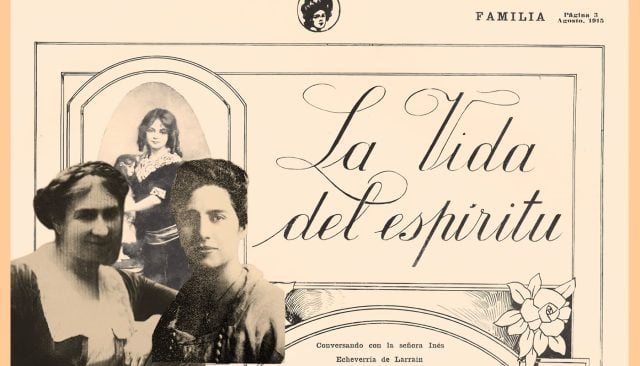
The second round is indeed recorded. In August 1915, Familia published “The Life of the Spirit,” an interview by Labarca with Iris. The first question seemed innocent: why, being Chilean and the great-granddaughter of Andrés Bello, had she written Entre deux mondes in French? “Because it is the language of my art; because I think and feel in French,” Iris responds, explaining that from a young age, this language had shielded her writing and her privacy from mockery.
Labarca —a Spanish teacher— insists, “And what about our language?” Iris replies that for her, it is “the language of the cook, of the provider, of the household bills” and of those who “mock her” (she says it literally).
Labarca cannot tolerate this: every writer, she tells her, “has the obligation to cultivate their language because it is part of the soul of the race.” Iris asserts that she also does not feel affinity with “her race.” The interviewer then resorts to the old dependable: “And does the Homeland not speak to your artistic conscience or to your soul as a Chilean?” Brace yourselves…
“What is the Homeland? Who can define it?” Iris retorts. And she concludes by stating that she loves Europe more than America because there she finds a freer and more refined life.
Labarca explodes: “I do not share your theories in any way,” arguing that in Chile, everything is more difficult because not enough love is demonstrated for the country to make the necessary sacrifices. The bell sounds: this moment of tension is interrupted by Rebeca, Iris’s daughter, about whom we will speak another day…
Thus, seizing upon the «soothing caress» of her introduction, Labarca closes by addressing the young woman instead of her indomitable interviewee, in a manner that reflects the tremendous admiration, despite their differences, that these giants had for one another: “Remember that your mother has worked, struggled, and suffered so that you can experience the comforts of a life we did not know.” Case closed.
Osvaldo Carvajal M.
Obtén tu Pasaporte y apoya a El Ciudadano
Elimina la publicidad, accede a contenido exclusivo y sé parte de la comunidad.
Cancela en cualquier momento · Sin permanencia