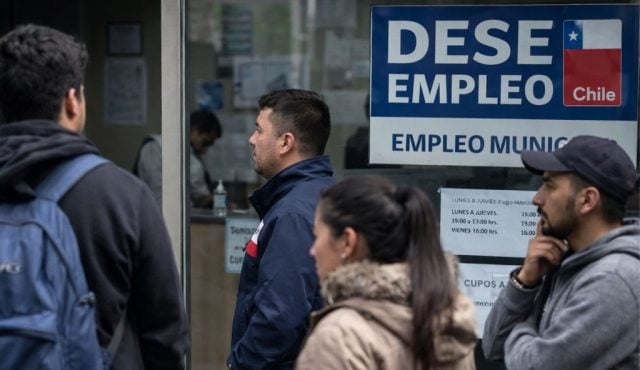
Original article: Chile marca su mayor desempleo en más de cinco años: tasa llega a 9,6% y personas desocupadas aumentan 13%
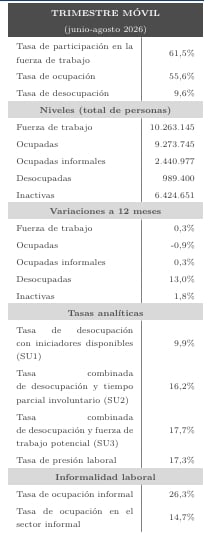
9.6% marks the unemployment rate in Chile for the period of June to August 2026 (JA 2026), a figure that represents the highest level in more than five years, according to the National Employment Survey (ENE) from the National Institute of Statistics (INE).
The agency noted that «this figure saw an increase of 1.0 percentage points over the past year, due to a rise in the workforce (0.3%) and a decline in employed individuals (-0.9%).» Concurrently, the number of unemployed individuals rose by 13.0%, driven by layoffs (12.1%) and first-time job seekers (23.2%).
The latest indicator also surpassed the 9.5% recorded in the April-June 2021 quarter, based on statistics from the INE.
According to the survey, the participation and employment rates were at 61.5% and 55.6%, reflecting declines of 0.3 percentage points and 0.9 percentage points, respectively.
Additionally, the population outside the labor force increased by 1.8%, influenced by both habitually inactive individuals (1.6%) and those potentially active (3.4%). This trend reveals a dual pressure on the labor market: less available employment and more individuals exiting or remaining outside the job search.
Unemployment and the Gender Gap
Among women, the unemployment rate reached 10.3%, up 1.0 percentage points over the past year. The female workforce saw a rise of 1.3%, compared to just 0.2% for employed women, while the unemployed women increased by 12.2%, influenced by layoffs (12.8%) and first-time job seekers (6.2%). Female participation rate stood at 53.0%, a slight increase of 0.2 percentage points, while the employment rate was 47.6%, reflecting a decline of 0.3 percentage points.
Furthermore, women outside the workforce grew by 0.3%, primarily affected by those who are considered inactive but potentially active.
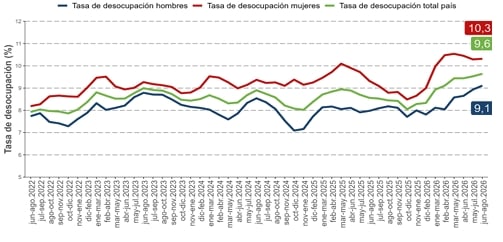
For men, the unemployment rate was lower at 9.1%, showing an increase of 1.1 percentage points over the year. The male workforce decreased by 0.5%, less than the drop of 1.7% recorded among the employed. The number of unemployed men increased by 13.7%, driven by layoffs (11.4%) and first-time job seekers (46.9%). The male participation and employment rates were 70.3% and 63.9%, with declines of 1.0 percentage points and 1.7 percentage points.
The number of men outside the labor force rose by 4.3%, mainly due to both habitual and potentially active individuals.
Reduction in Employed Individuals
Over the past twelve months, the total number of employed individuals decreased by 0.9%, exclusively due to a decline among men (-1.7%), while women saw an increase of 0.2%.
By economic sector, the contraction was mainly influenced by the manufacturing industry (-7.6%), information and communications (-16.8%), and trade (-1.1%). In terms of occupational category, declines were noted among formal wage earners (-2.9%) and unpaid family workers (-4.0%).
In detail, the loss was influenced by information and communications (-25.1%), manufacturing (-10.3%), and health activities (-6.0%), in addition to drops in formal wage earners (-5.5%) and informal wage earners (-1.3%). Hence, the labor deterioration is not only national but also significantly impacts the primary metropolitan area of the country.
The informal employment rate stood at 26.3%, with an increase of 0.3 percentage points over the year. For women and men, the rates were 28.3% and 24.8%, with changes of 0.5 percentage points and 0.1 percentage points, respectively. The number of informally employed individuals increased by 0.3%, solely due to a rise among women (2.0%), while men experienced a decline of 1.2%. By sector, this growth was mainly attributed to transportation (8.6%) and administrative and support services (10.2%); notable rises in occupational categories included domestic service personnel (14.6%) and private sector wage earners (1.1%).
The seasonally adjusted unemployment rate reached 9.4%, reflecting an increase of 0.1 percentage points compared to the previous quarter. This change is explained by the no variation in the labor force, resulting from a rise in unemployed individuals (0.8%) and a decrease in employed individuals (-0.1%). Meanwhile, the work volume, calculated based on effective hours worked, fell by 2.4%, and the average hours worked declined by 1.6%, down to 36.4 hours. By gender, men averaged 38.6 hours, while women averaged 33.5 hours.
Unemployment Rate in the Metropolitan Region
In the Metropolitan Region, the unemployment rate for the June-August 2026 period hit 9.8%, an increase of 0.9 percentage points over the past year. The employed population fell by 1.0%, exceeding the reduction of the labor force (-0.1%).
By economic sector, the decrease in this indicator was influenced by information and communications (-25.1%), manufacturing (-10.3%), and health activities (-6.0%), as well as by the categories of formal wage earners (-5.5%) and informal wage earners (-1.3%).
Featured image: News Outlook.
Obtén tu Pasaporte y apoya a El Ciudadano
Elimina la publicidad, accede a contenido exclusivo y sé parte de la comunidad.
Cancela en cualquier momento · Sin permanencia