Original article: «Lo premió la crítica literaria chilena: ¡qué buena!» Redolés y su merecido Premio Jorge Teillier 2026
By Osvaldo Carvajal M., Academic of Letters and Director of Community Engagement – Faculty of Education and Humanities U. Andrés Bello
Mauricio Redolés has just been awarded the 2026 Jorge Teillier National Poetry Prize. The announcement carries a sense of justice, as the artist has been an integral part of Chilean culture for half a century. Yet, it remains essential to highlight a fundamental truth: before he was a musician, rocker, chronicler, humorist, or countercultural figure, Redolés was—and continues to be—a poet.
His early works emerged before his music albums. Poema Homenaje a los caballos muertos en las cien mil batallas más importantes de la historia de los caballos was published in London in 1980; Poemas Urgentes followed in 1982; Notas para una contribución a un estudio materialista sobre los hermosos y horripilantes destellos de la (cabrona) tensa calma appeared in Budapest in 1983; and Chilean Speech / Shilean Espich, once again in London, came out in 1986.
In 1983, a perceptive Soledad Bianchi included fifteen of his poems in Entre la lluvia y el arcoíris, a crucial anthology for understanding Chilean poetry written in exile. Then came his music career, which introduced a kind of paradox.
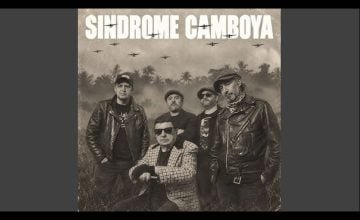
The poet took the stage, blending his verses with rock, cueca, bolero, punk, radio theater, the voices from the neighborhood, and audience reactions from below. As Redolés became more recognizable to his tribe, he seemed increasingly distanced from the realm of poetry.
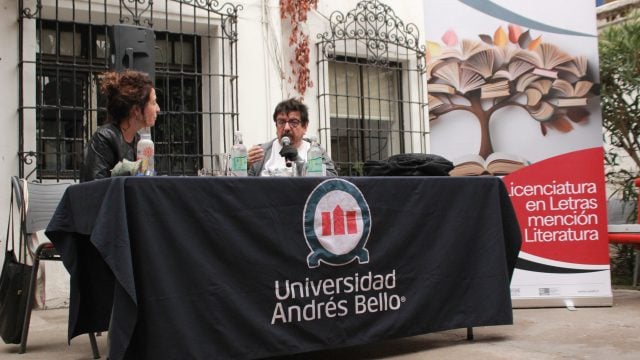
After our director Jorge Cáceres invited him for Writer’s Day and Professor Fernanda Moraga interviewed him at the Creative Campus radio studio in 2025, we decided this year from the Letters program at Universidad Andrés Bello to nominate him for the Jorge Teillier Award.
I had the task of preparing that nomination, and while organizing books, anthologies, articles, theses, awards, and readings, something intriguing happened: it wasn’t necessary to construct a poetic trajectory for Redolés to fit the award criteria; instead, we needed to clear away everything else to reveal it.
A similar effort was made with my colleague Nicolas Román in the dossier «Contracultura, memoria y política. Mauricio Redolés: 50 años de rock y poesía», published this year in Revista de Humanidades.
There, six investigations revisited his work through the lenses of memory, autobiography, punk culture, humor, historical experience, and intermediality.
My presentation began with this peculiarity: how could someone so present in Chilean culture have received such minimal sustained attention from literary studies? The answer might have been in plain sight.
Redolés has been a challenge to analyze as his work never intended to remain confined to a single space. In Estar de la poesía o el estilo de mis matemáticas, for example, foreign voices, autobiography, everyday speech, humor, memory, and orality emerge. The poem is not just written; it also resonates.
Yanko González recognized this years ago when he interpreted that poetics as a friction with the literate city and an overly narrow conception of what poetry could be.
As 2026 began, multiple pieces started to come together. Facsimile editions of Notas para una contribución a un estudio materialista sobre los hermosos y horripilantes destellos de la (cabrona) tensa calma and Chilean Speech / Shilean Espich, two exile publications that had seen almost no circulation in Chile for decades, were re-released.
The dossier emerged, through which the academic community began to address an unfair neglect of his work. Redolés was invited back to universities and events to discuss not only music but also poetry. Now, he receives the Jorge Teillier Award.
I don’t believe a prize can rectify half a century of literary history. Nor do I think Redolés needed a medal to prove he was a poet. However, the award does compel us to revisit his work.
In doing so, something becomes evident that perhaps we delayed too long in acknowledging: the very uniqueness of his project was what complicated his entry into the literary field. Orality has always been part of the poem. Music did not come later as mere decoration. Humor did not undermine the gravity of memory. The neighborhood, prison, exile, the dead, jokes, curses, and the voices of others could also be integral to a poetics.
This is why Redolés fit so well with the Teillier criteria. The award seeks original, recognizable, and relevant work for Chilean poetry, connected to historical memory and social justice. In his case, these facets were never needed to be rhetorically constructed for the application; they have always been present in the work.
In “¿Quién mató a Gaete?”, Redolés stated that it was the Chilean literary criticism that killed Gaete. This time, something different happened to him: he was honored by Chilean literary critics. How wonderful…
Osvaldo Carvajal M.
Obtén tu Pasaporte y apoya a El Ciudadano
Elimina la publicidad, accede a contenido exclusivo y sé parte de la comunidad.
Cancela en cualquier momento · Sin permanencia
Artículos Relacionados
"Lo premió la crítica literaria chilena: ¡qué buena!" Redolés y su merecido Premio Jorge Teillier 2026
Hace 41 segundos