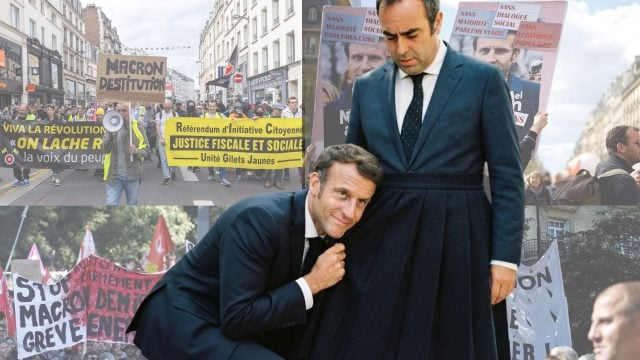
Original article: Macron se esconde tras las faldas de Lecornu: la estrategia para frenar su impopularidad
As the streets of France erupt once more due to rising living costs and social discontent, the Élysée Palace has chosen a low-profile maneuver. Macron’s strategy to hide behind Lecornu’s shadow becomes evident in this context.
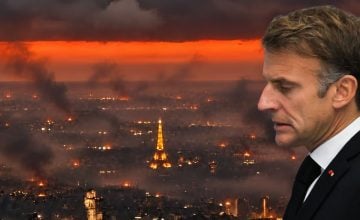
According to the Ipsos BVA-Cesi Survey (for La Tribune Dimanche), published on October 11, only 15% of the French population views Macron favorably, a decrease of one point from the previous month. This translates to a staggering 82% disapproval of his administration.
The Ifop-Fiducial Barometer (for Paris Match and Sud Radio), published on October 20, reports his popularity at just 25% positive opinions, marking a dramatic drop of 8 points within a month. In a ranking of 50 political figures, Macron ranks 49, with a 75% unfavorable opinion and a net balance of -50 points.
Indeed, Macron has been taking refuge behind Lecornu, seeking to deflect discontent away from the real culprits and maintain his grip on a France experiencing social upheaval that transcends its borders.
The Modus Operandi: Command and Disappear
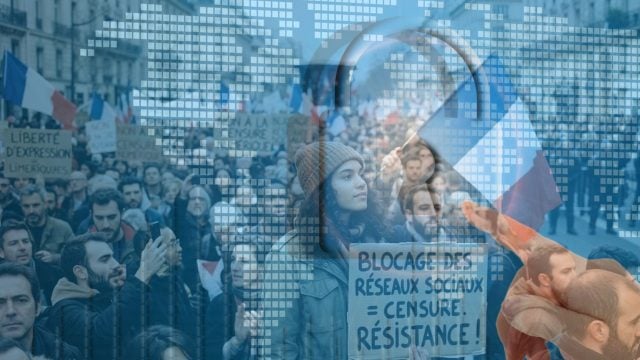
The order to prepare for the blockade of social networks such as TikTok, Instagram, Snapchat, and X does not bear Emmanuel Macron’s signature, but rather that of his Prime Minister, Sébastien Lecornu. This decision, revealed by the independent media outlet Blast, is not merely an administrative formality; it signifies a calculated political strategy: a president, nearing the twilight of his mandate, uses his head of government as a lightning rod for deeply unpopular and legally controversial measures.
This mechanism is recurrent. When the Constitutional Council censored in August the law prohibiting social media use for minors under 15, Macron did not take the stage to acknowledge the setback. Instead, as reported by the AFP agency, the president «reminded that he asked Prime Minister Sébastien Lecornu to find a ‘workaround'» to save his flagship reform. Similarly, BFMTV detailed that Macron «tasked Sébastien Lecornu» with drafting a new legally robust text.
This pattern is now repeating with the emergency blockade. Lecornu is the one who signs the letter, meets with operators, and ultimately faces the technical failures. Telephone companies have already expressed their «reservations» and inability to execute such a massive shutdown in so little time, a burden that directly falls on the Prime Minister. Meanwhile, Macron remains in the background, preserving the image of a president steering strategic direction without getting his hands dirty with a censorship implementation that borders on undermining the rule of law.
To this, we add the heavy repression that the French people have faced in their legitimate right to social protest, leaving the responsibility to the Minister of the Interior.
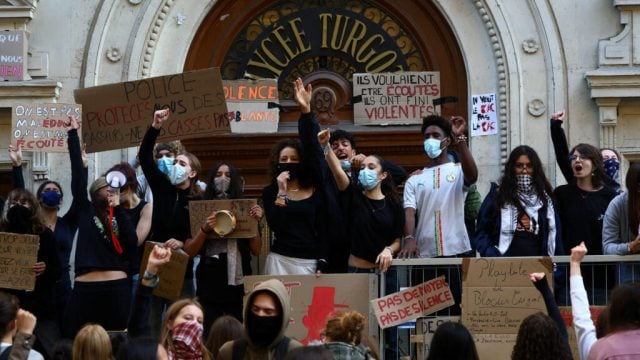
«On October 24, a million people mobilized in France despite the army being on the streets and the legal repression being very active, despite the injured, despite the dead, and especially the prohibition of demonstrating,» reports El Ciudadano from the Gallic country. «Without the prohibition, 2 million people or more would have come out,» they point out.
«Media and far-right political class, including Macronists, are attempting to blame radicalized youth for all the ills,» they explain.
The Purpose: A Legacy at Stake and Freedom in Jeopardy
This concealment serves a dual purpose. On one hand lies the obsession with legacy. Macron, aware that his time at the Élysée is running out, has turned social network regulation into a «battle horse» of his second term. He needs his reform to pass before he departs but cannot afford the political cost of appearing as the direct promoter of a blockade that infringes upon freedom of expression during a wave of protests.
On the other hand, there’s the calculation of unpopularity. The blockade of social networks does not enjoy broad social support. The opposition has labeled the move as «liberty-killing.» MP Nicolas Dupont-Aignan was particularly explicit on social media, stating that Macron is «so hostile to your freedom of expression that he immediately asked Sébastien Lecornu to revise the text to enforce this prohibition.» By delegating to Lecornu, Macron attempts to depersonalize the measure, presenting it as a technical public order decision rather than an ideological whim of the president.
Lecornu: The Perfect Lightning Rod
Sébastien Lecornu is not just any Prime Minister. His appointment was already a maneuver to overcome a political blockade, and his current role appears to be that of a crisis manager who bears the costs of the Élysée’s hardest decisions. By keeping him at the forefront, Macron achieves a dual objective: on one hand, if the measure succeeds, credit will go to the presidential strategy; on the other, if it fails spectacularly — as happened with the TikTok blockade in New Caledonia, overturned by the judiciary — the political and media responsibility will fall solely on the Prime Minister.
At a time when social tension is at its peak and trust in the executive crumbles, Emmanuel Macron has decided that his best defense is not to take the lead but to hide behind Lecornu’s figure and shadow.
El Ciudadano
Obtén tu Pasaporte y apoya a El Ciudadano
Elimina la publicidad, accede a contenido exclusivo y sé parte de la comunidad.
Cancela en cualquier momento · Sin permanencia