
Original article: El relato del «Chile Despega» de Kast se cae a pedazos: desempleo sube al 9,8% y supera el 10% en la RM
The narrative of “Chile Despega”, which supports the economic program driven by the government of José Antonio Kast, with a budget of $1.3 trillion and the goal of creating more than 100,000 jobs between 2026 and 2027, is falling apart: the unemployment rate rose again, reaching 9.8% for the July-September 2026 quarter, according to data released Thursday by the National Institute of Statistics (INE).
According to the data provided by the National Employment Survey (ENE), this figure represents an increase of 1.3 percentage points (pp.) over the past year, due to a weakening in the labor market’s capacity to absorb workers, where a 0.3% rise in the labor force contrasted with a 1.1% decrease in the number of employed individuals.
Thus, unemployment has reached its highest level since May 2021, when it was recorded at 10.00%.
Despite the “Chile Despega” program aiming to accelerate job creation through public investment and fast-tracked projects, direct hiring, and facilitating financing for businesses, the July-September 2026 period saw the unemployment figure surpass one million in the country, totaling 1,007,976 unemployed individuals, according to INE data.
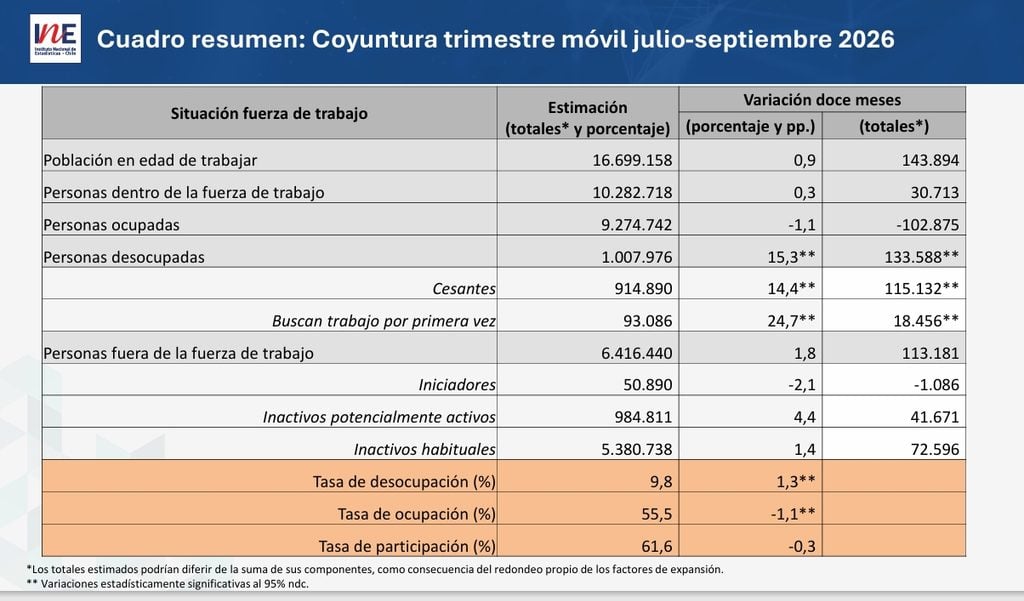
According to the ENE, the number of unemployed individuals increased by 15.3%, driven mainly by those who are laid off (14.4%) and those looking for work for the first time (24.7%).
Decline in Employed Individuals
At the same time, the employment rate declined by 1.1 percentage points to 55.5%, while labor force participation fell by 0.3 points, reaching 61.6%.
Both the participation and employment rates recorded rates of 61.6% and 55.5%, representing decreases of 0.3 pp. and 1.1 pp. respectively; meanwhile, the population outside the labor force increased by 1.8%, influenced by habitual inactive individuals (1.4%) and potentially active individuals (4.4%).
Over the past year, the estimate for the total number of employed individuals dropped by 1.1%, affecting both men (-1.9%) and women (-0.1%), significantly impacting the country’s productive structure. Nationally, the largest declines in total employment population were concentrated in the sectors of information and communications (-20.8%), financial services and insurance (-14.1%), and manufacturing industry (-8.1%).
By occupational category, declines were noted in formal salaried individuals (-2.5%) and employers (-2.8%).
The informal employment rate stood at 26.4%, experiencing an increase of 0.2 pp. over the year.
According to the INE study, the most significant job losses in informal employment were recorded in the service sectors (-10.8%) and commerce (-6.0%), which were negatively absorbed by the category of self-employed individuals (-1.9%) and private salaried workers (-0.6%).
Meanwhile, informally employed individuals decreased by 0.3%, affected solely by men (-0.8%), as women increased (0.3%). By economic sector, the decline was primarily due to commerce (-6.0%) and other service activities (-10.8%); while, by occupational category, it was attributed to self-employed individuals (-1.9%) and private salaried employees (-0.6%).
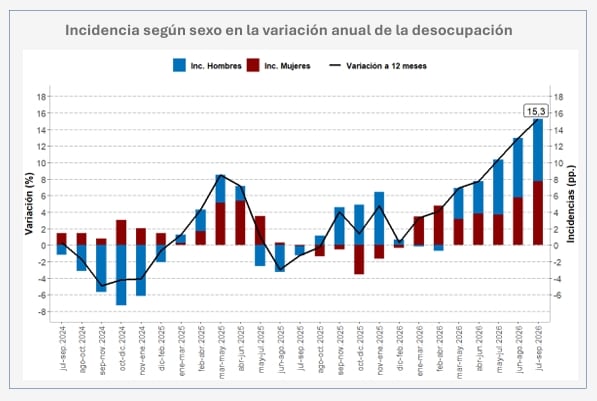
Unemployment and Gender Gap
Analyzing performance by gender, the report from the National Employment Survey (ENE) revealed an asymmetric impact on both groups. Among women, unemployment rose to 10.5% —an increase of 1.4 percentage points— driven by a rise in the female labor force (1.4%) against a slight decrease in employed women (-0.1%), which led to a 16.7% increase in the number of unemployed women (with a 19.6% gap for those looking for work for the first time).
Meanwhile, the male unemployment rate reached 9.3% (+1.2 percentage points), amidst a structural decline where the labor force contracted (-0.6%) but the number of employed men fell even more sharply (-1.9%), raising the number of unemployed men by 1.40%.
Unemployment in RM Exceeds 10%
The slowdown in activity is particularly evident in the Metropolitan Region (RM), where the unemployment rate surpassed the double digits, standing at 10.4%. Specifically, unemployment escalated by 1.6 percentage points year-over-year, with a contraction in the number of employed individuals (-1.3%) that was unable to absorb the growth in the regional labor force (0.5%).
According to the INE, job losses in the RM are attributed to systematic declines in sectors such as information and communications (-29.0%), financial activities and insurance (-15.7%), and manufacturing industry (-10.6%). Additionally, occupational categories of formal salaried individuals (-4.5%) and informal salaried individuals (-1.3%) also saw declines.
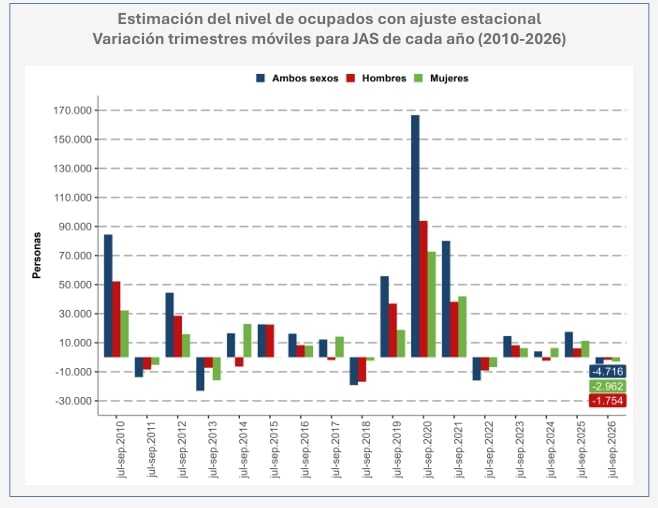
Seasonality and Working Hours
According to the ENE, the work volume experienced a widespread contraction, reflected in a 2.2% drop in the total effective hours worked. The weekly average of hours worked decreased by 1.1%, settling at 36.0 hours overall, with a gender gap placing men’s work hours at 38.1 hours and women’s at 33.2 hours.
Furthermore, when applying the seasonal adjustment to isolate non-economic temporary factors, the seasonally adjusted unemployment rate reached 9.6% (+0.2 pp compared to the previous moving quarter), due to the growth of the labor force (0.2%), which resulted from the increase in unemployed individuals (2.3%) and the decrease in employed individuals (-0.1%).
Obtén tu Pasaporte y apoya a El Ciudadano
Elimina la publicidad, accede a contenido exclusivo y sé parte de la comunidad.
Cancela en cualquier momento · Sin permanencia
Artículos Relacionados

Chile Experiences Highest Unemployment Rate in Over Five Years: 9.6% Increase in Jobless Rate
Hace 4 semanas