Original article: 5 víctimas siguen desaparecidas: Silva respaldó rebajas a exagentes de la CNI condenados por cinco secuestros y ahora atribuye sus firmas al criterio de Rabat
While five victims of Augusto Pinochet’s dictatorship remain missing, Deputy Justice Minister Luis Silva has endorsed sentence reductions for two former agents of the National Intelligence Agency (CNI) convicted of five kidnappings, attributing his signature on the decrees granting these benefits to the administrative criteria employed by Minister Fernando Rabat.
Silva defended the reduced sentences for ex-agents Patricio Leónidas González Cortez and Heraldo Velozo Gallegos before the Santiago Court of Appeals, despite the Justice Ministry having previously denied their requests through decrees issued on September 24, 2025, during the administration of former President Gabriel Boric.
The CNI ex-agents sought judicial recourse, but their appeals were dismissed, and the Supreme Court upheld the decision on December 2 of the same year.
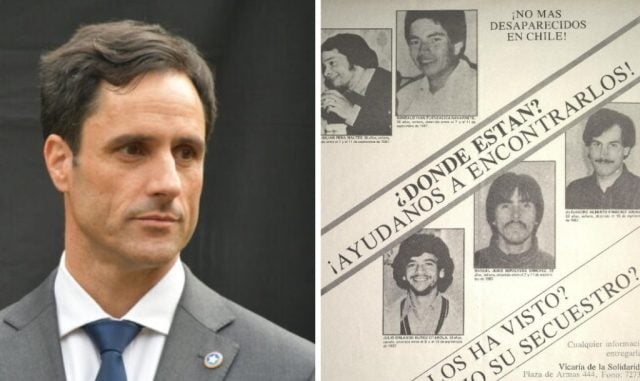
González and Velozo were convicted for their roles in the qualified kidnappings of five members of the Manuel Rodríguez Patriotic Front (FPMR): Julián Peña Maltés, Alejandro Pinochet Arenas, Manuel Sepúlveda Sánchez, Gonzalo Fuenzalida Navarrete, and Julio Muñoz Otáro.
According to reports, during events that occurred in September 1987, the victims were thrown into the sea off Quintay; their remains have never been recovered and are considered the last disappeared detainees of the Pinochet regime.
Following José Antonio Kast’s election as President, Deputy Minister Silva sent two reports to the President of the Santiago Court of Appeals, Marisol Rojas Moya, indicating that the sentence reductions were appropriate, arguing that both convicted individuals met the requirements established by Law 19,856 and that there were no grounds to deny them the benefits.
«This Subsecretariat believes that the requested sentence reduction should have been granted,” he indicated in both documents, as reported by Bio Bío Chile.
In Patricio González Cortez’s case, the convict sought a 19-month reduction in 2025 due to good behavior in Colina 1. However, then-Minister of Justice, Jaime Gajardo, rejected the request, arguing that the CNI ex-agent did not cooperate in clarifying the crimes, per the criteria of the Rome Statute.
Conversely, Deputy Minister Silva chose to support the petition of the former dictatorship agent, stating that “the severity of the crime, the nature of the legal interest affected, or the consideration of the penalty imposed do not constitute independent grounds for exclusion from the benefit.”
Had the requested reduction been applied, González would have completed his sentence in September 2025.
Silva Attributes Signature on Sentence Reduction Decrees to Rabat’s Criteria
Deputy Minister Silva has defended the signature of the controversial decrees that granted benefits to the convicted, arguing that the Ministry of Justice does not have discretionary powers to deny a reduction when legal requirements are met.
To justify the ministry’s overall change in criteria, he cited Supreme Court rulings from 2014, which are different from the highest court’s ruling in 2025 that rejected the requests of the CNI ex-agents, Patricio González Cortez and Heraldo Velozo Gallegos.
In his defense, Silva attributed his signatures to Minister Fernando Rabat’s decision to modify the administrative criteria of the Justice Ministry to align with the jurisprudence upheld by the Second Chamber of the Supreme Court for years regarding the non-retroactivity of criminal laws.
Unlike his predecessor, Jaime Gajardo, who opted to deny sentence reduction requests for the convicted, Rabat decided to grant those requests that, according to prevailing judicial interpretation, met the legal requirements.
In a video shared on social media, the deputy minister stated that neither Minister Fernando Rabat nor he intended for “any of those criminals to be released from prison a single day before serving their sentence” and emphasized that “granting the reduction is not a personal decision of the minister or me.”
In line with the state secretary, he noted that there is a procedure involving four different entities: the Chilean Gendarmerie, a commission comprised of professionals and judges led by a Court of Appeals minister, the Regional Ministerial Secretariat of the Ministry of Justice, and the ministry itself.
«In response to each of these and during the process, it is always possible to resort to the Courts of Justice,” he said, highlighting that “each of these entities has its own functions established by law and the Ministry of Justice itself must act in accordance with the law.”
According to Silva, after taking office, they rejected sentence reductions and he indicated that he personally signed several, but noted that “the Supreme Court issued rulings that forced them to reverse the decision.”
In agreement with Rabat, he argued that “the basis for the obligation from the Supreme Court was that the ministry was illegally depriving a person of their freedom.”
«And the decisions of the courts must be complied with,” he emphasized.
He also mentioned, like the state secretary, that during the Boric administration, when “ministers rejected sentence reductions, they were compelled by the courts to reverse that decision.”
He indicated that in this context, Minister Rabat “decided to adjust the legal criteria for resolving sentence reductions going forward.”
“And why does my signature appear? The minister of Justice is the one who should sign, but when the minister of Justice is unavailable, the deputy substitutes; and when the deputy, substituting the minister of Justice, signs, he does so applying the criteria established by the minister himself, and that was what I did,” he asserted to defend the controversial sentence reductions.
Obtén tu Pasaporte y apoya a El Ciudadano
Elimina la publicidad, accede a contenido exclusivo y sé parte de la comunidad.
Cancela en cualquier momento · Sin permanencia