Original article: Norma Lumínica: Una luz para cuidar y buscar vida
By Bárbara Rojas-Ayala, academic at the Institute of Advanced Research (IAI) of the University of Tarapacá and collaborator with the Cielos de Chile Foundation
As of October 19, Chile has implemented the Lighting Standard, which restricts blue light and promotes warm lighting that is directed downward and turned off when not needed.
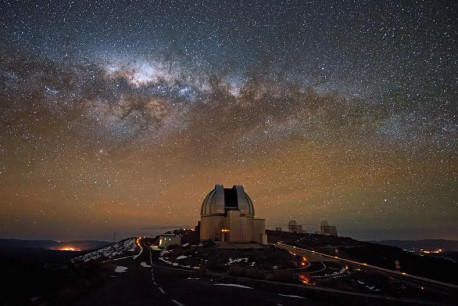
There are compelling reasons for this: to protect biodiversity, safeguard human health, and preserve the dark skies of the northern region of the country.
Blueish-white light disperses more in the atmosphere, disrupts circadian rhythms, confuses insects and birds, and increases sky glow, obscuring the faint signals that astronomical observatories need to capture.
The light chosen for Chile’s streets resembles the color of the stars around which we search for life in the universe. Red dwarfs are the most common type of stars in the galaxy, and around them, we can more easily find rocky planets in the habitable zone where liquid water might exist.
Consequently, most of the potentially habitable worlds we will be able to study in detail over the coming decades orbit these types of stars. Studying them requires observing the light from the star filtered through the planet’s atmosphere and looking for traces of gases like oxygen, methane, or water vapor.
This effort requires giant telescopes, highly sensitive spectrographs, and truly dark nights. Chile hosts a significant portion of this global capacity. All of this depends on an increasingly scarce resource: the darkness of the sky.
As we search for life on other worlds, we wonder how life adapts to the light of its star, and Earth has already provided an answer. Life here has evolved over billions of years under a cycle of day and night, becoming attuned to it: circadian rhythms, melatonin, migrations, and night pollination.
Our own eyes are part of that evolution: they respond logarithmically to light and adapt to darkness, allowing us to discern shapes and contrasts—even reading under the light of a full moon. Excessive and poorly directed lighting wastes that ability.
Thus, the fear that warmer light signifies less safety often stems from a flawed assumption: what matters is how we illuminate, rather than how much or what color.
When properly directed, uniform, and of the right intensity, warm light enables better vision, not worse. We are the only species capable of deciding how to illuminate the night; doing so intelligently is a responsibility we should not evade.
While an LED fixture is not a stellar photosphere, the similarity in color helps illustrate an essential point: protecting the night in Chile conserves the health of marine swallows, the sleep of urban residents, and our ability to explore other worlds.
Perhaps that is the strongest argument in favor of the standard. It is not only sound environmental and health policy; it is also a condition for us, from this side of the world, to continue asking one of the oldest questions that exists: is there life out there? To answer that, we must first care for our own life and our darkness.
Bárbara Rojas-Ayala
Obtén tu Pasaporte y apoya a El Ciudadano
Elimina la publicidad, accede a contenido exclusivo y sé parte de la comunidad.
Cancela en cualquier momento · Sin permanencia