Original article: El día que Jeannette Jara fue destacada entre las 10 latinoamericanas más influyentes, según agencia francesa
The Day France 24 Highlighted Jeannette Jara: A Glimpse of Her Presidential Future
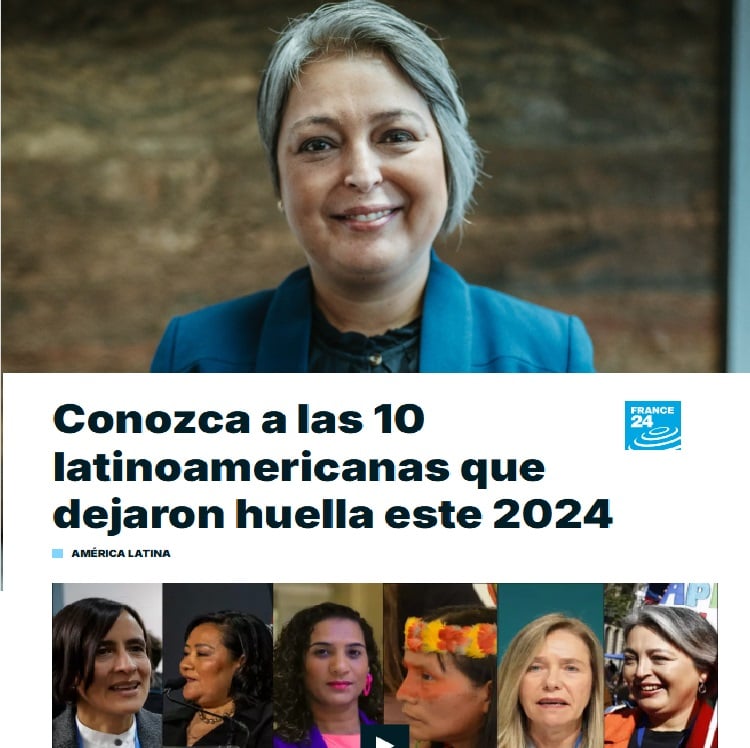
At the end of 2024, the international channel France 24 honored ten women whose leadership has made a significant impact in Latin America. Among the honorees was Chile’s then Minister of Labor, Jeannette Jara, recognized for her tireless advocacy of labor rights with a clear gender perspective. The outlet highlighted her efforts in reducing work hours and her fight to close the substantial pension gap that primarily affects women, establishing her as a pivotal political figure in the region.
Read more / «I don’t believe in the impossible»: Jeannette Jara officially launched her second-round campaign in Pedro Aguirre Cerda
The France 24 list was topped by Claudia Sheinbaum, who made history as the first female president of Mexico. The report emphasized her dedication to women’s rights and the working class from the National Palace. Other remarkable leaders included Brazil’s Anielle Franco, Minister of Racial Equality; Colombia’s Susana Muhamad, key figure at COP16; and Celeste Saulo, the first woman to lead the World Meteorological Organization.
Watch the France 24 report (video)
Jeannette Jara’s profile, shaped by her ministerial career, portrayed her as an official dedicated to prioritizing women’s rights in a pension system that, in her own words, left them in a «dramatically low» situation. This vision resonated in the international report and seems to have foreshadowed her political ascent, propelling her from the ministerial cabinet to the presidential candidacy she is currently contesting in the runoff election.
At that time, as Minister of Labor, regarding the pension reform being promoted, she told France 24: «It focuses on women because our pensions are a third of what men’s pensions represent. We have a pension gap of about 68 to 70%, meaning a woman earns 30 pesos while a man receives 100 pesos in pension. Both are low, but women’s pensions are dramatically low,» Jara stated.
Jeannette Jara’s Pension Reform Recognized by the OECD
The Organisation for Economic Co-operation and Development (OECD), in its annual report “Pensions at a Glance 2025”, highlighted Chile’s pension reform for significantly improving pensions for older women, narrowing the gender gap, and increasing the replacement rate. The recent report noted that key elements of this system modernization—approved in January—include raising mandatory contributions, creating redistributive components, and increasing the Universal Guaranteed Pension (PGU).
As a direct result of these measures, Chile rose significantly in the OECD rankings, moving from 34th place in 2021 to 19th in 2025. The improvements are attributed to changes benefiting current retirees, especially those with low incomes and women, alongside a gradual increase in employer contributions, which will rise from the current 1.5% to 8.5% by 2034, enhancing future pensions. The report forecasts that this will bring the Chilean system closer to the OECD average.
The report also places this progress within the context of Chile’s rapidly aging population, estimating a 23% decrease in the working-age population over the next four decades, compared to an average of 13% in the OECD. Among the specific benefits set to be paid between 2025 and 2026 is a compensation for annuities for women due to their longer life expectancy, a measure that previously did not exist, which will improve the net replacement rate to up to 61%.
Additionally, the reform introduces substantial improvements in access to the PGU. Starting in September 2025, individuals aged 82 and older will receive a PGU of 250,000 pesos (approximately $260). Subsequently, 18 months after the law is published, the access age will lower to 75, and eventually to 65, expanding coverage for older adults receiving inadequate pensions.
Jeannette Jara: «Changes are Achieved Through Actions, Not Speeches»
Jeannette Jara, the former Minister of Labor who oversaw the approval of this reform and is now a presidential candidate, stated on her social media: «This Friday, I want to reaffirm something very important with you: In Chile, changes are achieved through actions, not speeches (…) And I say this with authority, because I have been where things really happen.”
She added: “As deputy secretary during President Bachelet’s government, I advocated concrete policies that improved the lives of millions: Chile Grows with You, the PGU, and a pension reform recognized by the OECD. And as minister, I did it again: the 40-hour workweek, the highest minimum wage in history, and a serious pension reform.”
Jara further remarked: “I know how to make things work. I know when to hurry, when to correct, and most importantly, when to change what isn’t working. I don’t act alone, but I don’t wait for orders: I decide with responsibility, experience, and consideration for the families of Chile.”
Relacionados

El día que Jeannette Jara fue destacada entre las 10 latinoamericanas más influyentes, según agencia francesa
Hace 3 meses
2025 Elections: Initial Overseas Results Show Jeannette Jara Leading in Multiple Countries
Hace 3 meses