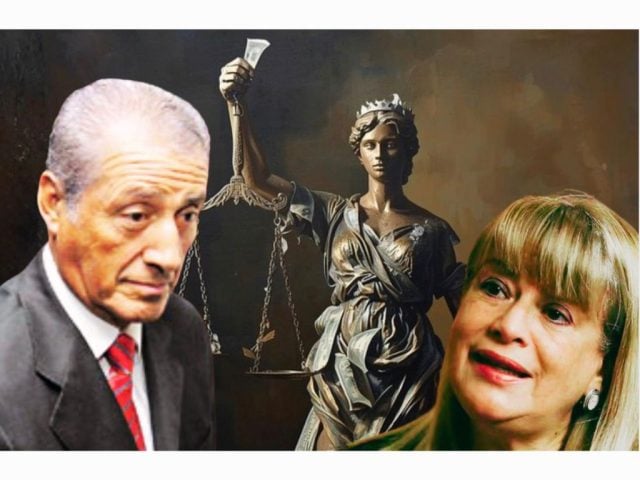
Original article: La red de influencias de Ángela Vivanco y sus recurrentes fallos a favor de SQM y la familia Ponce Pinochet
Ángela Vivanco: Unraveling the Influence Network and Controversial Rulings Favoring SQM and the Ponce Pinochet Family
One of the largest corruption networks in history: the «Muñeca Bielorrusa» scandal continues to generate discussion, staying true to its name. The former Minister of the Supreme Court, Ángela Vivanco, is at the center of significant economic scandals linked to the “tax forgiveness” granted by the national regulatory body to SQM, which could result in substantial losses for the state treasury.
The initial fines of 1,700,000 UF imposed in 2014 by the Superintendence of Securities and Insurance (now known as the Financial Market Commission) against SQM and Julio Ponce Lerou, among others, were related to the so-called “Cascada Case”. This was due to a series of infractions and a «recurring pattern of buying and selling shares, indicating a coordinated scheme of operations».
However, in a striking turn of events, in 2019 the Supreme Court decided to reduce this fine to just 75,000 UF, marking a 95% decrease from the original penalty but still maintaining a significantly lower financial consequence.
As a result, Mauricio Daza, a lawyer known for being a claimant in the Penta case, spoke with El Ciudadano and explained, «Both Julio Ponce Lerou and his executives managed to obtain this substantial reduction through rulings involving Ángela Vivanco. It is concerning that a series of operations that allowed Ponce Lerou to illegally gain over 120 million dollars in profits ended with a significantly lower sanction.»
The serious rulings involving the lawyer nominated by Sebastián Piñera could indicate -according to economist Carlos Smith– “potential losses of state wealth, since Codelco’s profits go directly to the public treasury, provided it is proven that there were improper transfers. There is a cost in utilities, funds that could have been well utilized but were not.
The ruling delivered by the Supreme Court was reached with a complex 3-2 vote, where Vivanco’s vote became the decisive factor in favor of the lithium company. This judicial reduction was the first of many favorable rulings by Ángela Vivanco for the company led by the Ponce Pinochet family, establishing a precedent that would recur in subsequent years.
Vivanco Claims to Have a Clear Conscience
The Ciudadano reached out to Vivanco’s defense team, who declined to respond to the ongoing investigation involving the former minister.
Nevertheless, in an interview with Bío Bío Chile, Vivanco stated that “she is leading a normal life” despite being investigated for bribery, kickbacks, and money laundering.
Furthermore, the relationships of the former minister with the national body were constantly scrutinized for potential conflicts of interest, particularly with the “Audios Case”, after conversations between Vivanco and lawyer Luis Hermosilla surfaced. It was from 2018 onward that Ángela Vivanco’s influence network started functioning increasingly.
The favors that Luis Hermosilla asked directly, whether through written communication or phone calls, became increasingly common within the judicial system, without any effort to conceal the continuous corruption attempts by the well-known lawyer, which could be related to regulatory decisions and her controversial rulings in favor of the company run by Francisca Ponce Pinochet.
This prompted Socialist Senator Gastón Saavedra to call for authorities to take action: “It is urgent to investigate all potential acts of corruption that may have occurred. Society can no longer tolerate corruption within the judicial system, and we, as public officials, should not remain in the shadows. We need more transparency; therefore, investigations are entirely necessary and urgent.”
“The fine imposed on SQM by the Supreme Court and Ángela Vivanco is ridiculous considering the factual circumstances and the initial sum indicated. Clearly, there is a situation that is at the very least suspicious, therefore the state must protect the financial and moral assets of the nation; these matters cannot be sustained by public institutions without a pronouncement and simultaneously investigate why the fine was reduced for SQM. The financial penalty should correspond to the moral damage inflicted upon the country,” he added.
“Muñeca Bielorrusa” and Vivanco’s Interventions
To be more precise, the «Muñeca Bielorrusa» plot and its connection to the actions performed by Ángela Vivanco escalate to the judicial conflict between the state mining company Codelco and the Bielorussian consortium Belaz-Movitec (CBM). Codelco accused the company of not complying with the established work progress, thus requesting guarantees totaling 17 billion pesos.
We must go back to July 4, 2023, when once again the Supreme Court and Ángela Vivanco spearheaded a favorable ruling for the Chilean-Bielorussian consortium CBM in litigation with Codelco – and thus beneficial for SQM as well. On that same day, according to information revealed by Reportea, Vivanco received 15,000 dollars in cash from lawyer Mario Vargas.
A year later, the Supreme Court unanimously agreed to the removal of Minister Ángela Vivanco due to «misconduct in the exercise of her duties (…), affecting principles of independence, impartiality, integrity, and transparency.”
Ultimately, in 2025 the Public Prosecutor’s Office revealed that Ángela Vivanco and her partner, Gonzalo Migueles, had received massive sums of money—at least 57 million pesos from the Bielorussian consortium CBM, which resulted in the detention of Migueles and the lawyers Mario Vargas and Eduardo Lagos, representatives of the Belaz-Movitec (CBM) consortium.
Vivanco’s Influence Networks and SQM
Ángela Vivanco’s network of contacts that presumably allowed her to organize a corruption scheme included lawyer Luis Hermosilla, her partner Gonzalo Migueles, as well as the aforementioned individuals: Mario Vargas and Eduardo Lagos. This is not merely a series of coincidences in an isolated case; it represents a systematic failure that favored a select few through corruption and power.
In this regard, the primary victims were the state, experiencing a significant economic loss, creating a structural void, and weakening the credibility of the judiciary. The former minister managed to articulate—with the help of similar powers—a relentless network of corruption aided by continual favors from major economic groups. Furthermore, the regional prosecutor of Los Lagos, Carmen Gloria Wittwer, stated that “those sponsoring the Bielorussian consortium were close friends of her (Vivanco), and she also had a financial interest in how the trial would turn out. If Codelco was forced to pay, Vivanco would receive a portion.«
The damage to the state is monumental; thus, the case of Ángela Vivanco has not left anyone indifferent, posing a constant problem for the judiciary and its credibility. Marcelo Trivelli, a political analyst and former governor of the Metropolitan Region, indicated that “The institutional harm is gigantic. It has been demonstrated in the eyes of the public that there are two justice systems in Chile: one for ordinary people and another for the powerful, obtained through bribery and influence peddling.
“The accusations are credible, both from those who have testified in the investigations and from the evidence that has appeared in the media. When one apple rots, it may appear to have only one blemish on the outside, but inside it is entirely rotten. This could be the case for Angela Vivanco, and therefore the investigation must reach the ultimate consequences, and the Supreme Court must assume an ethical leadership it has lacked in recent times,” emphasized Trivelli.
On another note, El Ciudadano contacted Deputy Víctor Pino, who stated that “an investigative commission should be opened to analyze all questionable rulings (…). I find the suspicion surrounding former Minister Vivanco serious, especially regarding this massive reduction granted to SQM in one of her rulings. Therefore, I believe it would be wise to investigate all her controversial decisions from August 2018 until her last day as a Supreme Court minister.”
“The State Defense Council should be working to recover the financial damage caused. These individuals must not remain unpunished, nor should those who instigated these irregularities,” he added.
Another of the controversial rulings issued by Ángela Vivanco and the judiciary relates to Julio Ponce Lerou: This involved a reduction for the scheme of stock operations that reportedly negatively affected other investments, including those of pension fund administrators.
Initially, the imposed fine was 65 billion pesos; however, following the Supreme Court’s intervention, this was reduced to 2.8 billion.
Vivanco’s Latest Ruling Favoring SQM
The Third Chamber of the Supreme Court continued to be embroiled in controversy when in 2023 it rejected a petition against Roberto Guzmán Lyon, a key figure in the Cascadas Case and lawyer for Julio Ponce Lerou. Once again, a historic annulment was made concerning the payment of fines; in this case, the initial sum was set at 3.1 billion pesos, while it was ultimately decided that Guzmán Lyon would not pay any of this amount.
Of course, one of the votes in favor of denying the fine for the former executive came from then-Supreme Court Minister Ángela Vivanco.
Despite ongoing demands from criminal lawyers for Guzmán Lyon to face a deep investigation, the ruling confirmed that the lawyer would incur no fines. Therefore, experts indicate a loss of state assets resulting in uncertainty within the judiciary, which continues to have repercussions to this day.
Returning to the topic of Vivanco and SQM, there is still no clear resolution regarding the events of 2019, even as the main developments point towards potential kickbacks to reduce the fine. Investigations remain active to ascertain with greater precision a corruption method aligning the Supreme Court minister and the aforementioned company controlled by the Ponce Pinochet clan.
Legal expert Mauricio Daza critically remarked to El Ciudadano that “Vivanco is being accused of receiving bribes in exchange for benefiting individuals with cases that must be resolved in the Supreme Court chamber she was part of. The hypothesis that her favorable rulings for Julio Ponce Lerou may have stemmed from illicit actions is compelling.
The conjecture Daza presents is not far-fetched, considering the extensive record and the diversity of favorable rulings for both Julio Ponce Lerou and SQM.
“I hope that the Public Ministry conducts a thorough investigation into the rulings that seem most implausible, especially those benefiting people publicly identified as possible corruption agents in our country, such as Julio Ponce Lerou and SQM,” Daza continued.
Similarly, former prosecutor and lawyer Pedro Orthuhsteguy emphasized that “honestly, I am shocked by what is occurring in the Supreme Court. For any lawyer who has sworn an oath before the highest court, it was unthinkable for there to be a corruption case at the highest levels of the judiciary. This raises questions from how ministers are appointed to whether there’s a need for ongoing financial auditing of ministers and their families. Nothing can be ruled out, as if corruption exists in the judiciary, the rule of law comes to an end.”
“Regardless of the fact that the investigation is reserved for parties not involved in the procedure, through the various leaks to the media, it is possible to assume that there exists a corruption network operating for quite some time that could have influenced various cases. Especially notable is the SQM case regarding the reduction of fines and the annulment resources in criminal matters linked to the Cascadas Case also associated with SQM. The network seems to be larger than what is known today. All these court suspicions must be thoroughly investigated and all public doubts clarified with maximum transparency,” clarified Orthuhsteguy.
From a similar perspective, Carlos Smith commented to El Ciudadano that “considering potential external influences, trust is lost, which has associated costs for investment, and poses challenges for future private investors. Chile has made significant efforts over time to be viewed as a responsible country with low levels of corruption. Corruption will be difficult to eradicate, but it must be minimized to prevent such occurrences.”
In fact, El Ciudadano reached out to the Supreme Court to inquire about the progress of the investigations, and the highest court explained that “in the resolution regarding the removal docket are the justifications and reasons of the Supreme Court concerning the charges against Ángela Vivanco.”
They also stated that all relevant information has already been published in official media and will not reiterate further statements from the jurisdictional body, emphasizing potential consequences arising from ongoing criminal investigations that prevent any type of pronouncement.
What Penalties Could Ángela Vivanco Face?
As the Prosecutor’s Office investigates the Supreme Court rulings issued by Ángela Vivanco in depth, a serious criminal sanction can be estimated for the former minister if her guilt is established regarding the accusations of bribery, kickbacks, and money laundering. “Ángela Vivanco faces a potential prison sentence, which includes various corruption cases, specifically repeated bribery offenses, which could total more than 10 years and 1 day of imprisonment, given the repetitions,” Daza said.
In this same context, the Santiago Court of Appeals has suspended its pronouncement regarding the complaint presented by the Regional Prosecutor’s Office of Los Lagos concerning the alleged crimes in the «Muñeca Bielorrusa» scheme. While a response was expected this week, the hearing concluded without setting a date for the resolution. Thus, before the end of the year, further investigation is anticipated to determine the future of Ángela Vivanco.
Hazte socio 👍
Con tu donación aportas a la sostenibilidad económica y existencia de este medio.
Elige cómo quieres aportar a la existencia y financiamiento colectivo de este medio!
 Reveniu
Relacionados
Former Minister Accused: Network Linked to Ángela Vivanco Faces Charges of Bribery and Money Laundering
Hace 2 meses
From RN Candidate to Corruption Scandals: The Controversial Profile of Former Supreme Court Justice Angela Vivanco
Hace 2 meses
CDE Files Criminal Complaint Against Gonzalo Migueles and Four Attorneys for Corruption Charges
Hace 2 meses
Prosecutors Claim $57 Million from Belarusian Firm Was Misappropriated by Ex-Supreme Court Minister's Husband
Hace 2 meses