Original article: “El arte no debe tener límites impuestos”: Unión Nacional de Artistas sale al choque por censura en Concepción
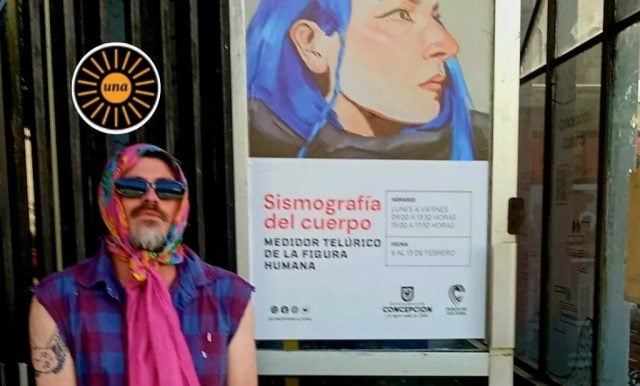
In response to the premature closure of the exhibition «Sismografía del Cuerpo» mandated by the Municipality of Concepción, the trade organization emphasized that art is «a legitimate space for reflection and debate, even when uncomfortable,» and that «limiting it through arbitrary decisions represents a democratic regression and violates guaranteed cultural rights.»
The National Union of Artists has raised its voice in defense of creative freedom following the controversial premature closure of the exhibition «Sismografía del Cuerpo» in the city of Concepción. In a public statement, the organization expressed its support for the cultural workers affected by this municipal decision, labeling the action as an assault on fundamental rights guaranteed within a democratic framework.
“As the National Union of Artists, we express our support for the cultural workers of Concepción regarding the early closure of the Sismografía del Cuerpo exhibition. We believe this measure directly impacts the fundamental right to freedom of expression and artistic creation,” they stated in a declaration shared on their social media.
The union highlighted that art constitutes «a legitimate space for reflection and debate, even when uncomfortable,» asserting that «limiting it through arbitrary decisions constitutes a democratic regression and undermines guaranteed cultural rights.»
The statement delves into the political dimension of this controversy, establishing a direct connection between protecting artistic expressions and the health of the democratic system: “Defending freedom of expression means defending democracy. Art must not have imposed limits,» they noted.
In this regard, the National Union of Artists reaffirmed its commitment to «the freedom of creation and expression, essential pillars of a democratic society.»
Cultural Blackout in Concepción
What began as an exhibition running smoothly transformed into what the artistic community is calling a «cultural blackout» in the capital of Biobío. As reported by this media outlet, the exhibition «Sismografía del Cuerpo,» set up in the Municipality of Concepción’s Culture Point, was closed before its scheduled end date, leaving behind a trail of controversy and accusations exchanged between the exhibiting artists and municipal authorities.
The exhibition, which featured works from ten visual artists, had passed all relevant administrative stages for its installation. The creators participated in a formal application process, submitted their portfolios, were selected, and subsequently set up for five days, culminating in an inauguration that, according to the artists themselves, went off without a hitch. However, days later, the exhibition was abruptly closed at the municipal government’s decision, triggering a controversy that Luis Almendra Villagrán, one of the affected artists, is not hesitant to label as censorship in Concepción, claiming that the municipality acted without dialogue or prior warning.
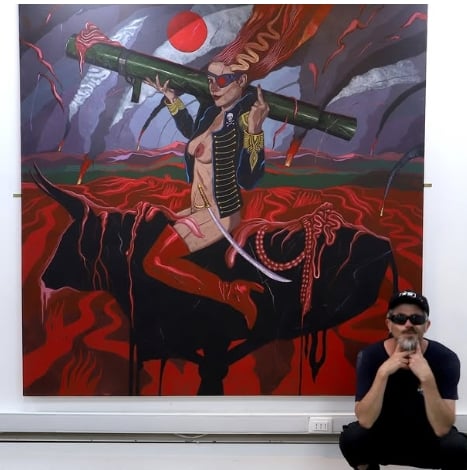
Censorship of the Work «Máquina de Guerra» Inspired by Camila Polizzi
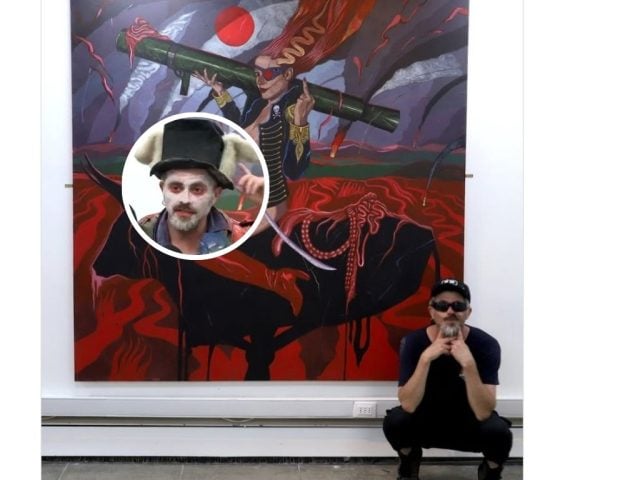
Among the works featured in «Sismografía del Cuerpo,» one piece that garnered significant attention—and likely triggered the municipal reaction—was «Máquina de Guerra,» created by Almendra Villagrán. This artwork depicts the well-known media figure Camila Polizzi on a mechanical bull, wielding a bazooka and a sword, in a composition that, according to the artist, seeks to explore the intersections of power, spectacle, and scandal in contemporary society.
Almendra has shared a detailed explanation of the profound meaning of his work on his Instagram account: «‘MÁQUINA DE GUERRA’ is a painting that addresses contemporary power through irony, excess, and the profanation of official symbols. The piece presents an allegorical portrait of @camilapolizzioficial Camila Polizzi, a media figure emerging from the intersection of scandal, desire, legality, and spectacle, portrayed as an anti-heroine who occupies and subverts Latin American historical and military iconography.»
In the same post, the artist clarified the independent genesis of his work, distancing himself from any external interests or commissions: «Note, this painting I did on my own; it’s not a commission, I wasn’t paid for it—I paint for enjoyment and to explore life, you see! I paint for the pure pleasure of painting and investigating life, you know!»
However, the exhibition was not limited to just this piece. It also included a dollhouse described as «sacrilegious-sexual,» titled «Jesus Meets Hello Kitty: God is an Employee at a Counter,» alongside other works that collectively presented a critical stance towards traditional institutions such as the church.
Closure and Administrative Inquiry
The municipal authorities opted to close the exhibition and instructed an internal administrative inquiry within the Cultural Directorate, aiming to establish the reasons and responsibilities behind the authorization of this exhibition in a municipal cultural space.
Tensions escalated when the character «Huachistáculo»—also a creation of Luis Almendra—appeared at the cultural space to demand explanations regarding the situation. At that moment, according to reports, the municipal administrator, Boris Negrete, reportedly asked him to leave the premises.
Lack of Dialogue and Arrogance
Luis Almendra Villagrán has been emphatic in stating that the closure took them completely by surprise, especially given that the exhibition had passed all institutional validation processes without any objections raised during the setup. In comments gathered by the media Sabes.cl, the artist expressed his displeasure about the manner in which the closure was implemented: «we were completely blindsided because, at the very least, they could have called us beforehand, proposed a dialogue, anything. This demonstrates a lack of dialogue, arrogance, and shows that they want to deny us, plain and simple.»
The creator also strongly rejected any interpretations that seek to associate his artistic work with harmful or disruptive intentions without basis: «It shows that they are demonizing our work as if we were a specter or a troop of zombies that want to harm society. Quite the opposite, we are very good people.»
«They Told Us: No, You Can’t»
One aspect that has particularly upset the affected artists is that the exhibition did not enter the cultural space «through the backdoor» or through informal arrangements, but rather complied rigorously with all the application and selection protocols established by the municipal Cultural Directorate.
Almendra detailed this process in his statements to the press, highlighting the arbitrariness of the closure decision.
«They are so ignorant among themselves; I believe they are somewhat drowsy. In fact, that’s why they incurred this mistake; we set up the exhibition for five days. We had the opening, and no one, nothing occurred, the inauguration was wonderful, except we didn’t have cocktails,» the artist recounted, adding a hypothesis regarding the real trigger for the closure: «I believe the mayor saw the news in the press and panicked and shut it down.»
The artist expanded on the contradiction involved in having successfully navigated all selection stages only to be expelled from the space afterward.
«And the issue is that before this, there was a selection process, of course, we applied with the exhibition and submitted a portfolio… No problem, we were selected, months passed until we exhibited. Sure, we made some changes; we thought there wouldn’t be any problem because no one said anything, not even at the inauguration, but we found ourselves with this surprise now that they tell us, no, you can’t be in this art space, which frankly seems insane to me,» he detailed.
This statement reveals the creators’ frustration at what they perceive as a late and unfounded invalidation of work that had previously been validated by the municipality’s own institutional mechanisms.
The Political Factor: A Conservative Mayor in the Spotlight
The political context surrounding this controversy adds an additional layer of complexity to the censorship debate in Concepción. The mayor of the municipality, Héctor Muñoz Uribe, was elected in 2024 as a member of the Christian Social Party and is widely recognized for his role as a pastoral leader linked to the religious group «Águilas de Jesús.» Since his arrival at the municipality, his administration has been characterized by a conservative Christian stance, generating various reactions in the local cultural and political milieu.
In this setting, the accusation of censorship acquires particularly sensitive nuances, as it raises an uncomfortable question that transcends this specific case: what real space do— or should—critical artistic expressions have, especially those addressing themes related to sexuality, religion, or political criticism, in cultural venues administered by a municipality with an explicit confessional orientation?
The controversy not only involves the relationship between art and religion but also the tension between the principles of creative freedom guaranteed within the Chilean constitutional and legal framework and the legitimate personal convictions of elected authorities. The challenge, in any case, lies in how to reconcile these dimensions without imposing particular criteria on artistic creation funded or housed in public spaces.
Are There Limits to Freedom of Expression?
The case of «Sismografía del Cuerpo» and its premature closure in Concepción has raised questions that far exceed the limits of this particular exhibition. Questions about what the limits of art in a democratic society should be, about the role of authorities in defining what can or cannot be shown in public spaces, and about protecting creative freedom against discretionary administrative decisions are inquiries that Chilean society as a whole is called to address.
The National Union of Artists has been clear in its stance: art should not have limits imposed from outside the creation itself, and defending this principle is an unrenounceable pillar of democracy.
Meanwhile, the affected artists continue to denounce what they consider an arbitrary act of censorship, executed without dialogue or respect for creative work.
Relacionados
Cultural Blackout in Concepción: Artist Claims Censorship After Early Closure of Camila Polizzi-Inspired Exhibit
Hace 1 semana
Massive Mobilization in Concepción Demands Reconstruction of Territories: "No More Forest Operations, No to Rare Earth Mining"
Hace 3 semanas