Original article: Clavícula fracturada y 9 horas detenido: dos casos reavivan alerta por violencia policial contra la prensa en Chile
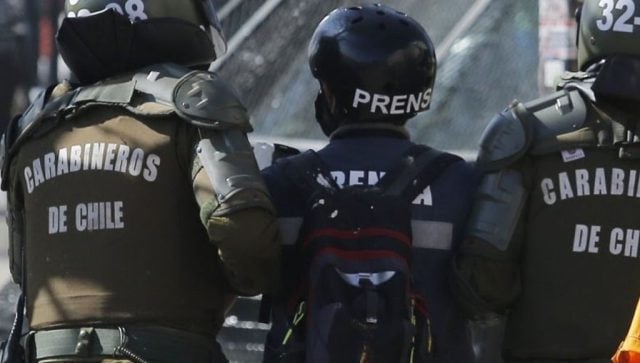
Two recent cases of journalists being assaulted while covering police operations have reignited concerns about the violence inflicted by law enforcement and the lack of effective protection for media professionals in Chile.
“While focusing my camera, a police officer came up from behind and pushed me. Due to the force of the shove, I fell, hitting my left shoulder on the ground,” recounts Juan González, a photojournalist for the international agency Reuters, describing the assault he faced on September 3 while covering student protests in downtown Santiago. Eight days later, he underwent surgery to repair a fractured collarbone, an injury that will keep him off work for several weeks with an uncertain rehabilitation timeframe.
This case has been documented by academics Claudia Lagos Lira and Javier García García in their column “Beaten with the Press: Police Violence Against Reporters Documenting Force”, which highlights the recurring issue of police violence against the press in Chile.
González, who has been a regular contributor to Reuters for a decade, had his camera, press credentials, and personal protective equipment at the time of the incident. According to his account, around 11:20 AM, Carabineros officers were charging towards protesters near the Gabriela Mistral Cultural Center (GAM) making arrests. While photographing the scene, an officer pushed him from behind, leading to his fall and the subsequent diagnosis of a left collarbone fracture. The images shared by colleagues and a video captured by the Señal 3 La Victoria team confirm the sequence, although none of the available footage identifies the names of the police officers involved.
Photographer Aliosha Márquez Alvear, who taught González years earlier, witnessed the events and photographed the moment when an officer pushed Juan. He noted how “it struck me how Carabineros were arresting people and neutralizing them.”
After the assault, González managed to seek refuge and send his photos, but the pain became unbearable, prompting him to call his colleague Carlos Santibáñez, who assisted him to Dr. Alejandro del Río Hospital (formerly Posta Central).
“I helped him organize his equipment. He looked very bad,” reported Santibáñez, who himself faced police violence during the social unrest of 2019. “They beat me. A lot. I was traumatized,” he confessed.
The investigation into the case is now with the human rights section of the PDI, which has received the complaint and awaits the Metropolitan Prosecutor’s Office to direct further actions. With support from the Communication Rights Observatory (ODC), González has requested the activation of the Protocol for the Protection of Human Rights Defenders, an instrument established in 2024 under the Coordinating Commission of the Criminal Justice System, but which remains largely unknown. The photojournalist emphasized, “I hope something can be done. That these instances do not continue to happen, and that no one else has to endure this.”
Nine Hours Detained: The Case of Benjamín Lillo
The second documented case by Lagos Lira—who holds a PhD in Media and Communications at the University of Illinois at Urbana-Champaign and is an academic at the University of Chile—and jurist García García occurred on Sunday, September 6, 2026.
On that day, Benjamín Lillo, a reporter and director of the community media Señal 3 La Victoria, was detained for about 9 hours, of which he was handcuffed for two, while covering the traditional pilgrimage to the Central Cemetery to commemorate the victims of Augusto Pinochet’s dictatorship.
The Señal 3 La Victoria team wore gas masks, press credentials, and vests bearing the channel’s logo, clearly identifying them as media workers. Around 1 PM, Lillo observed that Public Order Control (COP) officers from Carabineros were detaining a health brigadista. According to footage shared by the outlet itself, the reporter stepped away from the crowd to a side of the street to document the transfer of the detainee without obstructing police work. However, “Carabineros officers grabbed me from behind, claiming I was obstructing the arrest… I was just recording; I never interfered,” Lillo states. Despite identifying himself as press, he was taken to a police vehicle and handcuffed.
Before being taken to the Conchalí Police Station, Lillo was taken to CESFAM Dr. Lucas Sierra to check for injuries, where he remained handcuffed during the vital signs check. “In total, I was handcuffed for about two and a half hours,” he detailed. At 10 PM, after 9 hours in detention, he was released. Outside the police station, the reporter noted that the officers “could not agree on the reasons for the detention, whether it was an attack against authority or public disorder,” and as of the column’s publication in CIPER, there was no clarity on whether charges had been filed or if the Prosecutor’s Office would present accusations against him.
“This is becoming a daily occurrence,” warned Lillo, while denouncing that nearly all members of the Señal 3 La Victoria team have suffered harassment and police violence.
The community media director even filed a complaint with the Inter-American Commission on Human Rights. His case is not isolated: according to data from the Communication Rights Observatory, attacks on the press have become recurrent, with police officers being the main aggressors against reporters covering protests, as documented in reports by the ODC and international organizations such as the Rapporteurship for Freedom of Expression of the Inter-American Court of Human Rights.
Lack of Protection and Legislative Stagnation
The cases of Juan González and Benjamín Lillo are not isolated incidents. The column by Lagos Lira and García García emphasizes that despite existing protocols and training initiatives for police, they are still poorly known or implemented. Since 2023, a pilot program with Carabineros de Chile has sought to establish a permanent training module for media treatment and protection, but efforts have been sporadic and not sustained over time.
In 2022, a group of parliamentarians presented a Bill for the protection of journalists and media workers (Bulletin No. 14964-24), which has seen no progress in over two years, and to date, the Executive has not committed financial resources to create a protection mechanism. This lack of effective protection leaves journalists in a distressing state of vulnerability, especially since police officers are the main aggressors during protests.
The absence of responses from Carabineros to queries made by the authors of the column regarding the cases of González and Lillo, as well as the implementation of sustained training policies, deepens the feeling of impunity. Up until the publication of this article, it was only known that Juan González came through the surgery for osteosynthesis successfully—a plate and screws to fix his collarbone—but questions about press protection in Chile remain unanswered. As the bill stagnates and existing protocols are not effectively implemented, journalists documenting the use of force continue to be exposed to assaults, arbitrary detentions, and police violence, without clear mechanisms to ensure their safety and the full exercise of their informative duties.
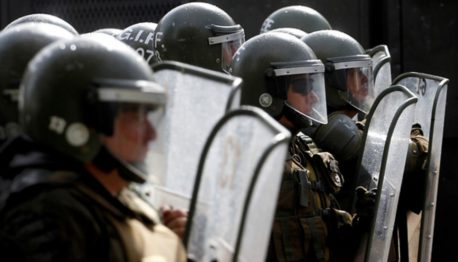
*Featured Image (reference): Colegio de Periodistas de Chile.
Obtén tu Pasaporte y apoya a El Ciudadano
Elimina la publicidad, accede a contenido exclusivo y sé parte de la comunidad.
Cancela en cualquier momento · Sin permanencia