Original article: Autor chileno de fantasía medieval llega a la FIL de Guadalajara y se rebela contra el algoritmo
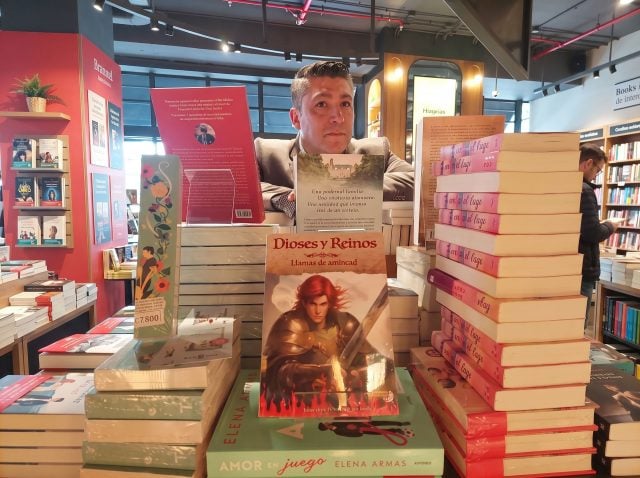
In a digital literary landscape dominated by the endless scroll of platforms like TikTok and Instagram, where social media often prioritizes instant gratification over deeper narratives, Chilean writer and engineer Iván Nilo Hernández embarks on a personal challenge to engage new audiences: to cultivate captivating literature that avoids excessive dramatics, evident in his works such as «Gods and Kingdoms» and the thriller «Dark Dreams.»
Nilo’s imaginative world reimagines the magic of medieval epic tales while enriching them with local geographical and identity references, crafting a niche for himself on bookshelves. He combines dreamlike suspense with an upcoming collection of stories inspired by Chilean mythology.
Originally from Laja in the Biobío Region, the author analyzes the current literary landscape through a lens that confronts algorithms: «I believe that today’s youth have access to a much greater variety of stories than previous generations. Social media and digital platforms have allowed many to discover books and authors they might not have encountered otherwise. That’s a positive development.»
«The challenge,» he adds, «is that we live in an environment where everything competes for our attention, and often the goal is to make an impact in seconds. Literature, however, operates on different timelines: a good story requires the reader to pause, imagine, and collaboratively build that world with the author.»
«Therefore, I believe the real challenge is not competing with social media but rather ensuring that young people rediscover reading as a worthwhile experience,» the author emphasizes.
In this context, Nilo balances his technical discipline as a mechanical engineer in the industrial sector with a narrative vocation that has earned him an invitation to this year’s International Book Fair of Guadalajara (November 28 to December 6), where he aims to showcase his works, foster relationships within the publishing world, and open new opportunities for regional literature.
New Times, New Readers
Simultaneously, within the corridors of young adult fiction and the burgeoning Romantasy phenomenon—a blend of romance and fantasy fueled by platforms like Wattpad and BookTok—a growing debate unfolds regarding thematic boundaries for these audiences.
Numerous academic studies and industry reports reveal trends where plots revolve around antagonistic characters marked by dynamics of dependency, jealousy, or power abuse.
These behaviors often introduce violence or hypersexualization that is romanticized to feed the so-called «attention economy,» a concept put forth by economist and Nobel laureate Herbert A. Simon.
Currently, genre fantasy accounts for nearly 25% of literary sales in the U.S. and Europe, according to NielsenIQ.
In the face of this prevailing trend, Iván Nilo offers an alternative grounded in restraint, respect, and the autonomy of his characters.
«I believe that when sexual or violent resources are overexploited, they can exhaust the reader. Something similar occurs when I see the casualness with which a loaded vocabulary of profanity is used,» he suggests.
«This doesn’t mean these elements can’t exist in my stories, nor do I question those who use them; each author has their own way of constructing a narrative. In my case, I try to resort to them only when they substantially contribute to the plot. I prefer to maintain the reader’s interest through the conflicts and the evolution of the characters,» the writer explains.
To achieve this, Iván Nilo’s creative process draws from daily interactions with coworkers, new readings, and classic literature that accompany him through airport wait times and lulls in his schedule.
He cites Agatha Christie and George R. R. Martin as influences from which he has adopted a structure of brief, dynamic chapters that explore dilemmas such as social vulnerability, responsibility, and power struggles, while steering clear of explicit moral lessons.
In this regard, the author approaches politics as a useful power play for building narrative tension, suspense, or high-flying fantasy but with a recognizable local flavor.
«I strive to find a balance where those in authority understand their social responsibility, recognizing that conflict arises when that function is neglected, and reminding that collective strength can also emerge from marginalized sectors,» he adds.
This perspective aims to revalue critical thinking through the habit of reading, allowing new generations to process their surroundings at their own pace.
For Nilo, this approach to books arose somewhat fortuitously during his studies away from his hometown, where he spent long hours waiting for the train home.
«One day I discovered that there was a public library just a block from the train station. I entered out of curiosity and ended up turning those hours of waiting into intense reading sessions,» he recounts.
«Suddenly those three hours were no longer wasted time but an opportunity to explore other worlds. I believe that’s the power of reading: a book doesn’t hand you everything resolved; it compels you to imagine the places, faces, and situations. Every reader ends up constructing part of the story in their own mind,» he emphasizes.
The Return of Storytelling by the Fire
In light of the immediacy of the entertainment industry and the rapid advancement of Artificial Intelligence, Nilo asserts that fantasy and mystery narratives retain their allure «when they are built on a foundation of empathy and human dignity,» a formula «that has prevailed since humans began communicating.»
«Technology and Artificial Intelligence are changing many things, including the way we approach creation and storytelling, but I don’t believe they can replace what has accompanied us since we started gathering around the fire to share tales. Tools and formats may change, but we still need characters with whom to identify, to feel fear, joy, or hope,» Nilo maintains.
At this point, he emphasizes that this is not a «boycott against technology» or new narrative forms and platforms that can ultimately enhance the mass adaptation of a fantasy novel into a series, film, or video game.
«For me, technology should be a tool that does not replace human creativity,» he stresses.
«A story can utilize all available resources, but ultimately it needs something that doesn’t rely on an algorithm: to make someone care about what is happening to another, even if that character lives in an imaginary kingdom, battles a dragon, or exists solely within the pages of a book,» Iván Nilo concludes.
Interview by Carlos Salazar
Obtén tu Pasaporte y apoya a El Ciudadano
Elimina la publicidad, accede a contenido exclusivo y sé parte de la comunidad.
Cancela en cualquier momento · Sin permanencia