Original article: Abril-junio bajo Kast: PIB cae 0,2%, inversión se estanca y construcción retrocede
The second quarter of 2026 marked the first full period under President José Antonio Kast, revealing troubling trends for the Chilean economy. From April to June, the Gross Domestic Product (GDP) recorded a year-on-year contraction of 0.2%, while investment stagnated and the construction sector declined, according to the Central Bank.
The statistics from the National Accounts Report coincide with the administration’s first four complete months since taking office on March 11. The decline was primarily attributed to falling exports and inventory fluctuations, which were partially offset by stronger consumer spending. The period experienced a neutral calendar effect, matching the same number of working days as the previous year.
The April to June period left the first half of the year in negative territory, following a 0.3% decline recorded in the first three months of 2026.
Moreover, the quarterly figure did not meet market expectations, which had forecasted a modest increase of 0.1% based on the latest data from the Monthly Economic Activity Index.
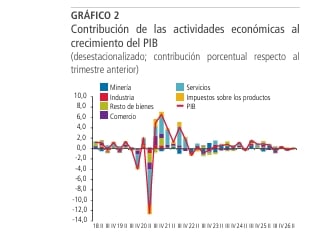
Analyzing the reasons behind the decline, the mining sector emerged as the most significant contributor to the overall GDP contraction. However, the non-mining GDP displayed positive performance, driven by personal services and retail.
When seasonal variations are discounted, the economy showed no change compared to the previous quarter. In this seasonally adjusted context, mining and personal services had an upward influence, yet this was completely negated by declines in construction, transportation services, and the activities of restaurants and hotels.
Decline in Exports
From the expenditure perspective, the behavior of domestic demand and external factors was crucial to the final outcome. A clear decline in net exports was noted, which detracted from overall economic activity, whereas internal demand saw an increase driven by higher consumption, although this growth was tempered by a decrease in inventory changes.
According to the issuing authority, exports fell by 2.1%, largely due to reduced shipments of goods, especially copper and, to a lesser extent, food products. Service exports also declined, with tourism expenditures negatively impacting the figures. In parallel, imports dropped by 1.6%, affected by lower arrivals of goods, especially fuels, chemicals, and clothing. In contrast, service imports increased, driven by business services.
Household consumption experienced a growth of 1.2%, with spending on services being the primary driver of this performance. Within this category, health services and tourism-related spending were the most dynamic. Expenditure on durable goods also positively contributed, particularly with increased purchases of automobiles, although this effect was countered by a decrease in spending on technology products. Conversely, consumption of non-durable goods fell, significantly influenced by declining fuel expenditures, which were partially compensated by a rise in clothing purchases. Government spending grew by 1.8%, reflecting increases in health and education services.
Investment Decline
Gross capital formation decreased by 3.9%, indicating stagnation in the creation of new productive capacities. Fixed capital formation (FBCF), which measures investment aimed at acquiring produced fixed assets, showed no variation during the period, resulting from a balance between a drop in construction and other works, and an increase in machinery and equipment.
“In the former, there was a lower investment in engineering works, while in the latter, there were significant purchases of electrical and electronic equipment,” the issuing authority stated.
Inventory depletion, particularly of manufactured goods, was the factor that dragged down FBCF, reaching an accumulated ratio of -0.3% of GDP over twelve months.
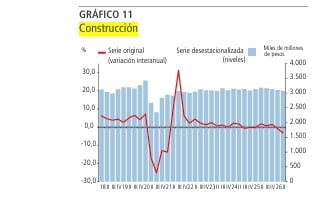
Construction Falls by 3.2%
One sector that reflected the low dynamism of the economy was construction, which fell by 3.2%, with all its components in the red. According to the Central Bank, building activity registered declines in both residential and non-residential components.
Simultaneously, engineering works recorded losses as a result of project completions, particularly in mining and desalination plants, while specialized activities saw a decrease due to reduced demand for repair services.
In contrast, trade showed a 2.4% rise, driven mainly by retail sales, and to a lesser extent by wholesale and automotive sales, highlighting greater sales of light vehicles and maintenance services.
To conclude, the Central Bank adjusted the GDP growth rate for the first quarter, revising it upward by two-tenths, from -0.5% to -0.3%.
Obtén tu Pasaporte y apoya a El Ciudadano
Elimina la publicidad, accede a contenido exclusivo y sé parte de la comunidad.
Cancela en cualquier momento · Sin permanencia