Original article: China, Estados Unidos y Comunidad Científica Internacional ¿Cuáles son sus posiciones y diferencias respecto a la IA?
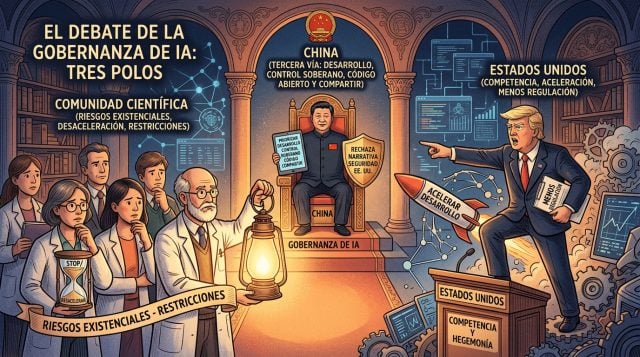
In the debate surrounding artificial intelligence governance, the scientific community, the United States, and China represent three distinctly differing «poles». The scientific community emphasizes existential risks, advocating for a slowdown and restrictions; the United States—particularly during the Trump administration—approaches the issue from a competitive lens, favoring rapid development and reduced regulations; China, in contrast, seeks to carve out a third path characterized by prioritizing development, maintaining sovereign control, promoting open-source solutions, and rejecting U.S. dominance in setting the global agenda based on security narratives.
The Citizen Team
The Scientific Community: Warnings About Risks and Calls to Slow Down
While the scientific community does not hold a completely unified stance, collective warnings from prominent AI researchers have garnered significant attention.
In May 2023, over 350 executives, researchers, and engineers in the AI sector signed a declaration published by the Center for AI Safety (CAIS). Its central message was succinctly expressed: “Mitigating the risk of extinction caused by artificial intelligence should be a global priority, on par with other large-scale social risks, like pandemics and nuclear war.”
Signatories included Sam Altman from OpenAI, Demis Hassabis from Google DeepMind, Dario Amodei from Anthropic, and Geoffrey Hinton and Yoshua Bengio, known as two of the «godfathers» of AI.
This position intensified in 2026, with former Anthropic researcher Jacob Coxon publicly warning that some industry professionals believe a catastrophe caused by AI “could occur before the end of this decade.”
Meanwhile, Evan Hubinger, an alignment researcher at Anthropic, stated his belief that there is greater than a 10% probability that AI could cause human extinction within the next ten years.
Dan Hendrycks, executive director of the Center for AI Safety, indicated that the declaration represented a type of «coming out» for some industry leaders, who had previously expressed their technological risk concerns privately.
However, the scientific community itself does not have a unanimous viewpoint.
In September 2026, 25 Fields Medal winners signed a declaration titled “Serious AI Misalignment Issues in Mathematics”, warning from a different perspective.
Although AI has shown remarkable capabilities in solving mathematical problems—OpenAI claims it used around 10,000 AI agents over 88 hours to address a problem concerning the Navier-Stokes equations—mathematicians caution that the mass and automated production of «true/false» answers could undermine the mathematics ecosystem as a field of intellectual exploration, eroding human intuition training and generational transmission of thought.
This warning is not centered on humanity’s extinction but rather on the degradation of cognitive abilities and the collapse of academic culture.
United States: Accelerate the Race and Reject Global Governance
The official U.S. position in 2026 has a distinct “accelerationist” character, especially during the Trump administration.
The fundamental premise is: “Whoever wins AI, wins it all.”
In public statements made in September 2026, Trump described AI lab leaders calling for caution as a “negative force” and explicitly rejected any slowdown in development:
“We are ahead of China in artificial intelligence. We are the most advanced country in the world. Frankly, I want to maintain that status because whoever wins AI, wins.”
The Speaker of the House, Mike Johnson, also opposed Congressional intervention to impose an «emergency pause» on AI development.
Rejection of a Global Framework
On the governance front, the United States has clearly articulated its rejection of establishing a global framework.
During the AI Impact Summit held in New Delhi in February 2026, Michael Kratsios, the White House’s science and technology advisor, stated:
“We completely reject global governance of AI.”
Instead, Washington advocates for a regulatory framework that favors entrepreneurship and innovation.
This stance contrasts sharply with warnings from parts of the scientific community. Researchers like Yoshua Bengio have called for establishing a global AI assessment mechanism similar to the Intergovernmental Panel on Climate Change (IPCC).
The U.S. has opted to maintain control over governance within its own national context and sees excessive regulation as a potential competitive disadvantage.
The China Factor
The primary driver behind this U.S. position is concern over technological competition with China.
According to the BBC, Washington believes that losing U.S. leadership to China in artificial intelligence could represent a “loss of strategic infrastructure”, not merely a defeat in a technological competition.
This security narrative means any proposal for «slowing down» could be interpreted as a concession to China.
China: Prioritizing the Right to Development, Sovereign Control, and Open Source
China’s official position has a dual dimension: on one hand, it acknowledges AI risks and advocates for regulation; on the other, it firmly rejects the notion that the United States can define the international agenda from a threat narrative.
The Global Governance Initiative for Artificial Intelligence, published in October 2023, systematically reflects this stance.
Among its core principles are the development of AI aimed at the “betterment of humanity”, ensuring that AI “remains under human control”, and building technological systems that are “auditable, supervisable, traceable, and reliable”.
At the same time, China asserts that all countries, “big or small, strong or weak,” have the same right to develop and use artificial intelligence.
Beijing opposes dividing the world along ideological lines or creating exclusionary blocs, as well as using technological monopolies and unilateral coercive measures to create barriers to development.
Rejection of the U.S. Narrative
Chinese statements from 2026 have deepened this position.
In response to calls from U.S. AI company executives to slow development to contain China, Chinese Foreign Ministry spokesman Guo Jiakun replied that “statements based on threats, confrontation, and malicious competition will only disrupt the global governance process for AI and will benefit no one.”
The spokesman urged all countries to promote AI development in a direction that is “open, inclusive, accessible, beneficial, and oriented toward the good.”
At the same time, the Chinese Minister of State Security, Chen Yixin, emphasized the need to “balance development and security,” establish legal systems and ethical standards, and create risk monitoring mechanisms to “protect people’s interests and national security.”
From Speech to Open Source
Practically, China is attempting to turn the concept of “open and shared code” into concrete policy.
In July 2026, the National Development and Reform Commission and other government bodies presented a plan for AI cooperation and development during the World AI Conference, covering eight areas, including:
- data;
- computational capacity;
- open-source ecosystems;
- talent training;
- rules and standards;
- and international cooperation.
The plan aims to provide the world with broader access to high-quality data and open-source AI ecosystems.
Later, Xi Jinping proposed the establishment of a “community of open-source artificial intelligence” during the BRICS summit.
The Chinese Strategy
China’s rhetorical strategy can be summarized as follows:
China recognizes that AI entails risks, but believes that managing those risks should not be an excuse for technological blockage or to deprive other countries of their right to development.
For Beijing, the principle of “human control” fundamentally means control within a framework of national sovereignty, and not a global governance structure led by the United States that unilaterally determines what should be considered “safe.”
Comparing the Three Positions
| Dimension | Scientific Community | United States – Trump Administration | China |
|---|---|---|---|
| Main Concern | Existential risks and destruction of the cognitive ecosystem | Technological competition and hegemony against China | Right to development, sovereignty, security, and rule-making capacity |
| Attitude Toward “Slowdown” | Calls for a coordinated slowdown | Rejects it, viewing it as a concession to China | Does not reject control but opposes being trapped in the threat narrative |
| Preferred Governance Model | International scientific assessment body, similar to the IPCC | Rejects global governance; favors national, bilateral frameworks or partnerships with allies | Multilateralism under the UN framework, respecting differences in national policies |
| Attitude Toward Open Source | Neutrality or caution | Commercial dominance, with security concerns regarding open-source | Active defense as a technological and diplomatic instrument |
| Fundamental Logic | Precautionary principle | Priority on competition | Development first + sovereign control |
The Global AI Dilemma
The tension among these three positions constitutes one of the main challenges in global artificial intelligence governance.
The scientific community requires an effective global mechanism to transform its warnings about risks into concrete policies. The United States rejects providing such a mechanism, while China seeks to fill that void with its own model.
However, the three actors clash on a fundamental question:
What does it truly mean for an artificial intelligence to be “safe,” and who has the right to decide what is safe?
This likely lies at the heart of the conflict.
For scientists worried about existential risks, the priority is to prevent technology from reaching a point where humans lose control.
For Washington, slowing the race could mean giving China a strategic advantage.
For Beijing, safety rules should not be used to impede other countries from developing their own technological capabilities.
Therefore, the battle over artificial intelligence is not confined to determining who will build the most powerful model.
Much more profound questions are at stake: who will set the rules for AI in the future, who will have access to it, and above all, who will decide what it means to keep it under human control?
The Citizen
Obtén tu Pasaporte y apoya a El Ciudadano
Elimina la publicidad, accede a contenido exclusivo y sé parte de la comunidad.
Cancela en cualquier momento · Sin permanencia