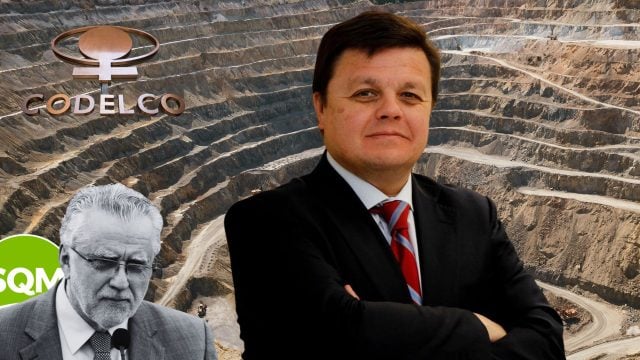
Original article: Denuncian posible “maquillaje” de los resultados de Codelco durante la gestión de Máximo Pacheco
Jorge Berríos, a distinguished academic and researcher in financial management and corporate frauds, has spent years scrutinizing the accounts of Codelco, the country’s leading state-owned company. His examination of Codelco’s financial statements raises questions about the evolution of costs, the escalation of debt, and particularly, the presentation of the results for 2025 by Máximo Pacheco’s administration. Berríos contends that the profits displayed by the corporation were largely a mere accounting effect linked to the new structure of the lithium business. He suggests that without this recognition, Codelco would have recorded losses, a scenario Pacheco sought to avoid at all costs in order to prevent a political backlash on his management. He also draws attention to another less visible area: the accounts payable to suppliers and contractors, cautioning that there may be obligations not transparently reported in the financial statements. In this interview, he reconstructs the figures that he believes indicate a deterioration persisting for over a decade.
By Bruno Sommer
-Can you tell me why you became particularly interested in Codelco’s finances and why you have been following their financial situation for years?
My interest began in 2018 when I was the Finance Manager at Geoassay, a company that had won a contract to set up a state-of-the-art robotic laboratory intended for chemical analysis of samples for Codelco’s four northern divisions.
What caught my attention was that Codelco did not pay the contract’s exit cost on time; instead, it took nearly a year and a half after completion, until May 2022.
In that context, considering that I have worked as an undergraduate and graduate lecturer for 27 years and my research area is focused on financial management and corporate fraud, I started to question why such a large company would have trouble meeting its obligations promptly and fully. This led me to review Codelco’s consolidated financial statements from a different perspective and compare them with other corporate cases I have studied.
-What was the first piece of data that caught your attention at Codelco?
-It was a statement made by Nelson Pizarro in 2016 when he was the CEO of Codelco. In a radio interview, he said, «There’s no money, man, understand, there’s not a single peso.»
A statement of that nature prompted me to examine the financial statements from 2015. That’s when I discovered something surprising: Codelco reported over US$2.501 billion in losses related to its participations in associated and joint ventures, accounted for using the equity method.
In other words, although there was a decline in gross profit due to reduced sales and copper prices, a significant part of the deterioration was linked to business dealings with other companies.
-Which business do you attribute this loss to primarily?
-Mainly to Codelco’s joint venture with Anglo American Sur. The investment made in 2012 reached approximately US$6.537 billion for a 29.5% stake, which it maintains to this day.
My interpretation was that there was a significant disparity between the public narrative about the lack of resources and what Codelco’s cash flow actually demonstrated.
-So you question whether Codelco was truly out of money at that time?
-When you review the Cash Flow statement from 2015, particularly the cash flow from operating activities, you do not see a cash decrease of such magnitude as to literally support the claim that the company “had not a single peso.”
This led me to another question: why was that statement made? I cannot say for certain what the motivation was, but I have always operated under the hypothesis that it might have served to deflect attention from the magnitude of the losses associated with Anglo American Sur and, at the same time, to prepare for the upcoming collective bargaining negotiations Codelco was facing.
-You indicate that the issue did not end in 2015. What do the accumulated figures until 2025 reveal?
-That is precisely one of my biggest concerns. As I have followed Codelco’s financial statements year by year, a significant patrimonial loss tied to that investment has emerged.
From 2012 to 2025, the patrimonial loss from the investment amounts to approximately US$4.376 billion, while the losses recognized in annual results total around US$2.587 billion.
What I wonder is why this has not raised the alarms it should, in my opinion.
-How is that deterioration distributed over time?
-The trend is quite clear. In 2012, the investment’s patrimonial value was around US$6.537 billion. 2015 marked the worst impact, with a loss of about US$2.597 billion and a drop in patrimonial value to US$3.215 billion.
After that, there were some years of positive or relatively stable results, but significant deterioration reappeared in 2023 when a loss nearing US$677 million was recorded. By the end of 2025, the patrimonial value of that investment stands around US$2.162 billion.
In other words, we are discussing an accumulated patrimonial loss of over US$4.300 billion compared to the initial investment value.
-Aside from that investment, what is happening with Codelco as a company?
-What’s concerning is that Codelco’s consolidated results do not seem to align with what one would expect, considering copper prices.
Since 2012, with copper prices even higher during several periods, the results are significantly lower than might be anticipated. When analyzing production costs, the discrepancy becomes even clearer.
Codelco’s Cash Cost or C1 has nearly doubled: rising from 129.4 cents per pound in 2020 to 208.6 cents in 2025. The most significant jump occurred between 2022 and 2023.
-What does that figure mean when compared to other mining companies?
The comparison is particularly relevant because the C1 is a standard measure used to compare production costs among mining companies.
While Codelco reached 208.6 cents per pound in 2025, BHP Escondida reported approximately 119 cents. According to data cited in my analysis, Minera Los Pelambres has costs close to 82 cents and Minera Centinela around 75 cents per pound.
It is true that we are comparing at a consolidated level and that Codelco’s ore bodies are old and have geological particularities affecting costs. Chuquicamata and El Teniente, for example, have operational histories exceeding a century. Mineral grade also plays a role.
However, those particulars do not eliminate the issue: since 2020, Codelco’s C1 shows a clear upward trajectory.
-What is, in your opinion, the structural problem revealed by those costs?
-The problem is that Codelco is producing at increasingly higher costs in a context where copper prices have reached historically high levels.
Between 2020 and 2025, the C1 rose from 129.4 to 208.6 cents per pound. In 2021, it increased to 132.7; in 2022 to 165.4; in 2023, it reached 203.1; in 2024, it slightly dropped to 199.1 and in 2025 it rose again to 208.6.
The question that no one should overlook is quite simple: what would happen to Codelco if copper prices returned to significantly lower levels?
-In your analysis, you also mention the discussion about produced tons. What connection do you see between that episode and the costs?
-Beyond what has already been publicly discussed regarding the potential manipulation of production tonnage for production bonus purposes, I consider there is an angle that should be investigated.
Codelco needed to demonstrate improvements in its production efficiency due to its relatively high costs compared to other companies in the sector, especially regarding C1.
That is why I find it important to determine if there were incentives to present certain production results in a manner that would allow for improved efficiency indicators. The C1 serves precisely to establish a homogeneous comparison and evaluate whether a real productivity improvement exists.
-We reach 2025. Codelco reported profits. Why do you maintain that this result must be viewed with particular scrutiny?
-Because, according to my analysis of the financial statements, the profit for 2025 is primarily explained by the accounting recognition of participation in joint ventures.
Specifically, Codelco recognized approximately US$3.391 billion for its participation in associates and joint ventures valued through the equity method, while the associated investment appeared recorded at around US$3.344 billion.
Without that recognition, the result for the year would have been negative: approximately US$968 million in losses, equivalent to about a -5% net profit.
-Are you saying that the profits for 2025 do not reflect a real generation of resources?
-What I am saying is that a fundamental part of the consolidated profit for 2025 arises from an accounting effect and not from an equivalent cash generation.
This result is linked to the new corporate structure associated with the lithium business. My interpretation is that by integrating these participations using the equity method, Codelco was able to recognize a gain that significantly impacted the consolidated result.
-Why specifically does the case of Nova Andino raise doubts for you?
-Because Nova Andino was created on December 27, 2025, from the merger of Minera Tarar SpA and SQM Salar SpA, and Codelco participates with a 50% plus one share through Salares de Chile SpA.
I find it remarkable that a company created at the end of December could have such a significant effect on the results for the same year. Thus, the hypothesis arises that this may have allowed for the recognition of a participation gain that ultimately prevented Codelco from showing a loss in 2025.
-You suggest that this result might have avoided a political blow to Máximo Pacheco’s administration. Why?
-Yes, because closing 2025 with losses would have completely altered the public perception of Máximo Pacheco’s administration.
That is why I argue that the outcome must be analyzed beyond the final profit figure. One must look at where that profit originates, how much corresponds to operational generation, and how much is attributed to accounting recognitions derived from the corporate structure.
My critique precisely targets this: it is possible to present a positive consolidated profit, but that does not necessarily mean that the structural issues of costs, debt, and cash generation have disappeared.
-What about Codelco’s debt during this period?
-Here we find another worrying element. Since Codelco’s functional currency is the dollar, we can compare the evolution of its debt in real terms between 2012 and 2025.
Long-term debt rose from approximately US$9.262 billion in 2012 to US$25.288 billion in 2025.
In other words, we are talking about an increase of over US$16 billion in thirteen years.
-What does the intermediate evolution show?
The trend is upward almost throughout the period. Long-term debt rose from US$9.262 billion in 2012 to US$10.848 billion in 2013, US$12.951 billion in 2014, US$14.027 billion in 2015, and US$14.931 billion in 2016.
It then remained around US$14.600-14.700 billion during 2017 and 2018, began to grow again from 2019 and reached US$18.075 billion in 2020.
In 2023, it reached US$19.814 billion, US$21.544 billion in 2024, and US$25.288 billion in 2025.
-What is your opinion on the decision to capitalize 100% of the profits for 2025?
-I consider it fundamentally a political decision regarding Codelco.
This is the first time a capital increase of 100% of the year’s profits has been carried out, although there have been past capitalizations under various modalities and percentages.
The issue is that capitalizing those profits does not itself alter the debt structure nor does it resolve operational cost problems. Moreover, it’s important to note that a significant portion of the profit from 2025 came precisely from the accounting recognition associated with Nova Andino.
-So, what real effect does that capitalization have?
It may have an important political effect, as it prevents profit withdrawals from Codelco. However, that does not necessarily mean that an amount equivalent to the recognized profit has actually entered the company’s cash.
It would be contradictory to consider available cash as a profit derived largely from an accounting recognition of a participation and not from a real transfer of resources from that business.
For this reason, I believe it’s essential to carefully distinguish between accounting profit, cash generation, and genuine strengthening of financial position.
-Where would you now focus a journalistic or financial investigation into Codelco?
-On the accounts payable to suppliers and contractors.
I believe there is a very relevant aspect here that has not yet been sufficiently studied. It would be necessary to determine how many companies have faced financial difficulties or even gone bankrupt as a result of delays in payments from Codelco and what the real volume of outstanding obligations is.
-How does that payment system work, and where could the issue lie?
-Codelco works with its contractors based on contracts that are paid monthly as HES (Hojas de Entrada de Servicios) are issued.
These are issued at the end of the month, and according to my experience as a manager, their authorization could take between five and ten business days. If they were rejected due to discrepancies or administrative issues, this process could extend for 20 days or more.
As long as the HES is not approved, the contractor cannot bill. Even once the invoice is issued, there might be a new validation process in Codelco’s portal, where an issue in any line or detail may necessitate reissuing the document.
-Why could this be significant in Codelco’s financial statements?
-Because there is an accounting question that, in my opinion, must be answered with absolute clarity: when does Codelco recognize that debt?
If the obligation is accrued when the HES is issued, then at the end of the year there could be a certain amount of pending obligations. But if recognition only occurs upon invoice issuance, the amount of unrecorded debt could be considerably larger.
That’s why I consider it crucial to understand the exact accrual model used by Codelco, as well as to determine the actual age of its obligations to suppliers and contractors.
Bruno Sommer
*Founder El Ciudadano
Obtén tu Pasaporte y apoya a El Ciudadano
Elimina la publicidad, accede a contenido exclusivo y sé parte de la comunidad.
Cancela en cualquier momento · Sin permanencia
Artículos Relacionados
«¡Les sorprende que todavía no hayamos caído!»: Pezeshkian afirma que Irán resiste la «máxima» presión durante la guerra
Hace 4 semanas