Original article: «Divino paparazzi»: Artista Kütral Vargas Huaiquimilla convierte cámaras de vigilancia en objetos de culto
What happens when a security camera stops watching and begins to be watched?
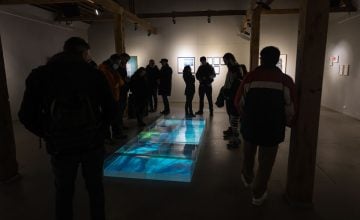
This question underpins Divine Surveillance, the new exhibition by artist Kütral Vargas Huaiquimilla at Judas Gallery (Pasaje Gálvez 167, Cerro Concepción, Valparaíso), which showcases a collection of pieces created from technological waste and security-related devices.
The exhibition opened on September 11 and will be on view until October 10, from Tuesday to Saturday, between 3:00 PM and 7:00 PM.

A New Investigation
This work is part of a broader investigation that Kütral Vargas Huaiquimilla will develop throughout 2027, focusing on electronic waste, surveillance systems, and our contemporary relationship with machines.
In her artworks, security cameras, circuit boards, and wiring are dismantled, intervened, and reorganized alongside symbols from religious traditions: sheep, stars, birds, eggs, crosses, rosaries, and crucifixes.
The result is a form of electronic religious imagery. Directly referencing the aesthetics of divine machinery, the exhibition creates a meeting point between what has been considered divine for centuries and the technologies that play a significant role in our daily lives.

For Vargas Huaiquimilla, ignorance also creates mythologies: “When we don’t understand how a specific machine or system works, we start projecting mysterious attributes onto it that leave us perplexed by its power.”
“I also use analog techniques like embroidery to critique this investigation and establish poetic relationships between machines, people, and techniques,” Kütral adds.
Safety is another central theme of the exhibition. Walls transformed into banners and sculptural structures evoke the need for protection, but also the contemporary obsession with delineation and observation. In this context, cameras abandon their original function to become aesthetic materials.
The works also incorporate references to liturgical embroidery, biological forms, and jewelry, interweaving rosaries, beads, and crucifixes with electronic components.
This “technological jewelry” allows us to see the inside of machines that typically remain closed and raises questions about material extraction, production chains, and the fate of technology when it is no longer useful.
Between electronic nostalgia and religious imagery, Divine Surveillance encourages us to revisit what usually remains hidden: the insides of machines and the beliefs we place upon them; an invitation to enter a domain where technology ceases to be just a tool and also becomes a mystery.
Obtén tu Pasaporte y apoya a El Ciudadano
Elimina la publicidad, accede a contenido exclusivo y sé parte de la comunidad.
Cancela en cualquier momento · Sin permanencia