Original article: Codelco-SQM bajo Máximo Pacheco: experto acusa que acuerdo por el litio se concretó para “manipular los datos del cierre” de 2025
Expert Accuses Codelco-SQM Deal Under Máximo Pacheco of Data Manipulation for 2025 Closure
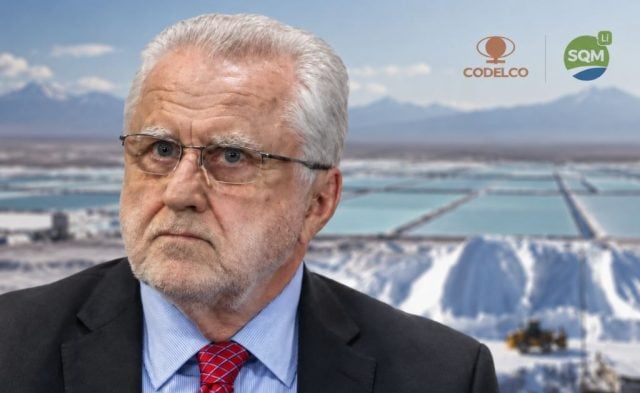
Academic and researcher in financial management and corporate fraud, Jorge Berríos, alleged that the establishment of the NovaAndino Lithium venture—formed by Codelco and SQM to exploit lithium in the Salar de Atacama—was executed on December 27, 2025, during Máximo Pacheco’s tenure as board president to prevent the state copper company from reporting annual losses, thus allowing for the «manipulation of the closure data» for that fiscal year.
Berríos claims that the lithium agreement with SQM was not about a productive development strategy, but rather a financial necessity to mask the state-owned company’s results and create an appearance of profitability that did not exist.
«Isn’t it alarming that the company was created on December 27, 2025? Therefore, the creation of NovaAndino, in my view, was solely because it was known that if it was not completed before December 31, 2025, Codelco would emerge with negative numbers. Thus, the urgency in finalizing the lithium contract was to present last year’s results as 12% instead of less than 0.5%, which would imply nearly two years of consistently negative profitability under the previous administration,» he stated during his presentation to the investigating committee of the Chamber of Deputies regarding Codelco’s production figures for 2025.
In his address to lawmakers, Berríos reflected on Codelco’s current status, emphasizing its strategic importance to the country.
«Codelco is a cornerstone of our economy and a crucial player in material supply, currently navigating critical, complex, and multifactorial challenges in its operational processes,» he noted.
Despite being «the largest mining company in the world when considering all its divisions and total production,» he asserted that the company faces a crisis stemming from various negative factors. He specifically pointed to a «geological decline associated with the grade of the ore and inefficiencies in executing mega-projects, particularly in capital investment,» highlighting that between 2010 and 2025, the state invested more than 58 billion dollars in capital assets, an amount that «is not reflecting in either cost or operational terms within the company.»
According to Berríos, the severity of the crisis is evident in profitability figures, asserting that the copper producer should report results similar to those of 2011-2012, «with profitability close to 12% or 14%,» while currently it shows «a negative profitability not exceeding 2%.»
«There is not only a financial effect but also a loss of capacity in terms of production versus what Codelco is currently producing,» the expert warned.
Berríos emphasized that without the profits from NovaAndino, the state-owned enterprise would have closed 2025 with a negative outcome near 900 million dollars «and a negative profitability close to below 4.5% or 4.6% at the bottom line.»
«Last year, Codelco reported profits of 12.86%. I believe we all saw it, amounting to 2,422 million dollars that were capitalized by Codelco. But is that really a profit for Codelco? No, it is not. Did it come from production? No,» he concluded.
«This is entirely due to the recognition of 3,391 million dollars for consolidation in 2025. What does this mean? When a company is merged for the first time, the previously accumulated profits can be recognized in that year’s accounting,» he elaborated.
Berríos’ conclusion was firm: «the creation of NovaAndino, in my opinion, was done solely because it was known that if it was not finalized before December 31, 2025, Codelco would exit with negative numbers.»
Production Overestimation and Its Implications
One of the central points of the academic’s presentation was the overestimation of copper production during 2025. He explained to lawmakers that the company artificially inflated its figures by over 27,000 metric tonnes of refined copper through an accounting maneuver that, while not altering the consolidated balance, distorted key operational indicators.
«Codelco’s financial statements are not going to change; there won’t be any alteration in what they presented. The change is subjective; it occurs in the inventory accounts, fluctuating between raw materials, work-in-progress, and finished products. Therefore, if I look at the overall consolidated statement, there is no change in the balance, none at all, but this has a second derivative,» he explained.
Berríos identified two divisions involved in this practice, reinforcing its systemic nature. «In one, there may be divergences, but here there are two. Thus, one can clearly assert that this is not normal,» he emphasized.
The academic highlighted that this irregularity was not detected by formal audit channels or internal controls but by an anonymous tip submitted through the channels established by the company itself.
«When we talk about fraud or accounting manipulations, 80% of the time when something is detected, it is because someone alerted or reported it through the established channels,» he noted.
This, in his view, evidences the existence of privileged information and a sufficient hierarchical level to understand how the figures were altered. «Someone brave enough to accuse within Codelco had to first possess the information, be aware of its location, and be in a hierarchical position to understand how and why the production figures that were incomplete were considered finished by Codelco,» he maintained.
Impact on Measuring Efficiency and Costs
According to Berríos, the accounting manipulation not only affected the bonus system for executives and workers but also distorted the measurement of operational efficiency through the C1 indicator (cash cost), which is used internationally to compare mining performance.
«What Codelco claimed was initially 1,334,400 metric tonnes of fine copper in 2025, which represented a 0.5% growth for the company. In other words, the image: we are efficient, we are doing well, and we are in line with Codelco’s efficiency goals,» he explained.
Debt, Internal Control, and Joint Ventures
Berríos also discussed Codelco’s debt level, which according to his calculations exceeds 26 billion dollars, compared to 10 billion in previous periods. «If I am investing or going into debt with Codelco, I am primarily incurring long-term debts to improve Codelco’s efficiency rather than to increase the C1 costs. The observable situation shows no direct relationship between the amount invested in Codelco and the efficiency of its operations,» he stated.
Simultaneously, the academic addressed the joint ventures of the copper producer, particularly Codelco’s stake in Anglo American Sur, which has seen an original investment of over 6.5 billion dollars translate into a current loss of 4.3 billion.
«Isn’t it striking to recognize the loss? That year, when Codelco was at 2.20 dollars, that is known as an assumed hypothesis. In other words, why that year? Why not? Why was it necessary to recognize it that year? Because widespread negligence has been evident. I did not see any committee; I did not see anyone reviewing the figures or explaining why we lost 2.5 billion dollars in a business that began in 2012,» he questioned.
«Modifying the Figures»
Before the investigating committee, Jorge Berríos explained that the only way to ascertain the level of control within Codelco or its audit committee is through that risk map, as: «if it is very low, it logically cannot be detected under any circumstance.»
In this regard, he stressed the importance of understanding the traceability of information, meaning, «where it starts, where it ends, and how different phases produce the record until reaching the final product.»
He emphasized that without understanding the process, it is impossible to determine who authorized what, thus highlighting the necessity to identify a sequence of approvals and the authorized individuals for such actions: «This is a first layer of understanding who is who and how the process is done.»
Regarding the potential manipulation of data and results, Berríos stated that it was not a systemic error but a direct action, asserting: «Logically, if, as has been mentioned, someone modified the figures, it was not done systemically, but rather someone directly told them to modify the figures.»
Obtén tu Pasaporte y apoya a El Ciudadano
Elimina la publicidad, accede a contenido exclusivo y sé parte de la comunidad.
Cancela en cualquier momento · Sin permanencia