Original article: Consejo Fiscal le tira la cadena a la megarreforma de Kast: rebajas para los ricos y más hoyo fiscal
The Autonomous Fiscal Council did not use those exact words, but the political effect of its report was unmistakable: it undermined the triumphant narrative surrounding Kast’s mega tax reform. The presentation before the Finance Committee highlighted that the government’s flagship project promises future growth but comes with assured costs, diminished state revenue, and a fiscal deficit that cannot be closed easily.
The concept is straightforward: Kast aims to pitch the reform as a recipe to reactivate the economy, lower taxes, attract investment, and organize public accounts. However, the Fiscal Council laid the numbers out and revealed the fine print. If the expected growth does not materialize as projected, the state will face reduced revenue, increased fiscal pressure, and the need for further adjustments.
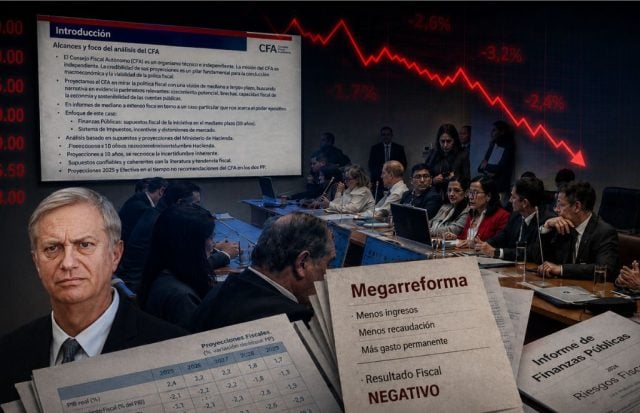
The weight of the report is significant. The Autonomous Fiscal Council is an independent, technical, and consultative body aimed at fostering responsible fiscal management in the Central Government. Comprising five members who are experts in fiscal and budgetary matters, its presentation to the Chamber of Deputies’ Finance Committee was led by its president, Paula Benavides. This is not a haphazard critique; it is a technical warning from the entity responsible for scrutinizing the sustainability of public accounts.

When discussing adjustments, we are not referring to a lost spreadsheet in the Treasury. We are talking about reduced resources for sensitive areas. In fact, according to information provided by the Budget Office to the Council, the first stage of the adjustment already includes significant cuts in ministries such as Health, Education, and Housing. This raises a tough question: if the tax cut benefits large businesses, who will pay the bill when funds run dry?
Kast’s Mega-Reform: Tax Cuts Now, Benefits Later
The Fiscal Council recalled a fundamental rule any government should have written on the wall: “permanent expenses must be financed with permanent income”. This statement hits directly at the heart of Kast’s mega tax reform because the project includes measures that reduce permanent income, particularly through the gradual reduction of the Corporate Income Tax from 27% to 23%.
Translated plainly: the tax burden on companies is lowered now, hoping for more investment, growth, and then increased revenue tomorrow. The issue is that this second part is a gamble. It might happen, but it could also fall short, take longer, or fail to materialize as promised by the government.
The report makes this clear: “the direct fiscal costs (or lower revenues) of the measures materialize with greater certainty from the first year of validity.” In contrast, the benefits associated with growth come “gradually over time” and with higher uncertainty.
Certain Costs, Uncertain Growth
This is the most critical point of the report: the reform guarantees costs, but does not guarantee benefits. The Fiscal Council summarizes it in a phrase that leaves little room for communication spin: “the uncertainty is asymmetric: costs are more certain and predictable, while benefits are uncertain, gradual, and conditional.”
The Fine Print of the Mega-Reform
Deficit until 2031: the project will remain in the red even considering the expected growth.
Corporate Tax Cut: the Corporate Income Tax would decrease from 27% to 23%, costing 0.44% of GDP by 2030.
Uncertain Benefits: the Fiscal Council warns that while costs are certain, the benefits from growth are uncertain and gradual.
Insufficient Adjustments: the CFA indicates that the announced cuts are not enough to finance the reform and simultaneously stabilize public accounts.
Sensitive Cuts: the first stage of the adjustment totals US$1.937 million, with the largest reductions in Health, Education, and Housing.
In other words: the government is distributing tax benefits today while crossing its fingers that growth will take care of it tomorrow.
The reduction of the Corporate Income Tax is the prime example. According to the CFA, this measure has a rising fiscal cost up to 2030, and the future revenues it would generate only “cover three-quarters of the cost.” In other words, even under the government’s optimistic logic, it does not fully cover the tax cut.
This gives context to the “more fiscal deficits” of the headline. Without considering the growth effect, the project creates a permanent fiscal deterioration of 0.43% of GDP in balance, with a maximum deficit of 0.71% of GDP in 2030. Even factoring in the expected growth by the government, the project would still have a negative fiscal impact in 2030.
Adjustments May Fall on the Citizens
The Council also warns that the project will lead to fiscal deficits at least until 2031, even considering the growth effect. It concludes with another key point: “the announced adjustments are insufficient to finance the PDL [the mega-reform], correct the fiscal deterioration of 2025-2026, and advance in fiscal convergence simultaneously.”
This point is brutal. Because the government must not only finance the mega-reform. It must also address the ongoing fiscal deterioration the country faces and meet structural balance goals. The Fiscal Council is essentially stating that what has been announced so far is insufficient for all of it.
So where do you start looking for money when there isn’t enough? In cuts, adjustments, postponements, or reduced public investment. The presentation itself shows that the first stage of the adjustment reaches US$1.937 million across 26 of 33 budget lines, with significant cuts in Health, Education, and Housing.
Therefore, this is not just a cold discussion among technocrats. If the state stops collecting revenue due to tax cuts benefiting businesses and then needs to adjust public spending, the burden will likely fall on citizens. And when those cuts affect basic services, housing, health, or education, social discontent doesn’t arise from nowhere: it accumulates.
Chile has seen what happens when economic policy is designed from above and the bill is passed down to the people. Social discontent is not an abstraction. It can transform into protests, legitimacy crises, and even social eruptions if people feel they are once again being asked to sacrifice to sustain benefits for the affluent.
The Fine Print of Kast’s Flagship Project
The Fiscal Council does not assert that growth is bad. On the contrary, it values that the project aims to stimulate economic growth. But its warning is unequivocal: one cannot finance a reform based on faith in future growth, especially in a context of prolonged fiscal stress, rising debt, and diminished sovereign funds.
The mega tax reform of Kast thus bears a fine print that is hard to conceal: concrete tax cuts for major businesses, fiscal costs from the first year, and future benefits dependent on uncertain assumptions.
Put bluntly: if the promised growth does not materialize, the government will not be asking the wealthy who received the tax cut to cover the difference. The pressure will fall on the state. And when the government adjusts spending, those who feel the impact the most are often the same: the citizens relying on public services, social investment, and rights that cannot be financed through promises.
Document
Here you can check the complete presentation of the Autonomous Fiscal Council on Kast’s mega-reform and the risks it identified for public accounts.
Presentation CFA Sobre PDL Reconstrucción H.C. Diputados 05-2026 by lahuanche
Obtén tu Pasaporte y apoya a El Ciudadano
Elimina la publicidad, accede a contenido exclusivo y sé parte de la comunidad.
Cancela en cualquier momento · Sin permanencia
Artículos Relacionados

Deputy Fries Critiques Government's Mega Tax Reform: "I Would Support Reversing Their Tax Policies in the Next Term"
Hace 3 meses