Original article: Francia y la millonaria deuda que debiesen pagar los mega ricos y no el pueblo
An analysis of how France’s fiscal crisis has made tax justice the focal point of political and social debate. In this context, the issue of France and the enormous debt that should be borne by the ultra-wealthy instead of the general public emerges as a central theme for the country’s economic future.
France is facing the perfect fiscal storm. With public debt expected to reach 119.3% of GDP this year and projected to climb to 121.7% by 2027, the government led by Sébastien Lecornu has unveiled a austerity plan amounting to €54 billion, cutting public sector salaries, freezing pensions, and reducing social benefits. The challenging question echoing through the streets—unifying students, unions, and workers in the largest wave of protests since the Yellow Vests movement—is uncomfortable yet essential: Why is the burden of austerity placed on the most vulnerable when the ultra-rich in France pay, proportionally, half the taxes compared to the rest of the population?
A Debt That Continues to Grow
The root of the problem is structural. France has not had a balanced budget since 1974. What began as a manageable debt has snowballed into a crisis that the country has failed—whether unwilling or unable—to stop. As of the end of the second quarter of 2026, France’s public debt surpassed €3.53 trillion, equivalent to 117.5% of GDP. Projections from the Ministry of Economy are relentless: the debt-to-GDP ratio is expected to hit record highs in 2026 and 2027.
The engine driving that debt is a stubborn deficit. The European Commission forecasts a 5.1% public deficit relative to GDP for 2026, rising to 5.7% in 2027, well above the 3% limit set by Brussels. Without new measures, the government itself admits the deficit could exceed 6.5%.
The underlying cause is excessive public spending: France boasts the highest public spending in the EU in relation to its GDP, at 57.3% by early 2026. This spending supports a generous social protection and pension system which, alongside increasing demographic aging, leads to growing deficits. Moreover, the cost of financing that debt has skyrocketed: the yield on 10-year French bonds surpassed 5% in October 2026, while the risk premium over Germany reached 150 basis points, the highest since the euro crisis of 2011-2012. Today, France pays more than Italy or Greece for financing in the markets.
Austerity Measures Impacting the Public
To try to contain the deficit, Lecornu’s government has crafted an austerity plan of €54 billion that largely falls on public spending and, consequently, on groups that had previously been shielded.
Among the most contentious measures are:
- Freeze on civil servants’ salary index: a move expected to save around €2 billion after several years without a general update. Public employee salaries reached about €362 billion in 2024.
- Reduced pension adjustments and cuts to social benefits.
- 23% reduction in the housing assistance budget for 2026, which could double in two years.
- Elimination of €34 million in direct aid to students, including cuts to the APL (Personalized Housing Aid), which will complicate access to housing in the private sector.
The government itself acknowledges that the deficit should hover around 5.4% of GDP in 2026 and reduce to 5% in 2027, but the markets remain skeptical about the credibility of these targets. The reason is simple: deficit targets have been missed in three of the last four years.
The Public Response: «No to Austerity»
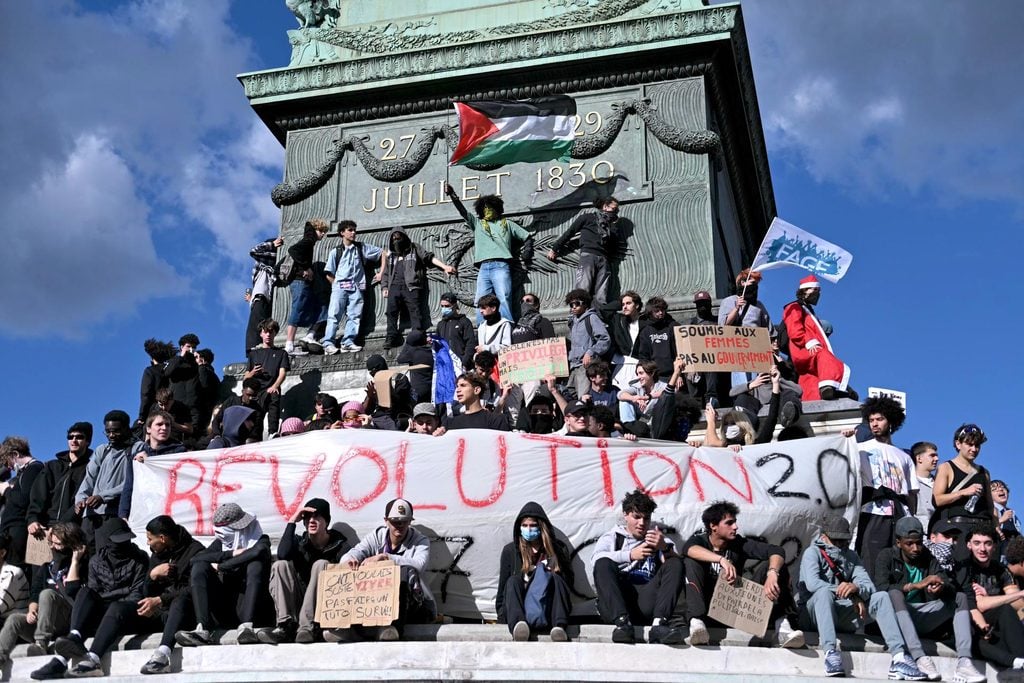
The social response has been swift. Protests that began in late September at high schools on the outskirts of Paris have spread nationwide, evolving into a national movement.
On October 6, known as «Black Tuesday,» over 260,000 people took to the streets across France—56,000 of them in Paris according to the Ministry of the Interior, while organizers claimed the number reached 450,000. Teachers, families, university students, and unions joined a mobilization denouncing the lack of teachers, the deterioration of educational institutions, overcrowded classrooms, and endless school days.
The day concluded with 488 arrests and clashes in various cities. Since the movement’s inception, over 5,000 individuals have been detained, most of whom are minors with no prior criminal records. A student from Lens lost a hand after picking up a stun grenade, and another from Tours lost sight in one eye.
However, the demands extend beyond education. As summarized by a 19-year-old student quoted by La Vanguardia: «Generation Z is rising up and wants to be heard. Instead of financing wars, we should finance our own country».
The Great Paradox: The Rich Pay Half
While austerity measures hit civil servants, retirees, and students, tax data reveals an uncomfortable reality. According to economist Gabriel Zucman, a professor at the École d’Économie de Paris and at the University of Berkeley, the 1,800 wealthiest households in France enjoy an effective tax rate that is half that paid by other social categories—from the lower classes to middle management—when including income tax, VAT, and corporate tax.
Wealth concentration is extreme: the top 500 fortunes in France hold €1.2 trillion in assets. The real impact of large fortunes on income tax revenue has become marginal. Zucman illustrates this with a devastating point: «If [the ultra-rich] all moved to the Cayman Islands tomorrow, their tax bills would barely drop. France’s tax revenues would hardly decrease, around 0.03% of GDP».
To rectify this injustice, Zucman proposes the so-called “Zucman tax”: a 2% annual tax on the wealth of fortunes exceeding €100 million, which would affect approximately 1,800 taxable households and yield between €10 billion and €25 billion annually.
The proposal has been met with enthusiasm from the left and hostility from the center and right. Billionaire Bernard Arnault, owner of the LVMH empire, accused Zucman of being “an extreme left activist” and wanting to “destroy the French economy”. However, Zucman has responded with irony: “I would have preferred that the ‘Zucman tax’ be called the ‘Arnault tax’ because that’s what it’s about: how to implement fiscal justice and ensure that large fortunes pay their fair share”.
Tax Evasion: The Black Hole of Public Finances
While a tax on the wealthy is a powerful tool, tax evasion is the hole that drains it. According to estimates cited in the National Assembly, tax evasion in France amounts to between €80 billion and €100 billion annually, a figure that far exceeds the €54 billion of cuts the government seeks through social spending reductions.
A report from the Finance Commission of the National Assembly acknowledges that France lacks an official comprehensive assessment of tax evasion, and that estimates from other entities—such as unions and NGOs—highlight a real and persistent problem.
The paradox is twofold: while social spending is cut, the means to combat tax fraud are also diminished. Personnel cuts at the General Directorate of Public Finances have left the tax administration understaffed to tackle a phenomenon that, according to Senator Eric Lombard, costs the state between €80 billion and €100 billion per year.
Alternatives to Cuts: What Can Be Done?
The question looming over the French political debate is whether there is a way out that does not involve cutting the Welfare State. The proposed solutions are varied:
1. The “Zucman tax” and other levies on the wealthy. This is the most repeated proposal. Besides the 2% tax on wealth exceeding €100 million, there are calls for taxes on inheritances and on the profits of large companies. The Socialist Party has presented a ‘light’ version that proposes a minimum 3% tax for fortunes starting at €10 million. Oxfam France suggests reforming the Dutreil Pact, a provision that allows for a 75% tax exemption on inheritance rights in the transfer of family businesses, which costs the state an estimated €3 billion annually.
2. Compulsory loans for the wealthy. Faced with the rejection of the Zucman tax, socialist senators have proposed a compulsory and non-remunerative loan for the wealthiest households: those with over a million euros in annual income or €10 million in assets. This measure would affect about 20,000 households and raise between €5 billion and €6 billion at a zero rate. Critics consider it “confiscatory” and warn it could lead to tax exile.
3. A frontal approach to tax evasion. The CGT and other organizations estimate that tax evasion amounts to €90 billion annually. The proposal includes hiring more agents for tax inspections—each can recover between 1 and 2 million euros per year—and eliminating tax loopholes that allow the wealthiest to drastically reduce their bills.
4. Efficiency in public spending. The goal isn’t to cut but to reallocate. France has the highest public spending in the EU relative to its GDP (57.3%), yet often produces outputs in education and health that fall below average. The idea is to reassess spending to eliminate waste and redirect it toward real priorities, with education being key.
5. Debt forgiveness. The most radical proposal, championed by Jean-Luc Mélenchon, suggests the European Central Bank cancel part of the French debt. However, this idea has faced harsh criticism from the Banque de France and the ECB, who deem it “illegal, dangerous, and useless” as it would violate European treaties and incite market distrust.
France is walking a tightrope. The combination of record debt, persistent deficit, skyrocketing financing costs, and political paralysis feeds the narrative that the country is teetering on the brink of financial disaster. Nobel laureate Paul Krugman‘s warning—that France has shifted from being “too big to fail” to “too big to save”—underscores the gravity of the situation.
Nevertheless, the French experience shows that there is an alternative to social cuts. The fiscal route is viable but requires political will and international coordination. Zucman himself acknowledges that his tax wouldn’t solve all problems: “It won’t solve all our public finance issues, but it would allow us to make significant progress”.
Meanwhile, in the streets of Paris, Lyon, and Marseille, a generation of young French people has made it clear that they are unwilling to pay the price for a crisis they did not cause. The question is no longer whether France can afford to tax the rich, but whether it can afford not to.
| Rank | Name / Family | Sector / Company | Estimated Fortune |
|---|---|---|---|
| 1 | Bernard Arnault and family | Luxury — LVMH | €121.2 billion |
| 2 | Hermès Family | Luxury — Hermès | €114 billion |
| 3 | Alain and Gérard Wertheimer | Luxury — Chanel | €95 billion |
| 4 | Françoise Bettencourt Meyers | Cosmetics — L’Oréal | €69.7 billion |
| 5 | Rodolphe Saadé and family | Shipping — CMA CGM | €31.5 billion |
| 6 | Xavier Niel | Telecommunications — Free (Iliad) | €30.1 billion |
| 7 | Dassault Family | Aerospace and Defense — Dassault | €27.7 billion |
| 8 | Gérard Mulliez and family | Retail — Auchan, Leroy Merlin, Decathlon | €27 billion |
| 9 | François Pinault and family | Luxury — Kering | €19.2 billion |
| 10 | Emmanuel Besnier and family | Food — Lactalis | €14.2 billion |
El Ciudadano
Obtén tu Pasaporte y apoya a El Ciudadano
Elimina la publicidad, accede a contenido exclusivo y sé parte de la comunidad.
Cancela en cualquier momento · Sin permanencia