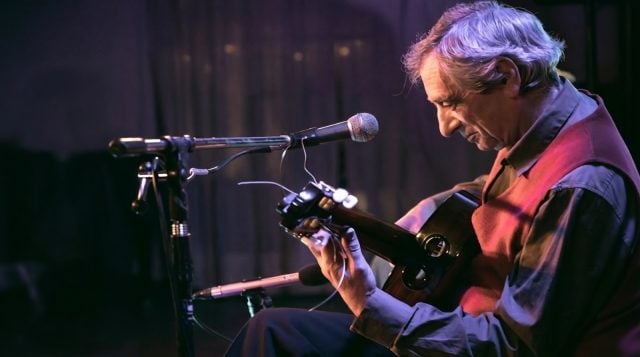
Original article: Juan Falú en Chile: «Cada vez es más urgente defender el silencio en la música»
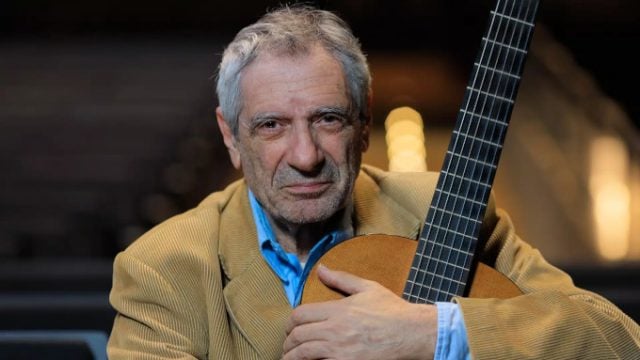
This week, renowned Argentine guitarist and composer Juan Falú will perform a series of concerts in Santiago, Viña del Mar, Valparaíso, and Osorno, celebrating 60 years of a career that began in his hometown of Tucumán. In this exclusive interview with El Ciudadano, he reflects on his parallel journey to academia, which has established his unique voice in guitar, earning him recognition as a master. He expresses admiration for various Chilean groups, soloists, and guitarists, including Los Cuatro Cuartos, while also voicing his disdain for artificial intelligence and the far-right government led by Javier Milei.
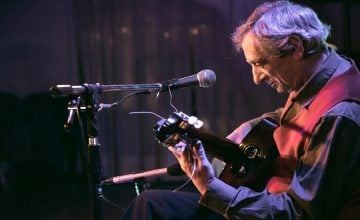
A decade has passed since Juan Falú (78) last visited Chile, making this return timely as he celebrates his 60 years in the artistic realm. An acclaimed guitarist, composer, educator, and mentor to successive generations of Argentine musicians, Falú is the creator of the Guitarras del Mundo Festival and is known for his political commitment. He is regarded as a true maestro of Argentine folk guitar and a pivotal figure for those aspiring to follow in his footsteps.
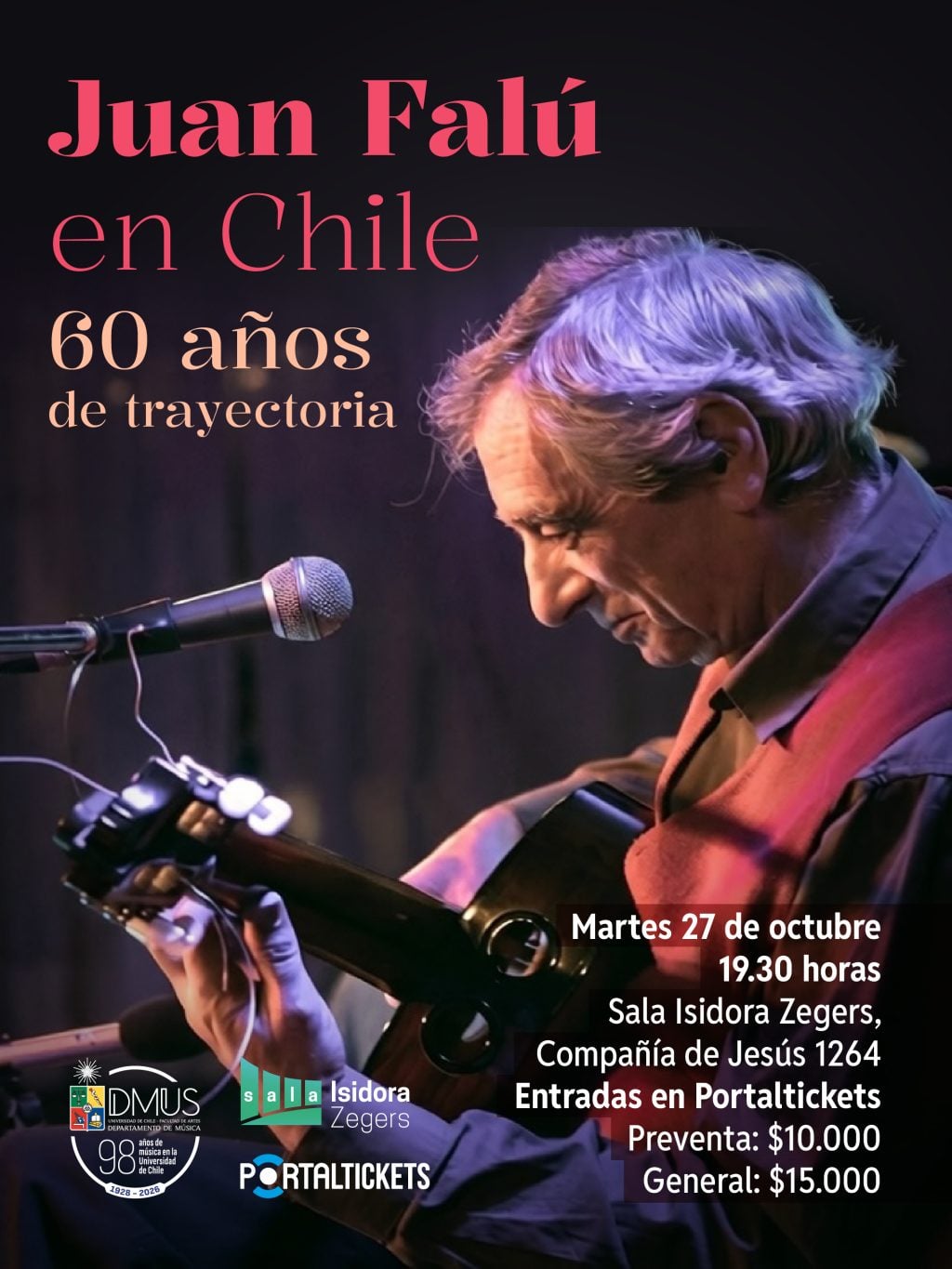
Falú’s anticipated return to Chile includes a tour kick-off on Tuesday, October 27, at 7:30 PM in the Isidora Zegers Hall at the University of Chile (tickets are still available). This will be followed by a master class and concert on the 28th at 11:45 AM at the Margot Loyola Hall of the Music Institute of the Pontifical Catholic University of Valparaíso (IMUS PUCV) in Viña del Mar, as part of the XIII Chilean Congress of Musicology (free entry, no prior registration). Later that day at 7:00 PM, Falú will perform at the IBC Hall of PUCV alongside the Andean Orchestra (free entry, register here). He will conclude his tour at the XXII International Seminar of Music of the Americas in Osorno, participating in various activities from October 29 to 30.
As the nephew of guitarist and composer Eduardo Falú, a prominent figure in Argentine music who inspired numerous Latin American artists, Juan asserts that he no longer lives in his renowned uncle’s shadow and has built a unique and original musical proposal, blending tradition and avant-garde elements.
Having won numerous awards in Argentina—including the National Music Award and the Gardel Award—and as the author of over 40 albums, both solo and in collaboration, Falú has showcased his guitar skills worldwide. In his youth, he was involved in leftist Peronism in Tucumán and carried the pain of having a brother who was a disappeared detainee during the last dictatorship—Luis Eduardo “Lucho” Falú, to whom he dedicated the piece «Vida la de Lucho»—until his remains were found in 2016. He experienced exile in Brazil and recorded his first album «With the Guitar I Have» in 1986, two years after returning to Argentina, which he describes as «opening a second chapter in my musical life.»
In this interview with El Ciudadano, Juan Falú recounts segments of his 60-year journey outside academic confines, shaped by spontaneous jam sessions. He condemns the rise of artificial intelligence in music, highlights the influence of samba songs on his own work, and identifies himself as a «Taliban» of silence in music.
Falú is well acquainted with Chilean music. He listened to the works of Los Cuatro Cuartos before even hearing Violeta Parra and Víctor Jara and has forged friendships with various masters in the field, like Romilio Orellana and Luis Antonio «Chicoria» Sánchez. Both, alongside Nano Stern, will join him as guest musicians at tomorrow’s concert in the Isidora Zegers Hall. «I would have loved to have returned to Chile much sooner because I enjoy it so much, but sometimes schedules are anarchic,» he laments.
– What kind of connection do you acknowledge with Chilean music or its guitarists?
– I find Chilean music and culture as a whole beautiful. I truly believe in the cultural ties we share in Latin America. I am very aware of how the cueca crossed the mountains, settled in Mendoza, and moved through to our northwest. I come from Tucumán, which gives us a clear sense of our cultural affinities. This manifests in many aspects: in humor, cuisine, music, dances, clothing, and crafts. I appreciate this because I believe that the great Latin American unity is cultural. It just needs political action to bring it to life.
– Have you been influenced by our great references like Violeta Parra? I ask this because, beyond being our mother singer, she was also a great guitar player, particularly known for her anticuecas.
– Yes, definitely. But I didn’t go through academies, nor did I read or study scores; I’m more of a spontaneous creator of my own music. So, before the scores of Violeta’s anticuecas and the music of Víctor Jara, we used to listen to Los Cuatro Cuartos as young people.
– What a surprise!
– Yes, we followed the emergence of vocal groups that mixed traditional knowledge with new ideas. I remember repeatedly humming a beautiful song by Los Cuatro Cuartos called «El arrayán» that says “In my land, there’s a place called El Arrayán…” (he sings). My connection with Chile goes back to childhood: one of the first songs I learned was «Yo vendo unos ojos negros».
– Well, «El corralero» was widely heard in Argentina. I remember Hernán Figueroa Reyes’ version…
– Yes, but that came later when I was a teenager. There have always been themes in common. Then, I began to establish ties with Chilean guitarists like Romilio Orellana and «Chicoria» Sánchez. I won’t name more, as I might forget someone (he laughs). I’ve become somewhat of a Taliban in the sense that I can’t play if there’s a short circuit in the atmosphere.
– Silence is very important for you, isn’t it? Both the audience’s silence and the silence you demonstrate on the guitar.
– Yes, it should be important to everyone, truly. I believe that it is becoming increasingly urgent to defend pauses and silence because music is being used to fill every space and moment, nullifying the possibility of silence. This is a topic that I find urgently needs awareness.
– Especially with the rise of artificial intelligence, I imagine. Do you have a perspective on that?
– Yes, I hate it. I don’t know if this is a very objective view. I hate it because one hates what frightens them. Well, it frightens me.
– Are you afraid that songs could be created with artificial intelligence, for example?
– No, no, that’s out of the question. I once provoked it to show it could fail. I asked it to write in the style of Borges on a specific topic, and it sent me pure nonsense. It uses Borges-like phrases or turns, but it is not Borges. Unfortunately, it replaces human thought on many levels. And that is terrifying.
– What happens to you when you are labeled a master? It must not be easy to be Falú, dedicating yourself to music in Argentina while living under the weighty shadow of your uncle, who was so influential not only there but also in Chile for many musicians like Horacio Salinas, for example.
– I also recognize that influence, as it has been significant. I have been learning to accept the perception from outside. Now, looking back at my own path, I believe I have earned my merits through hard work and commitment. I have never wavered in the fields of composition, transmission, teaching, creating encounters, or performing. I have always defended a perspective that integrates the past and the future in music and maintain those premises. I am not in anyone’s shadow, but rather, I have carved out my own path. I often say that Falú represents the challenge and mandate to be a musician, and Juan is the way I live music.
– So, the title of master suits you well. You can say you accept it…
– I accept it, but I don’t see myself as that character, with that title. I don’t like it when people take on characters. I prefer it to be a natural qualifier that reflects a journey.
«I have never wavered in the fields of composition, transmission, teaching, creating encounters, or performing. I have always defended a perspective that integrates the past and the future in music. I am not in anyone’s shadow, but rather, I have carved out my own path. I often say that Falú represents the challenge and mandate to be a musician, and Juan is the way I live music.»
Impacts of Exile
Juan Falú’s eight years of exile in Brazil intertwined with the grief over his brother Lucho’s disappearance and marked the beginning of his career as a composer, where the airs of his Tucumán homeland blended with the sounds of Brazilian music. In fact, all the songs on his first album were composed in Brazil.
– From afar, one develops another perspective on their homeland, and after so many years in exile, I imagine you were influenced by Brazilian music. Do you think that shaped your way of playing, interpreting, and feeling music?
– Yes, everything you say is exactly right. The perspective on oneself and one’s life is essential in exile. The nostalgia for the homeland was surely the source of my compositions, as I didn’t compose much when I left. I composed somewhat in isolation, but in Brazil, I experienced an explosion of ideas, creating Argentine folklore: vidalas, zambas, chacareras, gatos, cuecas, milongas, tonadas. It’s also true that, although I didn’t set out to, I absorbed a musical aesthetic. And thank goodness for that, because the Brazilian musical world is wonderful. I believe that I assimilated a tone of melancholic Brazilian music, particularly samba-song.
– I was going to ask if there is a specific genre…
– Yes, the slow Brazilian waltzes and samba songs, much more than what is typically associated with Brazil and viewed from its more popular aspects: samba, carnival, bossa nova. Of course, I love those too, but I realize that a strand of melancholic Brazilian essence exists in my musicality.
– And what about your voice? You are always described as a guitarist, but rarely as a guitarist and singer.
– It’s because I’m in therapy, so if I sing poorly, I no longer care (he laughs).
– But did you have an interest in singing at some point?
– I actually always sang, but later I started feeling complications from both a technical and anatomical perspective. A hundred of my compositions have lyrics. I want to sing them and showcase them. Many have been performed by various artists. Right now, my only concern is a discomfort, I don’t know if in my vocal cords or elsewhere. I need to examine it more, as it causes itching and results in a need to cough. That’s my main issue now in this phase of my life as a musician. But I have embraced singing since I was a child, in elementary school choirs, and I’ve had vocal groups in my teenage years; singing has always been natural for me. Plus, we love our folklore, and there is truly beautiful repertoire.
– Indeed, it’s gorgeous and highly varied too. Each province in Argentina has its own music. The diversity in Argentine music is incredible. In this regard, you have collaborated with many artists such as Juan Quintero, Marcelo Moguilevsky, Jorge Marziali, Jorge Fandermole, and Liliana Herrero. What does collaborative work with your peers generate for you?
– In all those encounters, which are many more, the hallmark has been creating free interpretations. That’s the common denominator. These meetings happen when there’s a synergy in terms of interpretation and the creation of versions that aren’t bound by prior arrangements. This has always been the case since that is my approach to making music, linked to those gatherings, where there was no arrangement.
– Where improvisation plays an important role, for instance…
– Yes, absolutely.
– And speaking of songs, I remember one called «Algo muy aquí», a duet with Mendoza singer-songwriter Jorge Marziali, which mentions Chile. How did it come about?
– Yes, of course, it’s a beautiful song. It says “but something very here, very Argentine, very much of music and wine, fills my heart with hope.” It’s a candombe we crafted during the crisis of 2001-2002, hoping to reflect our best selves. It mentions Chile by saying: “Already Chile will tell me how so much love clings in such little land, so much homeland under the sun.” The lyrics are by Jorge (Marziali), and the music is mine.
– It takes a sort of journey similar to «Canción con todos» at some point, naming the South American countries.
Yes, it does.
«I was taught to believe that the protagonist is the people, not an enlightened vanguard. When you see progressives continue with their insipid discourses that do not match an organized populace, that becomes very exhausting from my perspective. It tires me when progressives speak to other progressives, addressing their own tribune.»
The Nightmare of Milei and Weariness with Progressivism
Days before this interview, the Argentine public participated in a massive march defending public education. As a key figure in training hundreds of students, Falú feels a sense of helplessness in the face of the authoritarian policies of the ultra-right government of Javier Milei, evoking feelings of repulsion and fatigue shared by a significant portion of Argentine society. However, he also does not see any opposition movement on the horizon that can adequately respond with a vision for the future, perceiving that the answer lies in the streets. This is Falú, straightforward.
– How does this political reality in Argentina affect you?
– It’s a calamity, a nightmare. More than half of Argentinians feel a great unease, but for my generation, it’s something we never imagined: that a psychopathic character could win an election and surrender all our national resources. However, what worries me is the lack of a strong and united opposition. That is the great task we need to accomplish in our country.
– Indeed, in another interview, I heard you express your weariness with progressivism.
– I was referring to a more intellectual and artistic progressivism. It tires me because I was educated to believe that the protagonist is the people, not an enlightened vanguard. When progressivism continues its insipid discourses that do not coexist with an organized populace, that becomes a tiring situation from my perspective. I find it exhausting when progressives speak to progressive only, addressing their own audience. This feeds a sort of spectacle, where they coddle and applaud each other, but in political terms, it’s zero.
– Do you foresee any resolution? Recently, there was a massive march demanding that Milei comply with university financing laws. It’s incredibly basic and essential: as simple as complying with the law.
– Yes, the streets are the best expression of popular discontent, as it is not being conveyed in a united political opposition.
Juan Falú’s Tour in Chile:
Tuesday, October 27, 7:30 PM
Concert. Guests: Nano Stern, Romilio Orellana, and “Chicoria” Sánchez
Isidora Zegers Hall, Faculty of Arts, U. de Chile, Compañía 1264, Santiago
Tickets available via Portaltickets
Wednesday, October 28, 11:45 AM
Master class and concert
IMUS PUCV, Av. Alcalde Juan Luis Trejo 351, Viña del Mar.
Free entry, no prior registration
Wednesday, October 28, 7:00 PM
Concert with the Andean Orchestra PUCV
IBC Hall, PUCV, Av. Brasil 2241, Valparaíso
Free entry, prior registration required.
Thursday, October 29, 7:00 PM.
International Seminar of Music of the Americas concert
Aula Magna Monseñor Francisco Valdés, Mackenna 962, Osorno
Free entry, no prior registration
Friday, October 30, 9:30 AM
Presentation and masterclass at the International Seminar of Music of the Americas
Fundación Creciente, Amtahuer 1008, Osorno
Register at [email protected]
Obtén tu Pasaporte y apoya a El Ciudadano
Elimina la publicidad, accede a contenido exclusivo y sé parte de la comunidad.
Cancela en cualquier momento · Sin permanencia