Original article: Liú Wenrui, 刘闻睿 (Ethan): el artista que llevó el graffiti chino de Shanghái al mundo
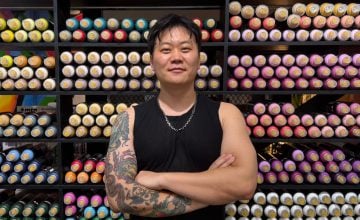
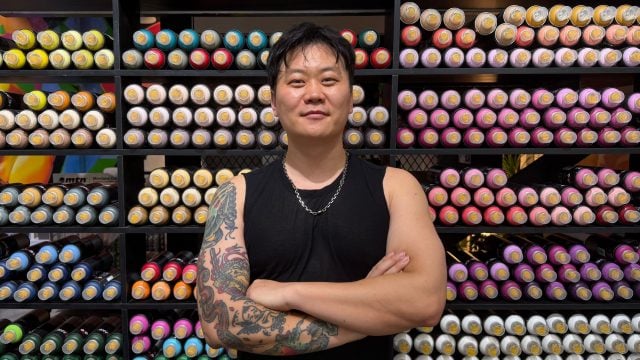
As we stroll through the bustling streets of Shanghai, our journey leads us to M50, the vibrant district of art and creativity alongside the Suzhou River, near the striking 1000 Trees shopping center, designed by Thomas Heatherwick. There, in the once-thriving Moganshan Road—a renowned hall of fame for Shanghai graffiti—one of its luminaries, 刘闻睿, also known as Liú Wenrui (Ethan), awaits in his creative space, Shake Well. With a background in animation from the Shanghai Theatre Academy, a former member of the historic Reload Crew, and ex-visual director in Beijing’s 798 Art District, Ethan has created a platform to showcase his art and that of his peers to both the community and travelers who recognize that cutting-edge Chinese art can be found here.
Central to his work is a recurring figure: Sun Wukong, the Monkey King, whom he describes as his ink-and-aerosol superhero. «He is the Chinese Superman, the Chinese Spider-Man; a figure at the heart of young Chinese culture, and one I personally admire greatly,» he shares passionately.
During my visit with Ethan, we enjoy a coffee-infused beer from a neighboring vendor—my first experience with this unique local drink, symbolizing the neighborhood’s creativity in every aspect. Amidst the slow smoke from a cigarette and conversation about life, we reminisce about the murals of Valparaíso, its open-air galleries, Latin American muralism, and the shared notion that a city itself can serve as a canvas. Ethan has painted in Beijing, Hong Kong, Tokyo, Bangkok, Paris, Madrid, and Barcelona, but here, in his studio-shop, Sun Wukong watches over the street, reminding us that authentic art needs no permission.
In recent weeks, several artists have been collaborating to paint the wall separating the soon-to-open shopping center, revitalizing some of the street’s artistic pulse at M50. As I finished my beer, I decided to purchase a few pieces from Ethan and his friends for myself and my children. He thanked me, gifted me a mousepad, and I promised to follow up with some questions about his art. «I look forward to them,» he replied with a smile. Here are his answers, shared for inclusion in a «citizen’s wall».
By Bruno Sommer
–After graduating from the Shanghai Theatre Academy in 2010, what motivated you to pick up a spray can and take to the streets for graffiti? What was the graffiti scene in China like at that time?
-In university, I met the first graffiti crew in Shanghai, Reload Crew. My major was audiovisual animation, which typically led to work in 2D animation and video games; however, I preferred the street. Graffiti transformed my view of art into a far more appealing form of expression. After graduating, I joined their crew. I practiced graffiti for a year, but had to work two years in an advertising agency for financial reasons. Coming from a graffiti crew and with a solid street culture background, I managed Converse’s social media in Shanghai. Eventually, I moved to Beijing’s 798 Art District, where I became the head of the visual department for a fashion company, before returning to Shanghai to establish my graffiti art studio, just as the market was flourishing.
-In university, you joined Reload Crew and created art with what was considered “the first generation of graffiti artists in China.” How did that experience influence your subsequent artistic path?
-That crew helped me immensely; I am grateful for that year. Back then, there was no national aerosol brand in China, and we were distributors for the Australian brand Ironlak, which allowed me to practice graffiti fundamentals for free. I owe a big thank you to William, the founder. Shier also played a major role; I studied his graffiti lettering closely, and he shared his creative experience with me. Sim, whose cartoon style graffiti is my favorite, also inspired me. Initially, I imitated and analyzed prominent national and international works, which greatly fueled my inspiration.
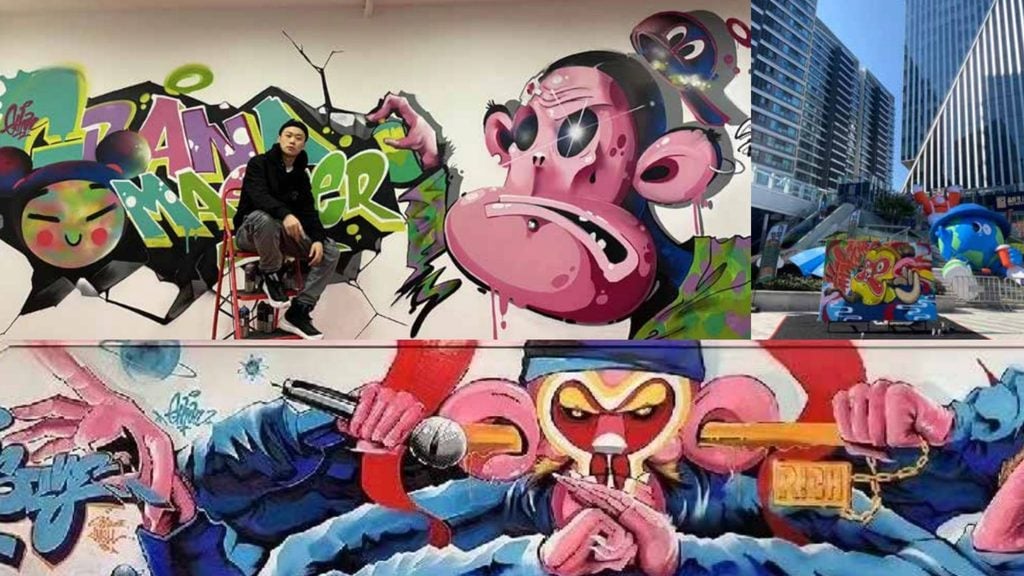
–You once joked that when you started doing graffiti, your skill level was quite poor, and you were considered a “toy” in the community. From being a “toy” to becoming a recognized professional artist, what do you think was the most decisive step?
-I believe that every art form goes through a phase of imitation and learning. Quantity transforms into quality. One day, William told me: “You can start making money with graffiti now.” I was thrilled because I was obsessively studying graffiti almost every day of the year: watching graffiti documentaries before bed and reading graffiti magazines during breaks. Back then, I lacked the confidence to paint at Moganshan Road, thinking my skills weren’t good enough. It took me two years before I gradually began to paint there; at that time, Moganshan Road was truly the hall of fame for graffiti.
-You describe graffiti as “Big Art”: on a massive wall, once you press the aerosol nozzle, there’s no turning back. Do you see this “irreversibility” as more of a creative pressure or as a challenge and a pleasure?
-In fact, graffiti adapts through layering; its charm lies in the impact of vast color surfaces and freedom. It’s a mode of urban artistic expression, a street museum. That’s what brings me pleasure and excitement. The beauty of graffiti is that it alleviates pressure rather than causing it. The only pressure needed is that of the index finger on the aerosol valve, which takes skill and adaptation.
(…) once I affirmed the creation through images, I chose the Chinese superhero Sun Wukong. He is the Chinese Superman, the Chinese Spider-Man; a hero in the hearts of young Chinese people and a character I greatly admire.
刘闻睿, Liu Wenrui (Ethan)
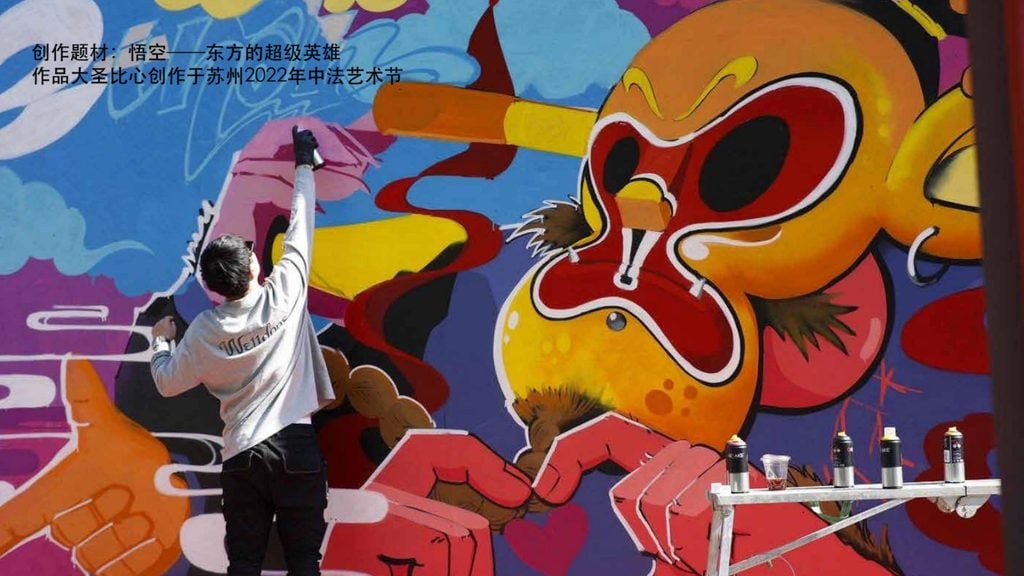
Your “Su Wukong” series is quite representative. Why did you choose this mythical character as a creative symbol? When integrating elements of traditional Chinese culture into a visual language like graffiti, which has Western origins, what specific difficulties did you encounter?
-After a period of accumulation and sedimentation, I realized that what I wanted to express was an Eastern, even Chinese perspective. The most legible form is, of course, the image rather than text. The cave paintings of early humans showed the importance of wall expression as the most direct form of communication. Language acts as a cultural barrier between ethnicities. Thus, once I affirmed the creation visually, I chose the Chinese superhero Sun Wukong. He is the Chinese Superman, the Chinese Spider-Man; a hero revered by the youth of China and a character I personally admire greatly. The only challenge is that many foreigners are still unfamiliar with the story of Journey to the West. Our Chinese culture hasn’t achieved the level of dissemination I imagined. Even many European friends, when mentioning Wukong, first think of the Japanese anime Dragon Ball. I think this is something to reflect upon regarding our cultural exposure, a challenge we Chinese creators must confront.
«Although graffiti belongs to contemporary art, galleries and most art spaces are commercial games with strong financial characteristics; they pass the ball around among their collector networks.»
刘闻睿, Liu Wenrui (Ethan)
You have said that “graffiti should be wild and free.” But when graffiti enters museums and commercial spaces, does that “wildness” dilute or get compromised in any way?
-Indeed. I deeply disdain the prevailing system of contemporary galleries. While graffiti is part of contemporary art, galleries and most art spaces operate as commercial enterprises primarily focused on profit, merely playing games among their collector circles. True art is like a piece of graffiti that suddenly appears on the street: it serves no commercial purpose and is indifferent to its longevity. That act becomes a genuine artistic statement. In contrast, the renowned curators, openings, tastings for collectors, and VIP openings are the aspects I think should be regarded with disdain. Of course, I understand that sometimes one must compromise for commercial reasons. I run an art shop myself and have found that many graffiti works carry little commercial value. While it’s essential to adapt to commercial logic and make concessions, graffiti should not be confined to that. It’s a real, raw issue, and each artist must find their own balance. Ultimately, artists also need to survive.
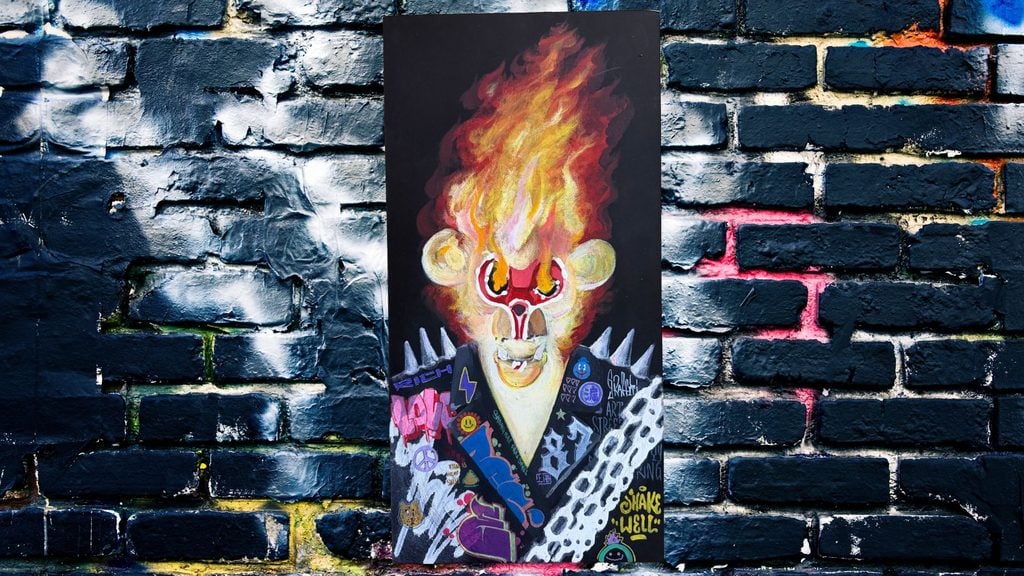
I sense a strong punk and rock vibe in your works. How much does music influence your creation? In contemporary China, how do punk culture and art coexist and interact?
-I love street culture and rock and punk music. It’s the driving force that has allowed me to find a confident direction in life. In China, the phenomenon of Chinese rap has emerged, but I feel that the quality of works is steadily declining year by year. Graffiti also doesn’t seem to thrive as much as I expected; rather, it appears to be facing a tougher reality. Everyone tends to pursue things that will generate social media traffic, an inevitable byproduct of the current economic recession and the age of short videos.
You have collaborated with numerous top-tier brands, from Louis Vuitton to Ferrari and Tiffany & Co. When these brands reach out to you, what qualities do they value in you? In commercial commissions, how do you maintain and present your personal style?
-Firstly, I’m very glad to collaborate with them because I’ve found that major brands respect the artist’s personal will and grant significant creative freedom. My advertising agency experience allows me to meet the client’s basic needs and brand tone. Balancing under these conditions naturally allows for personal artistic style expression while reasonably interpreting the brand’s concept.
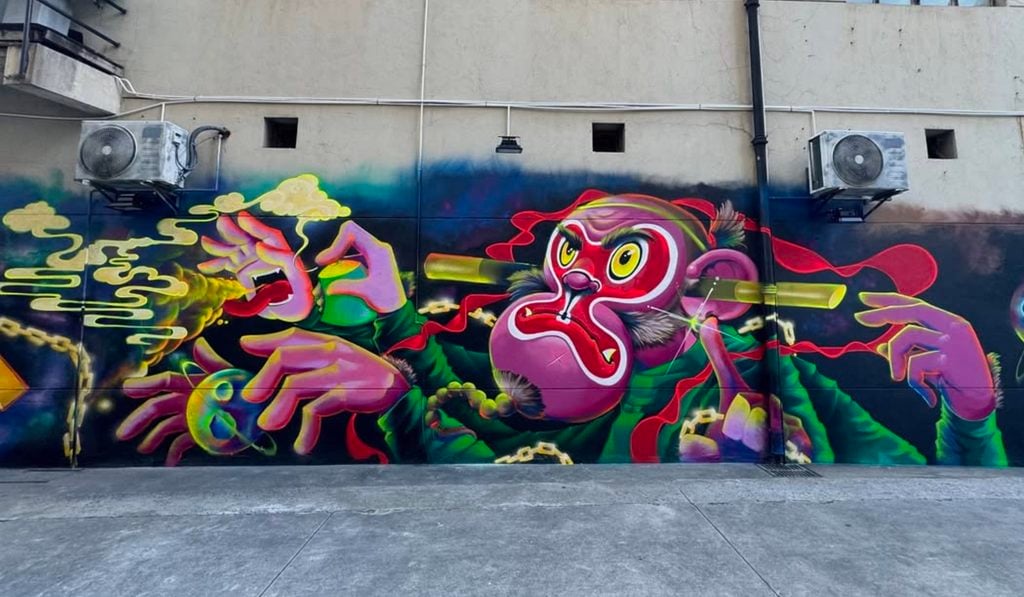
You’ve created graffiti for artists such as Jay Chou, BIGBANG, and Jackson Wang. How do collaborations with celebrities differ from those with brands in terms of the creative process and experience?
-The difference in working with celebrities is that they don’t need to convey a brand concept as much. What they care about more is their personal aesthetic and interests: what tones they like, the style, ensuring their needs are met for filming or photo shoots, and achieving a satisfactory visual image. This requires knowing their preferences in advance and good communication from the outset. Celebrities also show great respect for the artist.
–You are both a creator and director of your own company. It’s often said that “just painting makes it very difficult to survive in this society.” As both an artist and manager, how do you handle the relationship between artistic creation and commercial operation?
-Exactly. But expressing the content I want to convey is what defines an artist. I need my content to be marketable, so I must find patterns and summarize experiences in that process. Every month, we adjust our shop’s exhibitions, prices, and even styles. Controlling costs, packaging, dimensions in transforming an artwork into a product; this is more akin to the work of a product developer or designer. I must say that during this process, there can’t be too much emotional thinking from the artist. The market demands rational thought. We need to invest emotion in creation but operate rationally.
When the graffiti wall on Moganshan Road was torn down, you lamented that graffiti artists were left with »
Obtén tu Pasaporte y apoya a El Ciudadano
Elimina la publicidad, accede a contenido exclusivo y sé parte de la comunidad.
Cancela en cualquier momento · Sin permanencia