Original article: “La soberanía también está en la ciencia”: Milei hunde el sistema científico argentino a mínimos históricos y llama “terroristas” a quienes lo defienden
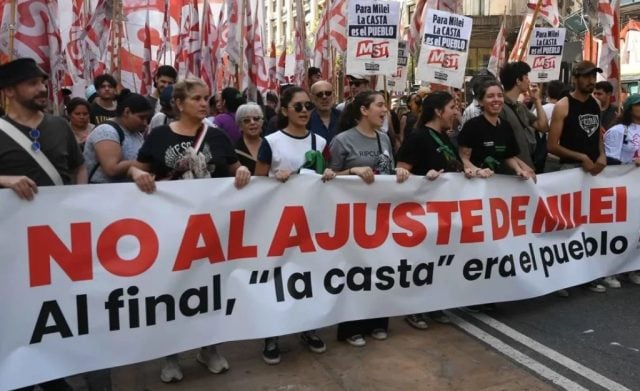
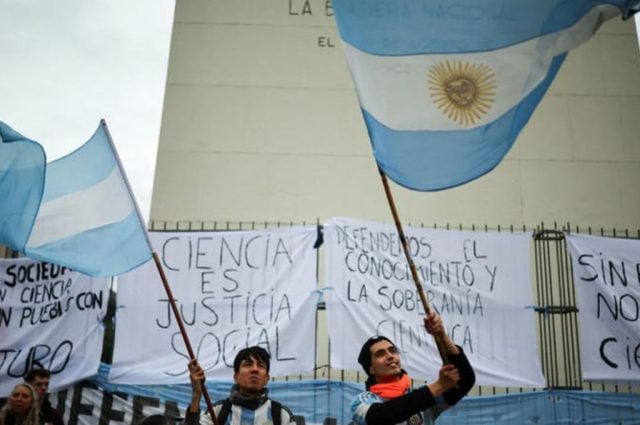
Dressed in national team jerseys and symbolically armed with pipettes, books, and chalk, thousands of Argentine scientists and students gathered around the Obelisk in Buenos Aires during a protest held last Tuesday, making it clear that “sovereignty also lies in science” and denouncing that Javier Milei‘s government is driving this sector to historical lows.
The mobilization came after last week when the so-called libertarian described those defending the Argentine scientific system as “terrorists disguised as students, professors, and researchers”, an accusation that protesters vehemently rejected by singing the national anthem and issuing a statement declaring: “They will not prevail against us. We will always be here to defend our homeland.”
The rally, which was replicated in various cities across the country, aimed not only to highlight discontent but also to denounce what they perceive as a systematic dismantling of the Argentine scientific and technological system, reaching levels of investment not seen since the return to democracy.
Scientific Budget in Free Fall
Official data reveals a troubling reality, even surpassing the most critical moments in recent history. So far this year, investment in Science and Technology accounts for a mere 0.14 percent of the Gross Domestic Product (GDP), the lowest recorded since records began, falling below the historical low of 0.17 percent marked in 2003.
This figure sharply contrasts with the 0.30 percent of GDP allocated to the sector in 2023, indicating a reduction of over 50 percent in just three years of libertarian governance.
Even during the “brain drain” that occurred under former President Carlos Menem or during the austerity measures of then-Economic Minister Domingo Cavallo, who once suggested that a CONICET researcher “wash dishes,” did the budget hit such alarming levels, warned the newspaper Página/12.
Milei’s Productive Model and Institutional Disruption
The scientific community interprets this intensification of Milei’s austerity as part of a larger plan that transcends mere economic considerations.
“In the current policy of delivering natural resources in a primarized manner, there is no need for people to think. That’s why we are seen as obstacles,” stated Bibiana Vilá, a biologist and senior researcher at CONICET, who studies vicuñas in Jujuy and attended the march with a patriotic umbrella.
According to researchers, the logic behind the budget cuts aims to dismantle the country’s critical and technical capacity to facilitate the exploitation of raw materials without added value. Meanwhile, the Freedom Advances Government (LLA) is pushing for the dissolution or restructuring of emblematic institutions such as the National Cancer Institute, INASE, and the National Water Institute, an assault that doctoral fellow Antonella Santin describes as “a structural adjustment aimed at concentrating wealth and redistributing misery,” stressing that knowledge production is tied to the common good and national sovereignty.
Destruction of Over 6,000 Jobs
The scale of the cuts imposed by Milei is evident in the systematic loss of qualified jobs. Since December 2023, over 6,400 positions in the sector have been eliminated, averaging nearly 8 workers per day. CONICET has lost 2,051 professionals, while INTA, INTI, and the National Atomic Energy Commission (CNEA) have also experienced hundreds of layoffs.
The situation is compounded for young researchers, such as Federico Lindenboim, a postdoctoral fellow left in limbo after his scholarship was not renewed, alongside 380 other colleagues.
“The results of the competition will be available in October 2027. They are expelling us from the scientific system for three years and expect us to continue researching and living off nothing,” he reported to Página/12, highlighting the precariousness of a salary just over 1.4 million pesos, which shows that the cuts do not stem from budgetary reasons but from political decisions.
Persecution of Critical Thinking
As Javier Milei’s administration aggressively pursues its agenda, initiatives to protect the sector in Congress face insurmountable obstacles.
Deputy Jorge Taiana (Union for the Homeland) denounced that “LLA halts any debate” and that the legislative majority is built “on favors and privileges,” preventing the discussion of projects that do not originate from the government.
This political obstruction is combined with a presidential discourse marked by high symbolic violence, which according to Sheila Suárez, a doctoral fellow in Psychology, reflects a specific model for the country. “Everything that generates critical thinking in people is attacked by Milei. He wants false news to circulate quickly,” she explained, emphasizing that science and journalism are viewed as enemies from the Casa Rosada due to their role in verifying information.
*Featured image: REUTERS/Agustín Marcarian
Obtén tu Pasaporte y apoya a El Ciudadano
Elimina la publicidad, accede a contenido exclusivo y sé parte de la comunidad.
Cancela en cualquier momento · Sin permanencia
Artículos Relacionados
Students in Brazil Condemn Javier Milei's Insults Against Lula Da Silva Amid Diplomatic Crisis
Hace 2 meses