Original article: Crecimiento con gusto a poco: Imacec sube 1,2% en noviembre, pero retrocede 0,6% frente a octubre
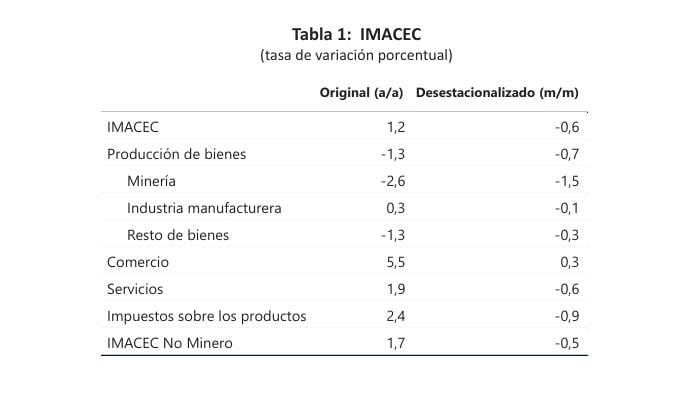
The Monthly Economic Activity Indicator (Imacec) for November 2025 displayed ambiguous performance, illustrating an economy that, while growing year-on-year, is losing momentum in the short term. According to the preliminary report released by the Central Bank, economic activity experienced a 1.2% increase compared to November 2024. However, the seasonally adjusted figure fell by 0.6% compared to October, marking a monthly decline that tempers the optimism surrounding annual growth.
«The Imacec results were attributed to growth in services and commerce, which were partially offset by reduced output in mining and other goods,» the official report details. Additionally, it specifies that «the decline in seasonally adjusted Imacec was driven by services and mining.»
Sector Performance: Bright Spots and Challenges
A detailed analysis of the components of Imacec reveals a heterogeneous outlook:
Goods Production: This segment registered a year-on-year decline of 1.3%. The contraction was led by mining, which fell 2.6% annually, «driven by lower copper extraction.»
The «rest of goods» category (including agriculture, fishing, construction, waste management, and electricity) also contracted by 1.3%, influenced by a decrease in the value added from electricity generation.
The only positive note in this group was the manufacturing industry, which achieved a slight growth of 0.3%, attributed to «increased fuel refining compensating for a fall in beverage production.» In seasonally adjusted month-to-month comparisons, goods production declined by 0.7%, «primarily due to mining.»
Commerce: This sector was the primary engine of annual growth, with a robust increase of 5.5%. «All of its components reported positive outcomes, highlighting growth in automotive commerce driven by vehicle sales,» stated the central bank.
Retail trade displayed strength in large stores, specialized clothing outlets, and online sales, while wholesale trade saw growth in machinery, equipment, and food sales. Nonetheless, its monthly dynamism slowed: seasonally adjusted, commerce grew only 0.3% compared to October, «affected by automotive commerce and partially compensated by a contraction in wholesale trade.»
Services: With a 1.9% increase over twelve months, this sector was crucial for the positive annual result. The growth «was primarily explained by the performance of personal services, particularly in health,» while transportation services saw a decline. However, in the seasonally adjusted monthly measure, services were one of the main contributors to the overall downturn, presenting a decrease of 0.6%, «determined by the performance of business services and transportation.»
Non-Mining Imacec: Relative Improvement Yet Stalls
A key indicator for monitoring internal activity, the Non-Mining Imacec—which includes manufacturing, the rest of goods, commerce, services, and product taxes (import duties and value-added tax)—showed a stronger year-on-year growth of 1.7%.
However, it also indicated a cooling trend: its seasonally adjusted series fell by 0.5% compared to October, though it increased by 1.6% year-on-year.
Contribution Analysis: Who Drives and Who Slows Economic Growth.
The contribution graphs published by the Central Bank clearly illustrate the balance of forces:
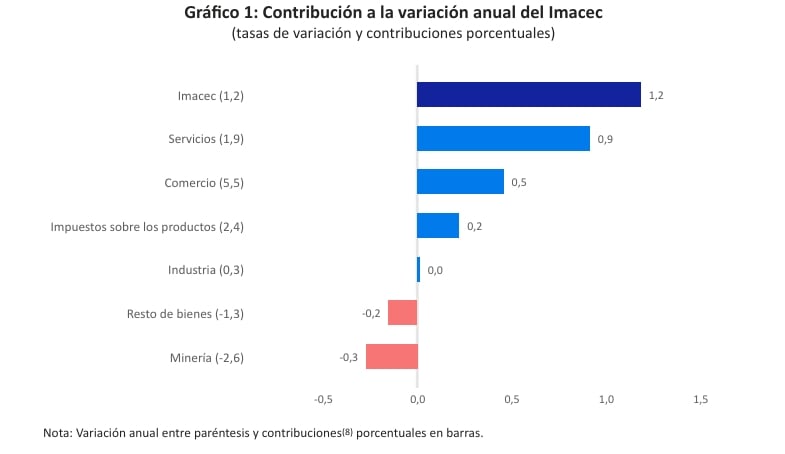
In annual variation (Graph 1): Commerce (+5.5%) contributed 1.0 percentage points (pp) to the total growth of Imacec (1.2%). Services (+1.9%) contributed 0.9 pp, and product taxes (+2.4%) added 0.5 pp. These positive impulses were partially offset by the negative drag from mining (-2.6%, -0.3 pp) and the rest of goods (-1.3%, -0.2 pp), while industry had a contribution of 0.3%.
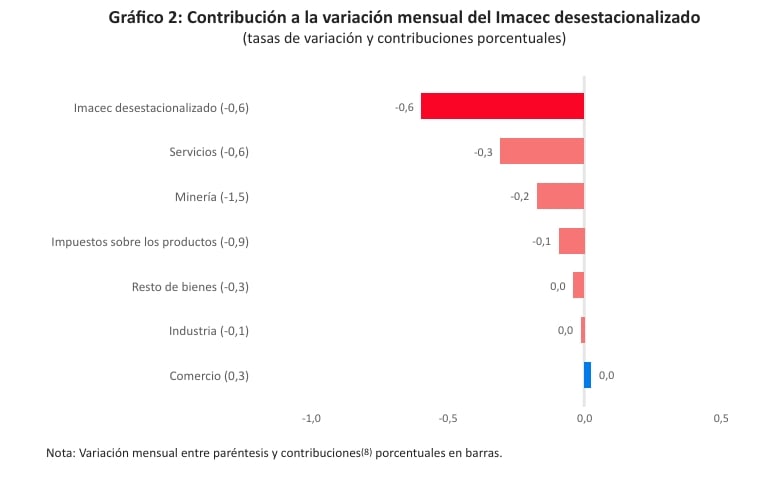
In the seasonally adjusted monthly variation (Graph 2): The -0.6% decline is primarily explained by the drop in services (-0.6%, -0.5 pp contribution) and mining (-1.5%, -0.3 pp). Product taxes (-0.9%) also negatively contributed -0.2 pp. The slight increase in commerce (0.3%) barely contributed 0.0 pp to the monthly total, insufficient to offset declines in other sectors.
The report from the Central Bank reminds us that «the seasonally adjusted series of IMACEC is obtained from the aggregation of its components adjusted for seasonality,» utilizing the X-13 ARIMA-SEATS process, which allows isolating the effects of repetitive seasonal patterns and better observing the cyclical trend of activity.
Relacionados

Positive December Growth: Chile's Economic Activity Index (Imacec) Increases by 1.7% Driven by Services and Trade
Hace 2 semanas



Minister Vallejo on Imacec Growth: "We're Far from a Crisis or a Country Falling Apart"
Hace 2 semanas