Original article: Cuando la pared se vuelve parte del paisaje: Nuevo mural en mosaico a orillas del Mallolafken (Lago Villarrica)
Text: Crónicas Vamos en Camino / Photography: Folil Estudio
As summer arrives, more people are enjoying walks along the Villarrica waterfront, taking in the fresh air and natural beauty.
This new mural invites visitors to explore and learn more about the species that inhabit the urban wetland, raising awareness among both residents and tourists this season.
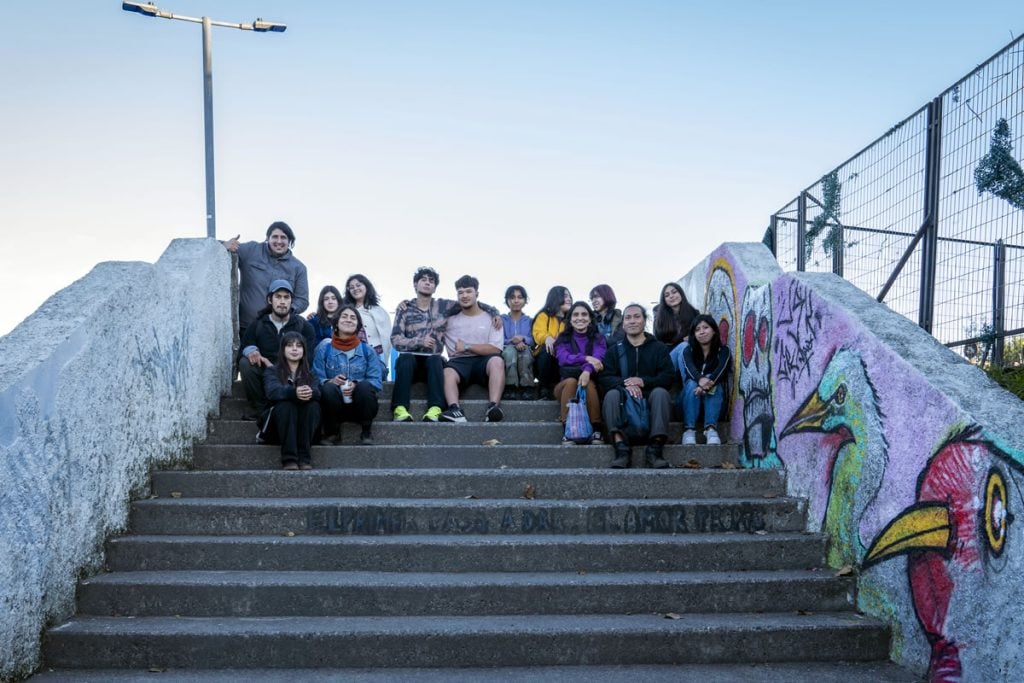
Near the location of the city name sign, a participatively developed public art piece utilizes materials designed to withstand the rain and wind typical of the local climate throughout the year.
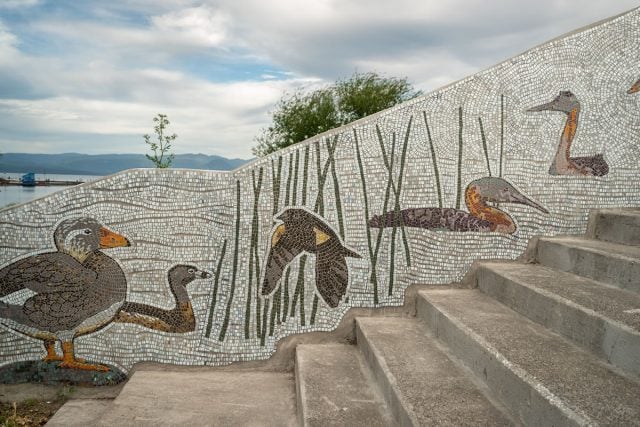
With a deep appreciation for the territory and the connections between community, landscape, and memory, the Colectiva Tierra Húmeda, together with Aner Urra and Paula Tikay, inaugurated the «Illustrated Mosaic Mural, Flora and Fauna of Mallolafquen» on Friday, November 28, an initiative funded by the Regional FONDART of La Araucanía for the 2025 call.
The work depicts the species and stories coexisting along the shores of Lake Villarrica (Mallolafquen). The mural’s theme was developed through a participative process involving local students.
This project—combining glass mosaic and illustrated ceramics—was realized in several stages, engaging 20 students from 7th grade to high school seniors from the Colegio Altas Cumbres, all part of the school’s environmental forge group.
Throughout the year, three workshops were conducted, focusing on various aspects specifically designed for children and young people to learn from the lake, its wetlands, and its living memory, providing observations, drawings, and notes that were later integrated into the final design.
Every Thing Has Its Time
To collectively create the mural’s imagery, multiple instances were necessary. The cycle began with an observation workshop led by the Colectiva Ko Habitantes in May. Here, students received tools for conducting community monitoring of the urban wetland.
Initially, they had a classroom session, after which they took their notebooks to record species and behaviors during a walk along the waterfront, from the Villarrica letters to the dock. The students were accompanied by Daniel Salvo, a Science teacher at Colegio Altas Cumbres.
Thus, they arrived at the following figures and recognitions. Within an hour of walking, they identified 15 different species and 75 birds, learning observation techniques, note-taking, and ecological systematization. This experience served as a foundation for their subsequent drawings.
The Colectiva Ko Habitantes, originally from Laguna Pullinque near Lake Kalafken, has conducted various training on observation, monitoring, and protected areas within the territory, thereby understanding the lakes that characterize the entire lake region as an interconnected ecosystem.
Notably, it is recognized as an ecosystem with a vast nesting area for many endemic and migratory bird species. It’s essential to remember that urban expansion often conceals biodiversity or renders it less visible, yet with some attention, its presence can be noted, and this mural aims to foster that contemplation.
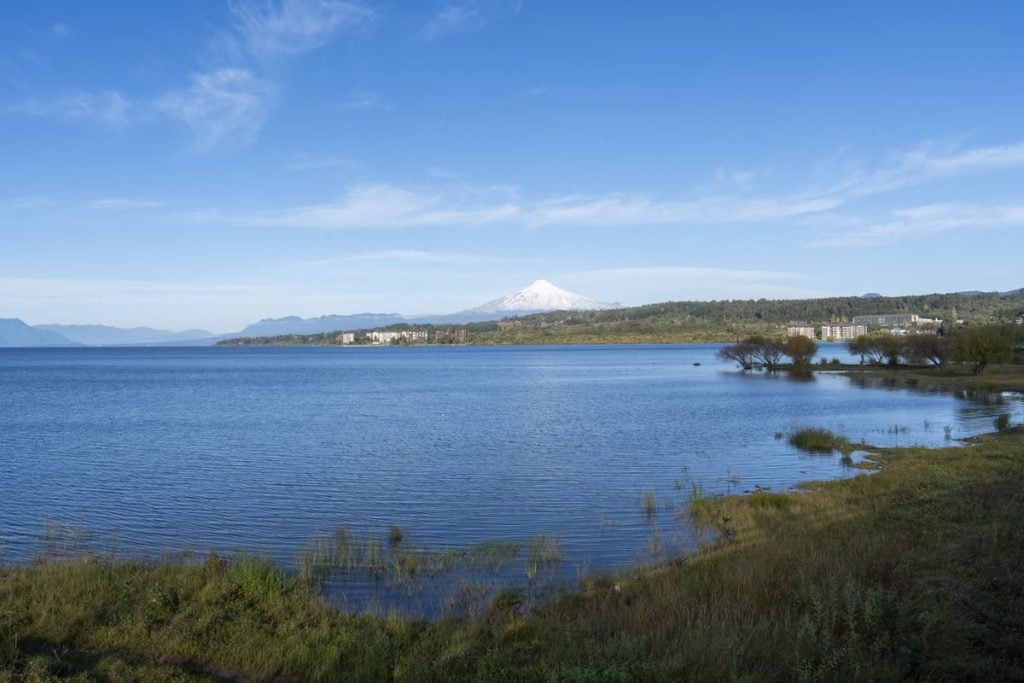
Cultural Heritage
Biocultural refers to the deep relationship between nature and culture. This new concept being employed in conservation and environmental education recognizes that people and communities are not separate from their natural surroundings, but instead, they care for, name, use, and transmit their knowledge through their practices and ways of life.
In this territory, the Mapuche people have been the primary custodians of nature’s balance. This is why the second meeting with the students was led by Juan Paillamilla, a local resident who spoke with the youth about the connection between people, the lake, and the beings that inhabit Mallolafquen (Lake Villarrica).
In this manner, the young people learned about the meaning of the name Mallolafquen and worked with lake clay (mallo) mixed with essential poleo oil. Paillamilla shared a metawe made from this clay and reflected on how scents and hands hold memories of the territory.
This experience was represented in the mural’s final infographic with the image of a Mapuche vase. The workshop led by lamngen Juan Paillamilla took place along the waterfront and in the wetland, attended by Gisela Vásquez, a History teacher from the same educational institution.
Introduction to Mosaic Art
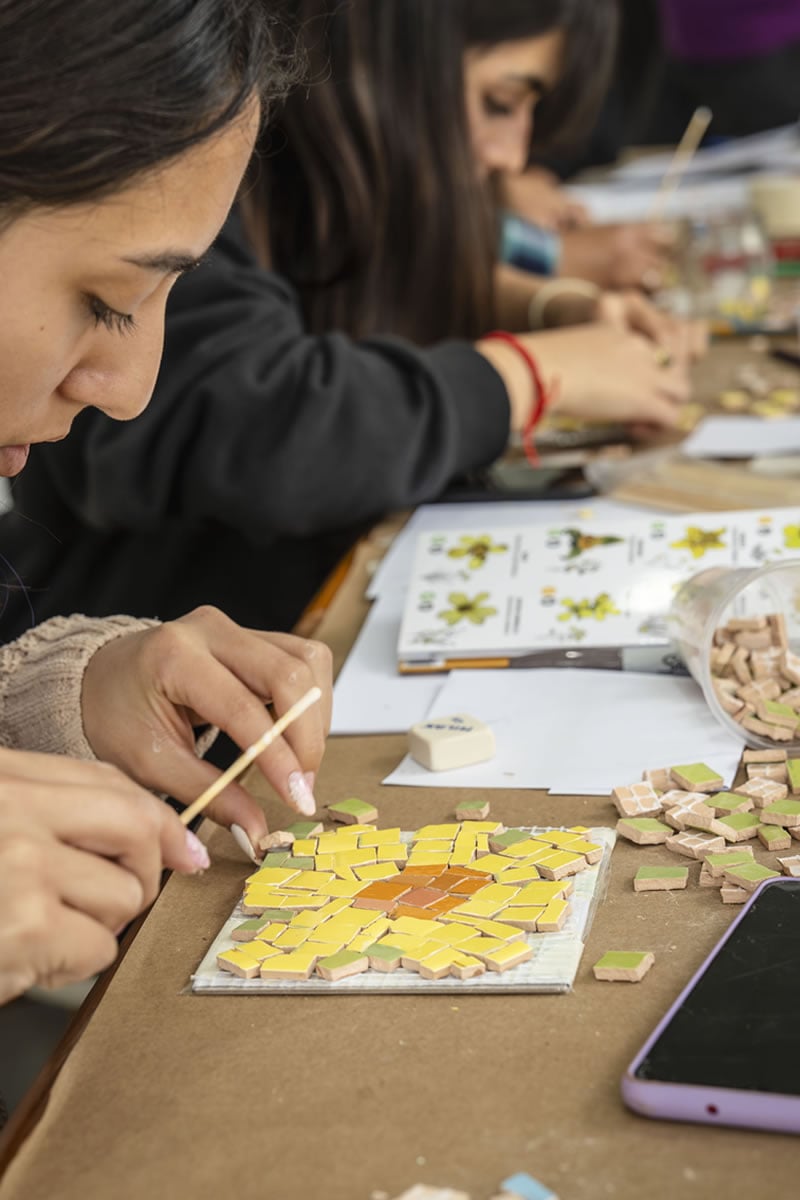
In concluding the educational process with the students, the Colectiva Tierra Húmeda conducted an experimental mosaic workshop, where the youth transformed their notes and drawings into pieces crafted using the indirect mosaic technique. This artistic technique involves assembling mosaic pieces on a separate support before moving them to their final location.
This introductory mosaic workshop was held over three classes, alongside Jessica Delgado, the Art teacher from Colegio Altas Cumbres. The first two sessions took place at the Liquen Cultural Center in Villarrica, and the last session was at the educational institution itself. Throughout the process, they learned about materials, grouting, and installation. In fact, they mounted their mosaics on one of the walls of the educational facility.
The Mural That Gradually Emerged from the Lake
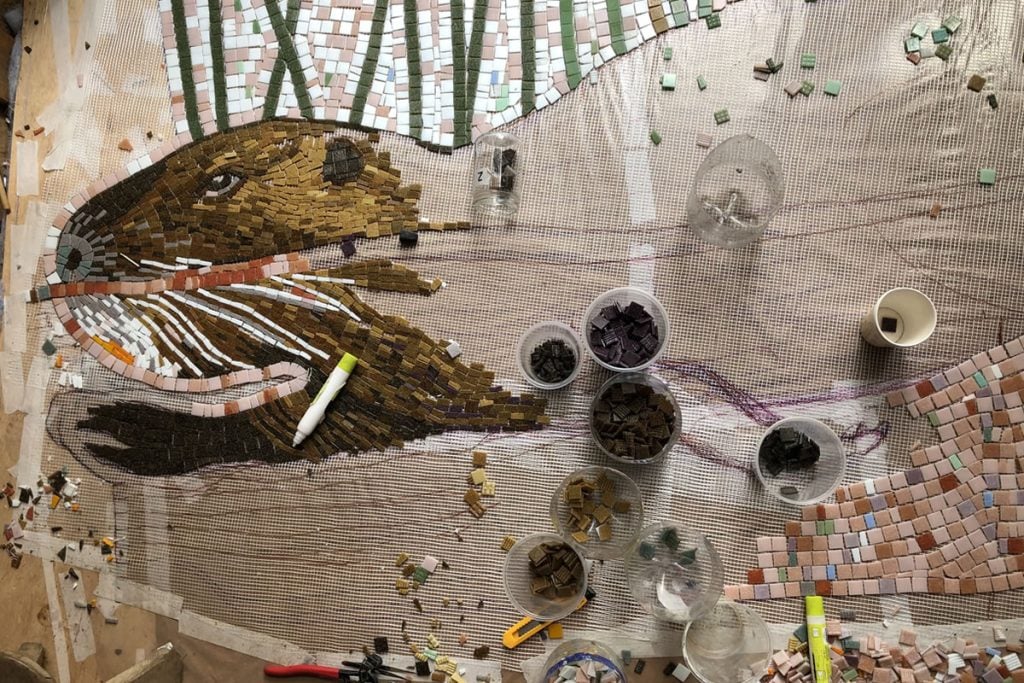
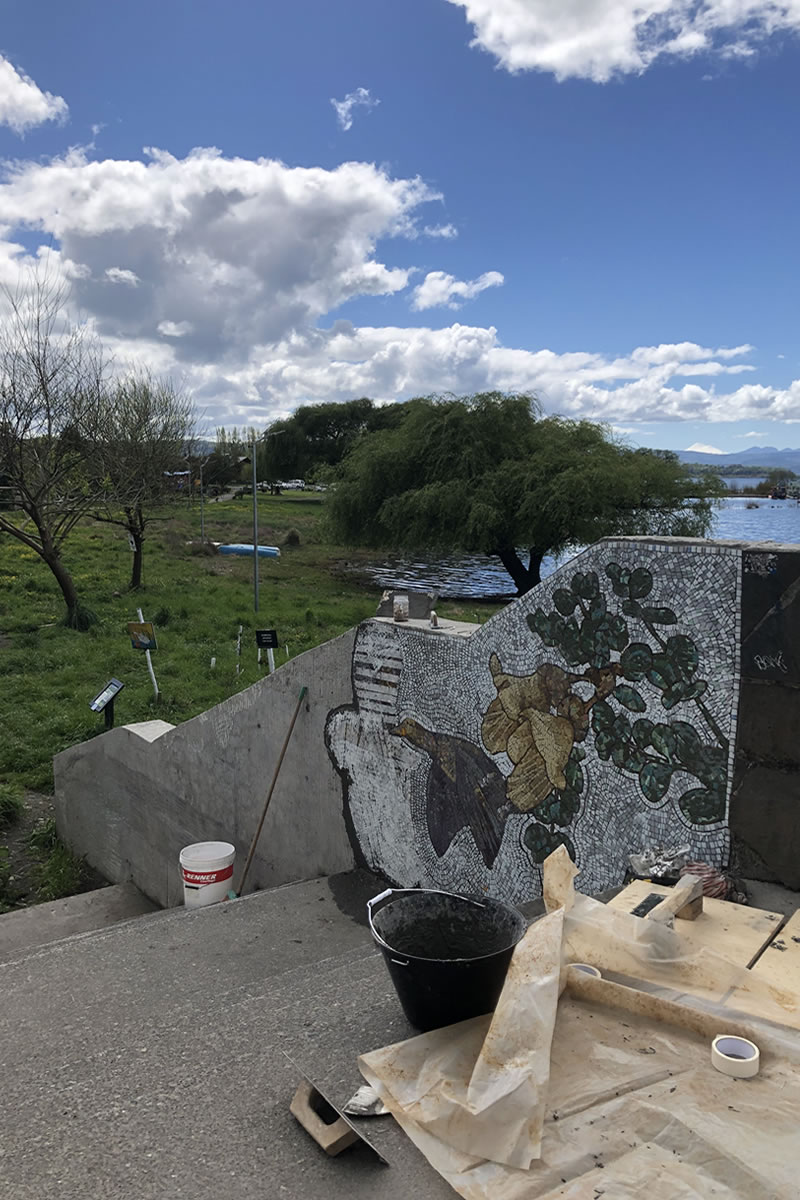
Using all the materials produced in the workshops—including drawings, notes, photographs, and species records—the Colectiva created two sketches that guided the final creation: a 20 m² glass mosaic mural assembled in the muralists’ workshop and then installed in parts along a stairway at the waterfront.
The first sketches were initiated in May, and piece installation began in June, a process that extended over five months. The technique used was indirect mosaic on fiberglass mesh, with color glass fragments (tiles) assembled like a puzzle to create the flora and fauna scene of Mallolafquen.
The collective of artists, Aner and Tikay, also participated in the autumn monitoring with the students, adding more species present along the waterfront, such as boldo, pilo pilo, and coipo. The latter was included as a gesture of remembrance, following an incident a few years ago when a pup was attacked under the staircase where part of the mural is now visible.
The mural captivates visually; however, it was essential to include an infographic to complement it with clear and straightforward information. Therefore, individuals of various ages, educational levels, or backgrounds can understand and engage with the content. For this reason, an infographic was designed in October, crafted from ceramics measuring 60 x 130 cm and illustrated with prepared pigments and slips.
It is worth noting that slip is used in ceramics to cover, decorate, or color a piece before firing. The pieces were painted on biscuit slabs and then fired at 1060°C in the Rag Mapu workshop in Pucura and Triple Lama Workshop in Chesque Alto.
Thus, the mural is accompanied by an infographic containing numbers to identify the species present in the mural. Additionally, there is a QR code to access a video created by Folil Estudio, recounting the process of creating this mural. The soundtrack for the video was composed by Looprana, Ivan Gonzalez.
A Collaborative Effort in the Community
The inauguration at the end of November brought together students, teachers, and families, who were able to recognize in the mural the species and stories constructed during months of collaborative work.
Paula Tikay and Aner Urra, members of Colectiva Tierra Húmeda, highlighted the youth’s commitment and the importance of creating art from observation and affection for the lake.
Jorge Olivares, the director of Colegio Altas Cumbres, present at the inauguration, praised the joint effort for the educational and enriching experience of the students, who engaged in various activities such as observing the birds in the wetland, learning about the Mapuche worldview regarding these spaces, and crafting mosaics with their own hands. “We hope this continues to grow, and hopefully, next year we can inaugurate new mosaics in this community.”
This work aims to strengthen the emotional and educational relationship between the community and its wetland, recognizing Mallolafquen as a living space that protects stories, memories, and species deserving of care.
At the inauguration, Paula Beltran from the NGO RETXIKURA DEL MALLOLAFKEN stressed the need for the adult population to also become involved in caring for the territory, saying, “we live in what is called a lakeside paradise, but what are we doing to protect it?”
Paula sees hope in how art and culture serve “as a tool to value, preserve, and learn about what we have in our city, commune, or territory.” She also stated that as Villarrica continues to grow, it is essential to direct that expansion with the participation of diverse voices to not trample on areas that serve as green lungs.
She is involved in a grassroots organization that protects the forest near the new hospital, which is also a wetland rich in biodiversity, a sensitive area recognized by the Mapuche people. Notably, the Limahue Stream, a water source for Lake Villarrica, flows through this area.
During the dedication ceremony for the mural to the community, Alejandra Íbañez read a reflective poem prepared for the occasion, emphasizing the need to re-establish the fabric of life of which humans are a part.
“Each and every one is a piece of this life; we are part of this biodiverse world: Hualas, pilo pilo, reeds, rayaditos, and caiquen; humans, coipos, and fish.. the Mallolafquen, this island, and this great volcano.. together we are a great living mural that connects wetlands, gathers knowledge, and revitalizes tired concrete. The creative pulse invites us to wish for that concrete to transform back into birds, to reclaim its space, to be planets of clay and poleo.”
The Citizen
Relacionados
Teachers' Unity Movement Holds 5th National Assembly: Critical Review and Strategies for the New Educational Landscape
Hace 4 semanas
Return of Pinochet's Ideology to Power in Chile: Statement from the New Anti-Capitalist Party – France
Hace 2 meses
José Kast and Javier Milei: More Than Just Friends in Latin America's Right-Wing Movement
Hace 2 meses
Organizations Declare 'Salmon Sacrifice Zone' in Protected Areas of Chilean Patagonia Amid Environmental Concerns
Hace 3 meses