Original article: Militarización de Noboa llega a la CIDH por denuncias de racismo y perfilamiento racial en Ecuador
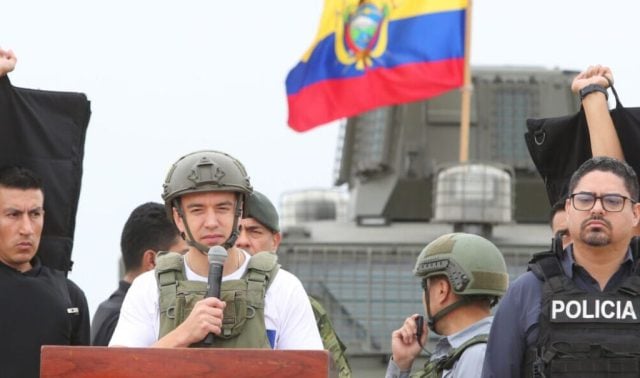
The human cost of the militarization of public security in Ecuador, initiated under the state of emergency declared by the government of Daniel Noboa, reached the Inter-American Commission on Human Rights (CIDH) on Monday. A delegation composed of social organizations reported structural racism and racial profiling.
The South American country has now endured over 900 days under exceptional measures since the right-wing leader took office in November 2023, in an effort to curb the wave of insecurity that has left the nation on edge.
The continuation of such declarations indicates that Noboa’s government has institutionalized exception as state policy, prioritizing militarization while failing to address the root causes of organized crime. The violence remains unrelenting, with a murder rate of 50.9 per 100,000 residents, totaling 9,200 homicides. Concurrently, human rights organizations and international bodies have expressed concerns about the rising reports of abuse associated with these military operations, which have resulted in numerous arbitrary actions without the state providing effective oversight.
«War Narratives Normalize Cruelty and Discrimination»
During the 196th session of the CIDH, Juanita Francis Bone, a representative of the Women of Asphalt collective and the Regional Human Rights Advisory Foundation (Inredh), warned about the dangerous line between citizen security and creating internal enemies.
«When a state declares an internal armed conflict without guarantees, security can cease to protect and start to create public enemies», stated the activist, who also recalled the attack she suffered on August 31, 2025, a case that remains in impunity due to the lack of effective investigation by the Prosecutor’s Office.
For the organizations, this militaristic narrative not only justifies excessive use of force but also legitimizes discrimination, normalizing cruelty and stigmatization against those who oppose or simply do not fit the mold of a «safe» citizen.
One of the most striking points during the intervention was the exposure of institutional racism evident in police operations. The groups reported that racial prejudices have transferred to the daily practices of law enforcement, resulting in systematic harassment of Afro-descendant and racialized populations.
«War narratives normalize cruelty and discrimination,» she asserted in statements collected by the newspaper Expreso.
Inés Santos, a representative of Inredh, shared that in many popular neighborhoods, «public services are first abandoned, followed by prejudice,» and denounced that «being Black and living in certain areas can be enough to be considered suspicious.»
This hostile environment manifests in specific cases, including the incident involving the «four boys from Malvinas,» who were detained on December 8, 2024, by armed forces during a security operation in the popular sector of Malvinas, Guayaquil, with their bodies found lifeless on December 24, 2024, showing signs of torture near a military base in Taura, Guayas province.
According to the organizations, this case exemplifies the «human cost» of a policy that, they claim, prioritizes the perception of threat over human dignity.
The hearing also highlighted the situation of Afro-Ecuadorian engineer and model Jimmy Ocles, who was intercepted by plainclothes police officers and a private guard on December 10, 2021, simply for standing on a public street. His testimony revealed a nightmare of insults, violent reduction, and public humiliation, incidents that were captured on video.
For Ocles, the violence did not end with the physical assault but continued in the judicial process, which he indicated has been slow and re-victimizing.
Petitions to the CIDH
In light of this situation, social organizations presented a list of demands to the CIDH, including a declaration to determine whether security policies have generated a humanitarian crisis in Ecuador, as reported by the cited media outlet.
They also request that racial profiling be classified as a serious violation, that supervisory systems be established, and that the state be urged to incorporate an ethnic-racial and intersectional approach in its policy design.
Among their demands are ensuring real access to justice, avoiding re-victimization, and producing data to highlight the unequal effects of security measures on historically marginalized groups.
Obtén tu Pasaporte y apoya a El Ciudadano
Elimina la publicidad, accede a contenido exclusivo y sé parte de la comunidad.
Cancela en cualquier momento · Sin permanencia